
How to Use Review Cards to Get More Google Reviews for Your Concrete Lifting Business
By: Josh Fulfer
Estimated Read Time: 6 Minutes
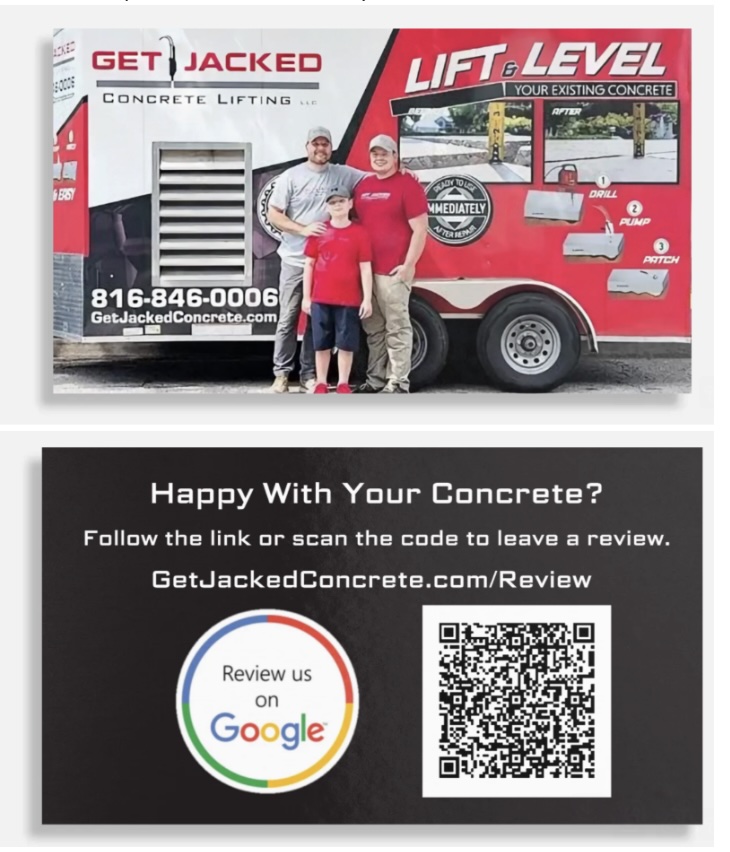
REVIEW CARD LEAVE-BEHIND
For local service companies, Google reviews are gold. They build trust, boost rankings, and tip the scale when a homeowner is comparing you to another contractor. But the hardest part is getting customers to actually leave them. That’s where review cards come in.
We’ve been helping clients create simple “leave behind” review cards—business-card sized handouts with a QR code and short URL that send customers straight to your Google review page. They’re cheap (around $48 for 250 on Vistaprint, and sometimes half-off for new accounts), easy to carry, and make it effortless for customers to follow through. And when you personalize them—like including a family photo if you’re a family-run business—the impact is even bigger.
Why Review Cards Work
Most customers are happy to leave a review if you’ve done a good job, but they get busy and forget. A review card is a tangible reminder sitting in their pocket, wallet, or on the counter. It removes friction and makes the process simple:
- They don’t have to hunt down your business listing.
- They don’t have to guess which “Get Jacked Concrete” is the right one.
- One quick scan or click and they’re writing the review.
That convenience is everything. Reviews are a numbers game. Even moving from a 5% review rate to 15% can double or triple your total review count over time.
Tips for Designing Effective Review Cards
1. Include a QR Code
Use a free generator like QRCode Monkey or the one built into your review link tool. Test it yourself to make sure it opens directly to your Google review form. Make the box large enough that it’s easy to scan (not tiny in the corner).
2. Add a Short URL
Not everyone wants to scan. Add a short, easy-to-type link (like GetJackedConcrete.com/Review) that forwards to your Google review page. This catches the less tech-savvy crowd.
3. Strong Call to Action
Don’t just say “Leave us a review.” Say something like: “Happy With Your Concrete? Leave us a Google review!” Keep it friendly and direct.
4. Personalize Where You Can
For one of our clients, we included a photo of the owner and his family on the card. When customers see the people behind the company, they’re more likely to want to support them with a review. It makes it human, not corporate.
5. Keep It Simple
Don’t overload the card with text. Logo, call-to-action, QR code, short link, maybe a photo. That’s it. Clean and simple beats clutter every time.
 How to Use Review Cards in the Field
Having the cards is only half the battle. Here’s how to actually put them to work:
- Leave one behind on every job: Whether it’s taped to the invoice or left on the kitchen counter, make sure it stays with the customer.
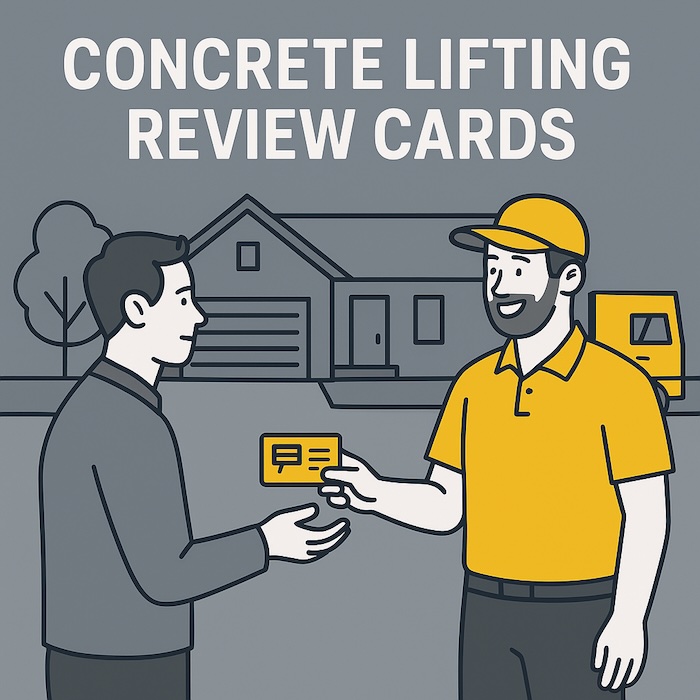
- Hand it directly to the homeowner: Don’t just leave it—personally ask if they’d be willing to leave a review. Handing it over makes it more likely they’ll follow through.
- Give extras for family/friends: If a customer is excited, ask them to share with a neighbor who saw the work.
- Make it part of your crew’s routine: Train techs to ask at the end of every job. Consistency is key.
Remember, people are most willing to leave a review when the job is fresh and they’re impressed. A card in that moment captures the energy.
Part of a Bigger Review System
Review cards aren’t the whole plan—they’re one piece of a larger system. Pair them with:
- Follow-up texts/emails with the same review link.
- Scripts for your crew to confidently ask for reviews.
- Automations (like Zapier + your CRM) that remind customers 1–2 days later.
- Incentives for staff when their jobs generate reviews (never pay customers directly—it violates Google policy).
For a deeper dive into review systems, see How to Build a Concrete Review System That Actually Works.
What Kind of Results Should You Expect?
Industry-wide, a 10–15% review rate is solid. If you can break 20%, you’re crushing it. With review cards, hitting 15% consistently is realistic if you train your team and ask every time.
Think of it this way: If you do 200 jobs a year and 30 customers leave a review, that’s good. But if 60 customers leave reviews because you made it easier, you just doubled your social proof. That difference shows up in rankings, trust, and call volume.
Why Reviews Compound Over Time
Each review isn’t just a star rating—it’s an asset that works for you 24/7. Reviews boost your Google Business Profile, make you more likely to show up in the map pack, and build homeowner trust instantly. When someone types “concrete lifting near me” and sees you have 50 reviews and the next guy has 7, the decision is made.
Pro tip: Mention reviews in your sales process. When you say “We’ve got 80+ 5-star reviews,” you’re already closing the deal before the bid even comes out.
Final Thoughts
Review cards are one of the cheapest, simplest tools you can add to your business today. For under $50, you can have 250 little salespeople working for you—reminding homeowners to leave a 5-star review that builds your credibility and gets you found online.
The bottom line: Don’t leave reviews to chance. Make it easy. Make it personal. Make it consistent. And watch your review count—and your leads—grow year after year.
Build assets. Not stress.