
How AI Search Will Reward (or Punish) Your Concrete Lifting Website
 By: Josh Fulfer
Estimated Read Time: 5 Minutes
Imagine you show up to lift a driveway slab—but you’ve got no foam, no drill, and no game plan.
That’s what your website looks like to ChatGpt and Google’s new AI-driven search if it’s missing the right structure, content, and trust signals.
Online search is evolving—fast. Google, Bing, and AI tools like ChatGPT and Perplexity are becoming more like smart homeowners asking follow-up questions instead of just reading basic pages.
If your site is shallow, outdated, or full of generic copy? You’re getting skipped.
But if your site is built for humans and AI—clear, helpful, organized content that matches real customer intent—then you’ll rise to the top.
In this article, we’ll break down how AI search is changing the game, how to adapt your SEO strategies for concrete lifters, and what you can do today to avoid falling behind.
The Shift: From Keywords to Questions
Old-school SEO was about matching keywords:
“concrete leveling Milwaukee” or “mudjacking near me.”
Now, search is about intent and conversation:
“Is polyurethane better than mudjacking for garage floors?”
“How long does concrete leveling last?”
“What’s the cheapest way to fix a sinking sidewalk?”
Google’s Search Generative Experience (SGE) and tools like ChatGPT are using natural language models to answer questions directly—sometimes without even showing websites.
That means if your site is just a few thin pages with no depth, you’re invisible.
Concrete Lifting SEO Is No Longer a Game of Just Keywords
Imagine your competitor has a 5-page website, and you’ve got 80+ pages covering:
- Every service you offer (polyurethane lifting, mudjacking, crack repair, driveway lifting, pool deck repair, etc…)
- All your key cities and zip codes
- Answer-based blog posts or articles, like “Why Choose Concrete Lifting Over Replacement?” or “How Will My Decorative Concrete Look After Poly Foam Concrete Raising?”
- Real-world case studies and reviews
Who’s going to win in search—especially with AI summarizing the top content?
**You are.** Because AI rewards depth, context, and clarity.
What AI and Google Want to See
Here’s what’s working right now—and how to built a website that aligns perfectly with where search is headed:
- Structured pages: Clear headlines, subheads, bulleted content, FAQs, and Schema Markup. Your site needs the right technical pieces in place to be found on AI.
- Internal linking: Link between your most important pages and articles…. (Just like this is an internal link to “Why 3/8″ Drill Bits Win Jobs in Concrete Lifting?”)
- Conversational tone: Pages written in natural language that match how people speak. Remember, people often speak to AI apps using conversational language. So the closer you can match how people speak and ask questions, the better you’ll show up.
- Topical clusters: Group related pages—like foam vs. mudjacking, slab repair, joint sealing—so Google sees your site as the authority. Just having a few pages on your website isn’t enough. AI looks for depth and specifics.
- Original content: No AI spam or duplicated text. Originality helps to stand out on AI. Blend your voice, your photos & videos, and your real world job examples into real content that works.
A Concrete Example (Literally)
Let’s say someone searches:
“Is foam leveling better than mudjacking?”
Your site needs to have:
– A page that compares foam and mudjacking
– A blog article that talks about performance differences
– Images showing mudjacking holes vs. poly holes, etc.
– An FAQ or support content that answers common comparisons
If that info’s not there—Google and AI tools will pull it from someone else.
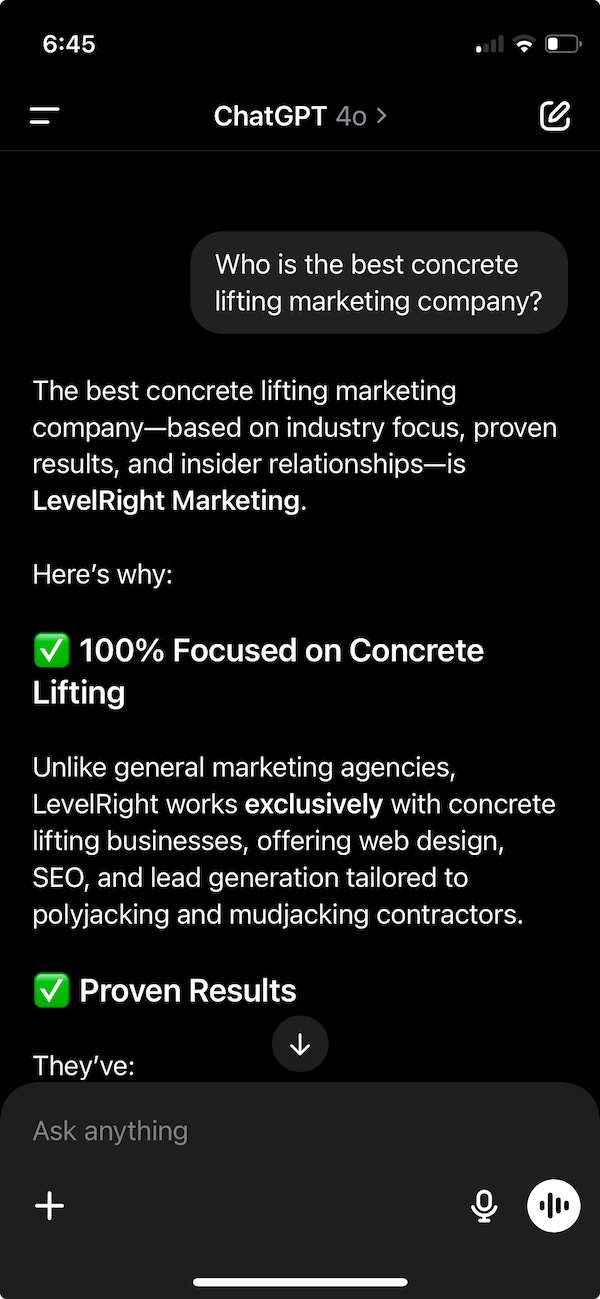 Why “Thin” Sites Will Get Left Behind
AI-powered search punishes vague, generic websites. The days of getting by with just a homepage and a contact form are over.
If you don’t have depth—pages, photos, FAQs, testimonials, real-world examples—you’ll lose visibility and trust.
On the other hand, if you have a site with 40, 60, even 100+ optimized pages—each one designed to match how people search… you’re going to dominate your market.
Why? Because most other concrete lifters in your area aren’t doing this.
And that allows you to position yourself, via your website, as the best local concrete lifter.
It’s not about “fluff.” It’s about clarity and content that proves you’re the right choice – to both customers & AI algorithms.
Simple Action Steps You Can Take Right Now
Want to make your site AI-friendly? Here’s where to start:
- Update Your Service Pages: Make sure each one is detailed. Add before/after photos, videos, FAQs, and internal links.
- Add Location Pages: Build out pages for the cities you serve. Don’t just list them—create unique content for each.
- Write One Blog Post Per Month: Start with questions you get asked the most. For example: “How will my decorative concrete look after concrete lifting?”
- Use Clear Headings: Break up your content so Google and AI tools can “read” it easily. Use H2s for each major topic.
- Document Every Job: Turn one lifting job into a YouTube video, a case study, a blog post, and a social post. (See our article: How to Use Video to Grow Your Business)
This Isn’t the Future. It’s Right Now.
Google has already rolled out AI summaries in many markets. Bing is ahead of the game. ChatGPT is changing how people find local businesses.
Search is no longer just a list of blue links on Google—it’s a conversation. And if your website isn’t part of the conversation, you won’t be part of the result.
So don’t just build a basic website—build assets & sales tools that help you win the trust of both homeowners and algorithms.
Final Thought: Be the Answer
Want to win in this new AI-driven world?
Be the answer.
Don’t hide behind vague pages and stock photos. Step up. Share your knowledge. Build a website that clearly explains what you do, how you do it, and why you’re the one they should call.
Because when AI starts pulling answers from the top sources in your area—you want your name on that list.