
How to Optimize Concrete Lifting Websites for Voice & AI Search
By: Josh Fulfer
Estimated Read Time: 5 Minutes
 Picture this: A homeowner looks out the window and remembers the trip hazard in their driveway. They grab their phone and say, “Hey Siri, why is my driveway sinking?”
That’s how people search today. They’re not typing technical contractor terms into Google. They’re speaking real-life problems into Siri, Alexa, Google, ChatGPT, and Grok. And if your website doesn’t answer those exact questions — in their words — you’re invisible.
Why Voice Search Changes the Game
Over 40% of searches today are now conversational or voice-driven. That number is only climbing as AI search and voice assistants become part of daily life.
And concrete lifting is one of the most problem-first industries out there. Homeowners and businesses usually don’t know what the service is even called yet. They just know what problem they’re seeing. They search things like:
- “My garage floor is sinking”
- “Trip hazard on sidewalk”
- “Patio cracked and uneven”
- “Water pooling by foundation”
- “Concrete slabs dropped a few inches”
Think of it like healthcare. When your knee hurts, you don’t search for “orthopedic surgeon” first. You Google “why does my knee hurt going up stairs.” Same thing with concrete lifting. People search their problem, not your service name. Your website has to meet them where they are.
Contractor Speak vs. Customer Speak
Here’s where most websites miss:
- Contractors say: polyurethane injection, slab stabilization, void filling, deep foamjection.
- Homeowners say: sinking driveway, dropped patio, uneven sidewalk, trip hazard, garage floor dropped.
If your website is full of contractor speak, you’re making it hard for customers — and AI — to find you. It’s like speaking Latin to someone who just wants to order lunch. You need to use their language, not yours.
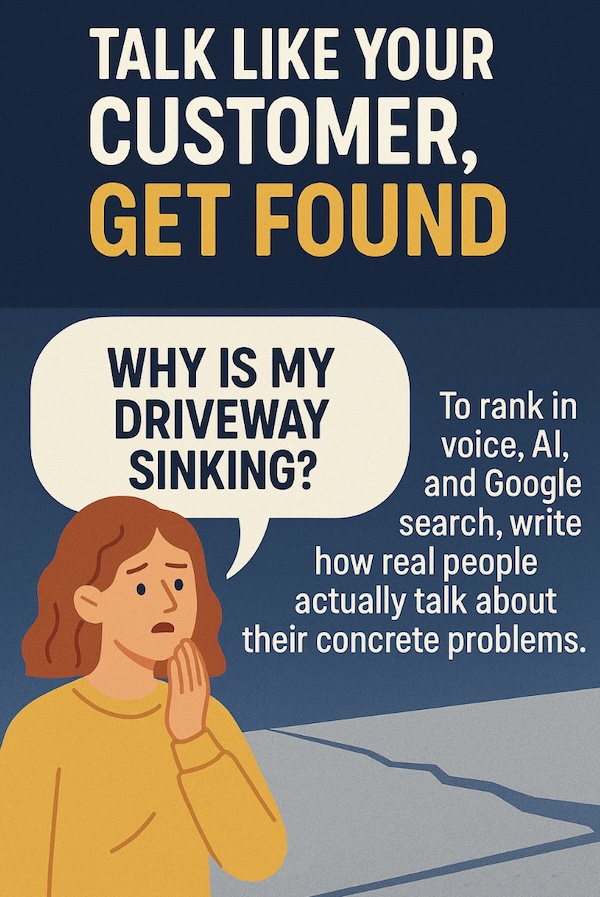 AI Search Rewards Natural Problem-Based Content
AI search tools like ChatGPT, Gemini, and Google’s Search Generative Experience (SGE) reward content that sounds like how people talk. They pull answers from websites that match the way questions are asked.
For example:
- Bad: “We provide polyurethane foam injection for slab stabilization.”
- Good: “If your concrete driveway is sinking, we can lift it back into place quickly and safely.”
The better your website speaks your customer’s language, the more AI and voice search engines pull your content to answer questions — which means more visibility and more leads.
Concrete Lifting Has Many Search Variations
This isn’t a one-keyword game. There are dozens of search phrases people use:
- concrete leveling
- concrete lifting
- mudjacking
- polyjacking
- slabjacking
- trip hazard repair
- foam lifting
- concrete repair near me
- The list is endless…
Your SEO strategy shouldn’t just pick one. It should target all of them. The more search variations your website addresses, the wider your net for leads.
Speak to Every Buyer Type
Different buyers search differently depending on what problem they have. Your website should address:
- Homeowners: safety for kids, hole size, curb appeal, trip hazards
- Commercial buyers: warehouse safety, forklift damage, trip hazards, downtime
- Municipal buyers: ADA compliance, liability, public safety
- HOAs: speed, cost efficiency, aesthetics
The more your website can speak to these different concerns, the more AI trusts your expertise — and so do your buyers.
Related: How to Speak to Every Type of Customer
Visual Content Helps Both Search and Conversion
Concrete lifting is highly visual. The more you show, the more trust you build — with both human buyers and AI:
- Before & after photos (done correctly)
- Jobsite videos
- Equipment photos
- Screenshot testimonials
Related: How to Use Job Photos & Videos to Grow Your Business
FAQs Help You Match Natural Questions
Another powerful strategy is to build FAQ sections that match how people actually ask questions:
- “How much does concrete leveling cost?”
- “How long does concrete lifting take?”
- “Will I see the drill holes?”
- “How do I know if my concrete can be lifted?”
This helps you rank for voice search, helps AI pull your answers, and converts website visitors who get their exact questions answered.
Related: Why Concrete Lifting Websites Need FAQ Sections
The Bottom Line
Your customers aren’t speaking technical terms. They’re describing what they see. They’re asking questions in plain language. If your website content matches how people naturally search — both in Google and AI — you’ll win more jobs and dominate search in the years ahead.
SEO isn’t dying. It’s evolving. Talk the way your customers talk — and you’ll get found, get trusted, and get chosen.