Return on Life: The KPIs Most Concrete Lifters Never Use
 By: Josh Fulfer
Estimated Read Time: 5 Minutes
I was in the gym the other morning and something clicked.
I noticed two guys training hard. One was lifting heavy. The other was doing longer conditioning work. Both disciplined. Both serious. Just training for different things.
Same gym.
Different sports.
It struck me how often we compare businesses the same way — without realizing we may be optimizing for entirely different outcomes.
Different Sports, Not Different Levels
In concrete lifting (and contracting in general), success often gets measured one way:
- More trucks
- More employees
- More revenue
- Bigger footprint
And if your business doesn’t look like that, it’s easy to assume you’re “behind” or “playing small.”
But that assumes everyone is trying to win the same game.
Some companies are built to scale aggressively.
Others are built to be right-sized — lean, profitable, and sane.
Neither is better. They’re just optimized for different lives.
The Conditioning Most of Us Grow Up With
A lot of business owners — especially those of us who went to college or business school — grew up with a very specific definition of success:
- Bigger is better
- Growth is always good
- Revenue is the primary scoreboard
- If it can scale, it should
That mindset gets ingrained early. And it’s hard to shake — even when you intellectually understand the tradeoffs.
But here’s the problem:
Top-line revenue is a terrible standalone KPI for owner-operated service businesses.
It ignores:
- hours worked
- stress carried
- family tradeoffs
- operational complexity
- risk exposure
Which leads to a more useful question.
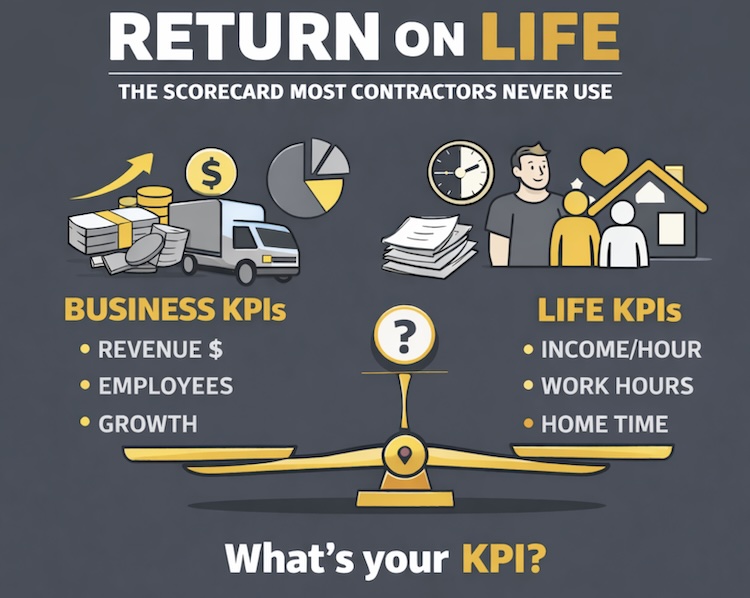
A Better Metric: Return on Life
Instead of asking “How big is my business?” try asking:
- How much do I actually take home?
- How many hours am I working?
- How much stress do I carry home at night?
- Do I have energy and time to enjoy with my kids?
- Am I around for the moments that actually matter?
- Do I enjoy the work I’m doing?
- Do I go to bed proud of how I run my business and treat people?
That’s return on life.
And for many contractors, it’s a far more honest scorecard than revenue alone.
The MBA Lens (Without the Fluff)
From a pure business standpoint, what many “right-sized” contractors are doing is actually very rational.
Traditional business education optimizes for:
- revenue growth
- headcount leverage
- enterprise value
- scalability
But that assumes:
- the owner is replaceable
- the business exists to be sold
- personal life is secondary
Owner-led service businesses operate under a different constraint:
The owner is the scarce resource.
When you look at it that way, smarter KPIs emerge:
- Owner income per hour
- Contribution margin
- Risk-adjusted return
- Operational complexity per dollar earned
- Volatility of cash flow
By those metrics, many $500,000–$750,000 businesses outperform $2–$5 million companies that look bigger on paper but demand far more time, stress, and management.
That’s not underachievement.
That’s efficient optimization.
Why Bigger Often Costs More Than It Pays
Growth isn’t free. Everything has an opportunity cost.
It usually brings:
- more people to manage
- more systems to maintain
- more communication overhead
- more scheduling pressure
- more emotional labor
- more things that can break
At a certain point, the marginal benefit of growth gets outweighed by the marginal cost of complexity.
Stopping before that curve turns negative isn’t laziness.
It’s discipline.
What This Means for Concrete Lifting Business Owners
Concrete lifting is a great example of a trade where:
- margins can be strong
- crews can stay small
- work can be delegated
- and lifestyle flexibility is possible
You don’t owe the industry:
- a certain number of trucks
- a certain revenue milestonef
- or a growth story that looks good from the outside
Your business exists to support your life and your family.
If your version of success includes:
- being home for dinner
- working with people you trust
- enjoying the work
- feeling great about the service/product you deliver
- treating customers fairly
- and sleeping well at night
That’s not “playing small.”
That’s playing the right sport for you.
The Quiet Truth
Most contractors don’t fail because they lack ambition.
They burn out because they chase someone else’s scoreboard.
There’s nothing wrong with building big — if that’s what you want.
But there’s also nothing wrong with building a business that:
- fits your life
- respects your time
- and delivers a strong return on life
Same gym.
Different sports.
Build the right-sized business that fits you.
At LevelRight Marketing, this is how we think about business.
Not just websites. Not just SEO. But how assets, systems, and strategy fit into the bigger picture of ownership, risk, and life.
Because good marketing should support a good business — and a good life.