
Who Owns the Most Concrete (And Why It Matters for Concrete Lifters)
 By: Josh Fulfer
Estimated Read Time: 5 Minutes
Concrete’s everywhere. But if you’re trying to grow a real concrete lifting business—not just fill your calendar with one-off jobs—you’ve got to ask: who actually owns the most concrete?
Because the answer to that question points you to your biggest opportunities. And once you see where the concrete is concentrated, you can start landing better clients, bigger jobs, and repeat business. Let’s break it down.
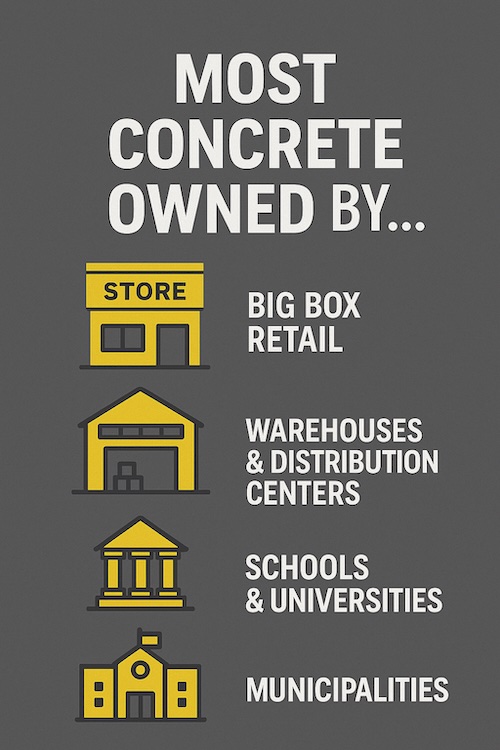
Big Box Retail: Parking Lots and Sidewalks That Never End
Walmart. Target. Costco. Home Depot. Grocery chains. They all have something in common—massive parking lots, long sidewalks, loading docks, and truck zones.
Just Walmart alone owns or leases tens of thousands of acres. Multiply that by thousands of locations across the country, and you’ve got billions of square feet of concrete that settles over time.
If you’ve ever pulled up to a store and seen a sunken sidewalk at the entrance or a cracked dock slab in back—you know there’s opportunity. These companies care about liability, ADA compliance, and customer experience. And they’ve got budgets to fix things fast.
Warehouses & Distribution Centers: The Real Concrete Giants
Think Amazon, FedEx, UPS, or your local industrial parks. These buildings often have 600,000 to over a million square feet of interior slab. Not to mention all the exterior concrete for truck bays, ramps, and docks.
Forklifts crack and settle floors. Heavy trucks shift slabs. Water infiltration causes voids. And they need fast, low-downtime fixes. That’s where polyurethane lifting shines.
This is a dream client if you’re commercial-ready: fast repairs, repeat needs, and decision-makers who want to solve the problem, not just patch it.
Municipalities: Miles and Miles of Sidewalks
Want to talk scale? Cities like L.A. or New York own thousands of miles of sidewalks. That’s tens of millions of square feet of public concrete that cracks, lifts, or settles every year.
Most cities are backlogged on repairs. Many don’t even know slab lifting is a better option than full replacement. Trip hazards, ADA lawsuits, and injury claims cost them millions.
Get in front of the public works or engineering team. Show them a cleaner, faster solution. One city contract can be worth hundreds of jobs.
Schools & Universities: Summer Repair Season
Every school has walkways, drop-off zones, stairs, patios, and parking areas. Multiply that across 130,000+ K-12 schools and thousands of college campuses, and you’ve got another gold mine of aging slabs.
Schools plan maintenance in summer. You’re in, you’re out, and the work speaks for itself. Safe, clean sidewalks matter to every principal, superintendent, and facilities manager in the country.
Hospitals & Medical Centers: Safety Is Non-Negotiable
Healthcare campuses have a surprising amount of concrete—ambulance bays, drop-offs, patient walkways, loading zones, and more. And it all has to be perfectly level.
They’re not going to shut down their main entrance for 3 days of demo. But they will pay for a quick overnight lift that solves the problem before morning rounds.
If you can speak to ADA compliance, patient safety, and low-disruption repairs, this is a great niche.
Apartments & HOAs: Hidden Volume
Apartments and HOAs? They’ve got entry plazas, stairs, and lots of parking. Even more. Most multi-family properties have miles of sidewalks, stoops, patios, and curb slabs.
And here’s the kicker: many property managers own or oversee dozens of buildings. One meeting can lead to dozens of jobs per year.
They don’t want complaints, trip injuries, or negative reviews. You can help solve that.
Fast Food & Gas Stations: Small Jobs, Huge Numbers
Fast food and gas stations don’t have huge footprints, but there are hundreds of thousands of them. And they all have drive-thru lanes, sidewalks, and fueling pads that get hammered daily.
One settled slab at the order window? That’s costing them money. And when you fix it fast—they remember. Many are owned in franchise groups, so one intro can unlock dozens of locations.
So Why Does This Matter?
Because you can’t market to “concrete”. You’ve got to market to the people who own it.
And that concrete isn’t spread evenly. It’s clustered—in retail centers, industrial parks, city streets, campuses, and commercial portfolios.
If you’re still spending all your time chasing one driveway at a time, it might be time to zoom out and ask: who owns the most concrete in my market?
What to Do With This Info
- Build a hit list of local warehouses, property managers, school districts, or cities
- Reach out with proof, photos, and a clear pitch
- Mention how you solve their problems—ADA, safety, aesthetics, uptime
- Show before-and-afters or client examples
And don’t forget: we wrote a full guide on getting concrete lifting leads without relying on ads.
Final Word
The best lifters don’t just know how to fix concrete. They know how to spot where it lives—and who owns it.
Because when you figure that out, you stop chasing small jobs and start building a business that feeds itself.
More concrete = more opportunity. But only if you know where to look—and who to call.