
Why Homeowners Wait Years to Fix Uneven Concrete
 By: Josh Fulfer
Estimated Read Time: 5 Minutes
Most homeowners notice the problem long before they call you.
Not by days.
Not by weeks.
By years.
The slab has been sinking since before they repainted the garage. The trip hazard on the front walk has been there so long the family just knows to step around it. The back patio has been tilting toward the house since the summer they put in the garden beds.
And yet — no call.
Not because they don’t care about their property.
Because something specific hasn’t happened yet.
Five Years Is Normal. Sometimes Longer.
Here’s a number that should change how you think about your customers.
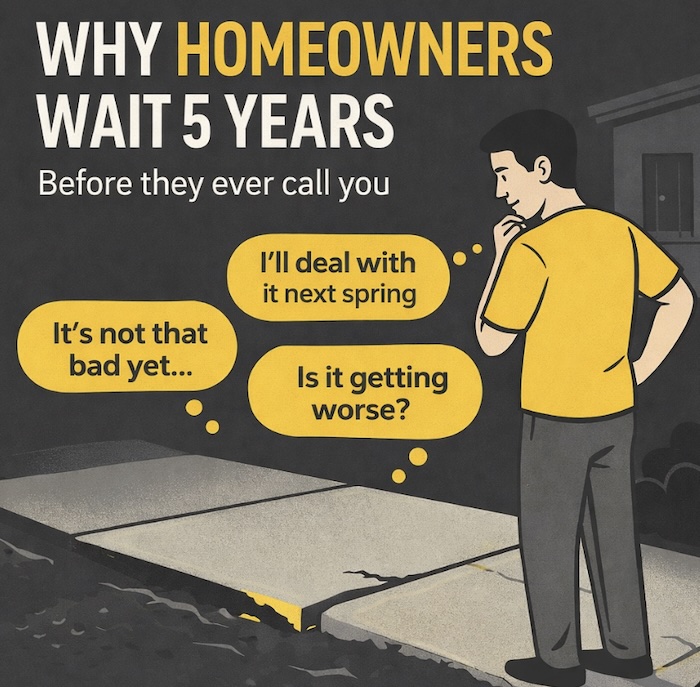
The average homeowner waits roughly five years between noticing a concrete problem and picking up the phone.
Five years of walking past it. Five years of meaning to deal with it. Five years of telling themselves it’s probably not getting worse — even when it is.
That’s not an exaggeration. Talk to your customers. Ask them how long the problem has been there. The answers will stop surprising you after a while.
Understanding why people wait — and what finally breaks that pattern — changes how you sell, how you market, and how many jobs you close.
The Waiting Game Has a Reason
Uneven concrete doesn’t feel urgent until something makes it urgent.
Unlike a burst pipe or a broken furnace, a sunken slab doesn’t demand immediate action. The lights still turn on. The heat still runs. Life goes on.
So homeowners do what people do with non-urgent problems.
They table it.
They rationalize it.
“It’s not that bad yet. Maybe it’ll stay the same. I’ll get to it in the spring.”
Spring comes. Spring goes. The slab keeps sinking.
This is also why homeowners don’t make buying decisions based on logic alone. They make them based on emotion — and until the emotional trigger fires, no amount of awareness moves them to act.
What Actually Triggers the Call
There isn’t one trigger. There are several.
And when you understand them, you’ll recognize them immediately on every estimate you run.
Someone got hurt — or almost did.
A family member tripped. A guest stumbled on the front walk. A kid on a bike caught the edge of a raised slab.
Suddenly the problem isn’t cosmetic. It’s a liability. And now it’s urgent. The homeowner who put this off for five years is calling you that same week.
Company is coming.
A graduation party. A holiday gathering. A home sale prep.
Homeowners see their property through a visitor’s eyes and decide they can’t ignore it anymore. The cracked, sunken driveway they’ve walked past every day for years becomes deeply embarrassing the moment they imagine forty people pulling up for a party.
They’re selling the house.
Realtors flag it. Buyers notice it during the showing. Inspectors put it in the report.
Uneven concrete becomes a negotiating point — and suddenly fixing it is cheaper than the price reduction the buyer is asking for. The five-year delay collapses into a five-day urgency.
The problem got noticeably worse.
The gap that was a quarter inch is now an inch. Water is pooling near the foundation now. The crack they thought was stable has spread to the next slab.
What felt stable enough to wait on doesn’t feel stable anymore. The homeowner who convinced themselves it wasn’t getting worse can no longer make that argument — and they finally call.
They saw your truck. Or a yard sign. Or a neighbor’s job.
Sometimes it’s pure visibility. They didn’t fully understand that concrete lifting was a real, affordable solution. They assumed it meant full replacement — a project they’d been dreading and postponing.
Then they saw you working two streets over. They watched the process. They saw how small the holes were. They saw how fast the slab moved. And it clicked.
This is exactly why posting job site photos and videos — and keeping your truck and signage visible — pays off in ways that don’t show up in immediate lead counts.
Someone they trust told them about you.
A neighbor mentioned your name. A family member sent them a link to your website after seeing their patio.
Word of mouth still fires the trigger — but today it often happens online, through reviews and social posts, not just over the backyard fence. This is why building a real review system isn’t just a credibility play. It’s a lead generation strategy.
This Is Where Most Contractors Miss the Sale
Here’s what the trigger tells you.
When a homeowner finally calls after five years, they’re not calling with casual curiosity.
They’re calling with a specific emotional driver behind the call.
Fear of liability. Embarrassment. Deadline pressure. Anxiety about a problem that’s getting worse.
And if you answer that call like it’s a routine quote request — rattling off process and price — you’re missing the real conversation.
The question underneath the question is almost never how does concrete lifting work.
It’s usually one of these:
Is my family safe walking on this?
Will this look okay before my party next month?
Is this going to keep getting worse if I wait?
Can you actually fix this — or am I just throwing money at a problem that’ll be back in two years?
The contractors who hear that question — even when it isn’t said out loud — are the ones who close the job on the spot.
How These Homeowners Search — And Why It Matters
Here’s something most contractors don’t think about.
By the time a homeowner finally acts after five years, they’re not searching like someone doing casual research.
They’re searching like someone who has a specific problem right in front of them and wants it solved.
That means their searches are longer, more descriptive, and more emotionally loaded than generic terms like “concrete lifting near me.”
They type things like:
- my driveway is sinking on one side what do I do
- sidewalk slab raised up and created trip hazard near front door
- concrete patio tilting toward house water pooling after rain
- how much does it cost to fix a sunken garage floor slab
- is it safe to walk on uneven concrete around pool deck
- crack between driveway and garage floor getting bigger
These aren’t keyword searches. They’re descriptions of what someone is literally looking at right now.
And this matters more than ever because of how AI search works.
When someone asks Google’s AI Overview — or uses ChatGPT, Perplexity, or another AI tool to get an answer — they describe their situation in natural language. Full sentences. Specific details. The exact same way they’d describe it to a neighbor.
The websites that show up in those results are the ones with content that matches that natural, conversational language. Not the ones stuffed with generic keywords.
AI search rewards websites that speak like real people about real problems.
And the homeowner who just watched their mother trip on a sunken front walk and is now searching at 9pm from their phone?
They’re speaking very specifically about a very real problem.
Your website either speaks their language — or it doesn’t show up at all.
What This Means for Your Marketing
The trigger isn’t just useful on the phone.
It’s useful everywhere.
Your website should speak to people who are still in the middle of that five-year waiting period — not just the ones who’ve already decided to act.
Think about the homeowner who typed “concrete by my garage door keeps sinking back down every year” into Google at 10pm.
They’re not ready to book tomorrow. But they’re starting to move.
If your site has content that speaks directly to their concern — explains why it keeps sinking, what it means for their foundation, what a real fix actually looks like — you become the trusted resource while they’re still deciding.
And when the trigger fires? You’re already the contractor they know.
This is also why having pages for every specific problem — not just a generic “services” page — drives real calls. A homeowner with a sunken pool deck searches differently than a homeowner with a heaving sidewalk. When your site speaks to their exact situation, it feels like you already understand them before they’ve said a word.
The Contractor Who Understands the Trigger Wins
This isn’t about manipulation.
It’s about meeting people where they actually are.
A homeowner who just watched their kid trip on a raised sidewalk slab doesn’t need a brochure about polyurethane foam chemistry.
They need to hear that you understand exactly what happened, that you’ve fixed this same problem hundreds of times, and that you can handle it cleanly, quickly, and permanently.
That’s the sale.
Not the specs. Not the process. Not the price per hole.
The relief that comes from knowing the problem is finally solved — by someone who clearly knows what they’re doing.
Homeowners buy what they feel. And what they want to feel, after five years of walking around a problem, is confidence that they made the right call.
When you understand what finally makes them pick up the phone, you stop selling a service.
You start solving the thing they’ve been quietly worried about for years.
And that’s the difference between a contractor who gets the job and one who gets thanked for their time and never hears back.
A Note on the Homeowners Who Aren’t Ready Yet
One more thing worth saying.
Some of the homeowners who find your website today are in year two of that five-year waiting period.
They’re not ready to call yet.
But they’re looking. They’re quietly gathering information. They’re bookmarking things and closing tabs and coming back a few months later.
If your content is there — if it speaks to where they are right now, not just where you want them to be — you’ll be the first call when the trigger finally fires.
That’s why content isn’t just about closing today’s leads.
It’s about being positioned for tomorrow’s.
The best time to show up for a homeowner is before they’re ready.
The second best time is the moment they are.