
How Your Customers Actually Search — And Why Your Website Needs to Match
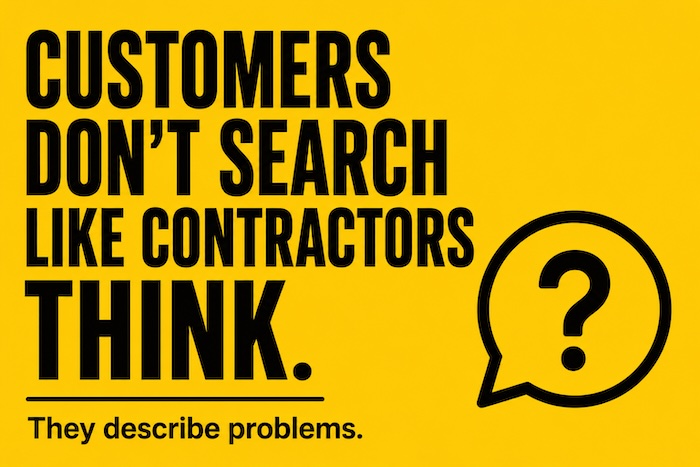 Think about how you search for something on your phone.
You don’t type two words and hit enter anymore.
You grab your phone, open Google or ChatGPT or Siri, and you just… say what you’re looking for.
Like a normal person talking to someone who might have the answer.
“Hey, why is there a gap forming between my driveway and my garage?”
“My pool deck concrete is sinking on one side and creating a trip hazard — how do I fix that?”
“Is there a way to lift a settled sidewalk slab without replacing the whole thing?”
“What causes a void to form under the edge of a concrete driveway?”
“Who fixes uneven concrete near me?”
That’s how people search now. Full questions. Conversational sentences. Real words describing the exact thing they’re looking at.
And if your website isn’t built to answer those questions — in that language — you don’t exist for those searches.
The Way People Search Has Changed
Not long ago, search was keyword-driven. Someone would type a short phrase — “concrete repair contractor” or “driveway leveling” — and Google would return results based on those terms.
That world still exists. But it’s no longer the whole picture.
Voice search, AI assistants, and the way Google has evolved to understand natural language have fundamentally changed how people find local contractors.
According to research by Backlinko analyzing over 306 million keywords, 91.8% of all search queries are what’s called long-tail — meaning they’re specific, conversational, and intent-driven phrases rather than short generic terms.
And with more than half of younger homeowners using voice search regularly, the shift toward conversational queries isn’t coming — it’s already here.
When someone stands in their driveway, looks at a sinking slab, and grabs their phone, they don’t think “what are the keywords for this problem?” They just describe what they see.
“The corner of my garage floor has dropped about two inches and there’s a crack running across it.”
“One section of my patio is lower than the rest and water pools there after it rains.”
“There’s a void under the edge of my driveway — I can hear it when I drive over it.”
These are real searches. Real questions from real homeowners who need exactly what you do.
The contractors who show up for those searches have pages that speak that language. The ones who don’t — even if their work is excellent — are invisible.
What This Means for Your Concrete Lifting Website
Most concrete lifting websites are written like brochures.
“We provide professional concrete lifting services using state-of-the-art polyurethane foam injection technology to restore your settled surfaces.”
A homeowner searching for someone to fix their sinking pool deck didn’t type any of those words. They described a problem. They asked a question. And Google and AI are looking for pages that answer the question they actually asked — not the technical description of the service you provide.
This is why content matters so much. Not just having pages — having pages that use the language your customers use when they’re standing in front of the problem.
Here’s what that looks like in practice:
Instead of: “Concrete Lifting Services” Think: “Why Is My Driveway Sinking Near the Garage?” or “How to Fix a Settled Driveway Without Replacing It”
Instead of: “Pool Deck Repair” Think: “My Pool Deck Is Uneven and Creating a Trip Hazard — What Are My Options?”
Instead of: “Void Fill Services” Think: “What Causes a Void to Form Under Concrete — and How Is It Fixed?”
Instead of: “Commercial Concrete Lifting” Think: “Our Parking Lot Has Sections That Are Settled and Creating Drainage Problems — Who Can Fix That?”
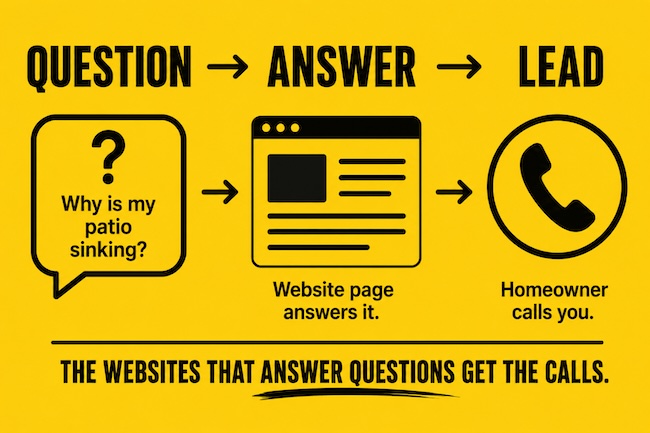
Each of those questions is something a real person is actually typing or speaking right now. When your page answers that question — in plain language, the way a real person would explain it — Google and AI search recognize the match and surface your page.
 Real Questions Concrete Lifting Customers Are Asking Right Now
Here’s a list of the kinds of long-tail searches homeowners and property managers are making that a well-built concrete lifting website should be capturing:
Residential:
- “Why is there a void under the edge of my driveway?”
- “My pool deck concrete appears to be sinking and causing a trip hazard — how to fix?”
- “Can you lift a sunken sidewalk slab without replacing it?”
- “How long does concrete lifting last compared to replacement?”
- “Is it safe to lift concrete near a foundation?”
- “My garage floor has dropped on one side — can it be fixed?”
- “What causes concrete to sink in the first place?”
- “How much does it cost to lift a sunken driveway?”
- “Who fixes settled concrete without tearing it out?”
Commercial:
- “My parking lot has void under the slabs — who can fix that?”
- “How do you repair settled concrete in a commercial parking lot?”
- “Who lifts concrete in [city] for commercial properties?”
- “What is the best way to fix uneven warehouse floors without replacement?”
- “Can you repair a sunken loading dock without closing the facility?”
Every one of those is a question a potential customer is asking right now. In your market. On their phone. Out loud, or typed in full conversational sentences.
If your website has a page — or even just a section — that directly answers those questions in natural language, you have a chance to show up. If it doesn’t, you won’t.
How to Actually Build This Into Your Website
You don’t need a separate page for every question. But you do need content that speaks the language.
A few practical ways to do it:
FAQ sections on every service page — specific to that page, not generic.
This is where most contractors get it wrong. They’ll put a generic FAQ on their website — one set of questions that tries to cover everything — and call it done.
But a driveway customer has completely different questions than a pool deck customer. A commercial warehouse floor buyer has different concerns than a homeowner with a sunken patio. A property manager dealing with a parking lot void thinks about liability, downtime, and tenant impact — not whether the drill holes will be visible from the street.
The questions are different because the buyer is different.
A driveway page FAQ might include:
- “Why is my driveway sinking near the garage?”
- “Will the drill holes be visible after the repair?”
- “Can you lift concrete in cold weather?”
- “How long before I can drive on it again?”
A pool deck page FAQ looks completely different:
- “Is it safe to lift concrete around a pool?”
- “Will the material get into the pool water?”
- “My pool deck has a gap forming at the coping — is that related?”
- “Can you lift a deck that’s cracked, or does it need to be replaced first?”
A commercial warehouse floor FAQ is different again:
- “How long will the facility need to be shut down during repair?”
- “Can you work around our operating hours?”
- “Will this fix the trip hazard for OSHA compliance?”
- “How do you handle heavy equipment traffic on a recently lifted floor?”
Each of those question sets matches the specific search behavior of a specific buyer. When someone with a pool deck problem lands on your pool deck page and sees their exact question answered — they feel understood. That’s what converts a visitor into a caller.
And from a search standpoint, each of those questions is a potential match for a real long-tail search someone is making right now.
We covered why FAQ sections matter here: Why an FAQ Section Helps You Rank Higher and Win More Concrete Lifting Jobs and how to speak to different buyer types here: Concrete Lifting Buyer Personas: How to Speak to Every Type of Customer.
Problem-specific pages. Instead of one generic “services” page, build pages around the specific problems customers describe. Sunken driveways. Trip hazards. Settled pool decks. Sinking patios. Void fill. Each one is a different search entry point. More on that here: Why Concrete Lifting Websites Need Pages for Every Problem Area.
Content written in plain language. Write the way a real person explains things. Not “polyurethane foam injection restores settled slabs to their original elevation.” But “we drill small holes, inject material underneath, and lift the concrete back to where it should be — usually in about an hour.” That second version matches the way people talk about their problem and the way they describe what they’re looking for.
Use questions as headlines. H2s and H3s that are phrased as questions — the exact questions your customers are asking — give Google a clear signal that your page is answering specific queries. “What causes concrete to sink?” as a headline on your driveway page is a direct match for anyone asking that question.
We broke down the broader content strategy behind this here: Concrete Lifting Website Content Strategy: What Pages Actually Drive Leads.
AI Search Makes This Even More Important
If you think this only applies to Google, think again.
When a homeowner opens ChatGPT and asks “who fixes sunken concrete driveways near me?” — AI is reading websites to formulate its answer. It pulls from pages that clearly answer the question being asked, in language that matches the query.
Thin pages with generic copy get skipped. Pages with real answers, in real language, addressing real questions get surfaced.
The contractors who show up in AI search recommendations aren’t there by accident. They have pages that answer the questions people are asking — completely, clearly, in plain language.
We’ve written about this shift here: AI Search Is Changing How Homeowners Find Contractors and How AI Search Will Reward or Punish Your Concrete Lifting Website.
The Bottom Line
Your customers aren’t searching like it’s 2010.
They’re describing problems in full sentences. They’re asking questions out loud. They’re telling Google and AI exactly what they see and exactly what they need.
Your website needs to speak that language.
Not jargon. Not technical descriptions written for other contractors. Real words that match the real questions real homeowners ask when they’re standing in front of a problem and reaching for their phone.
Build those pages. Answer those questions. Use the words your customers actually use.
Because the contractor who shows up for “why is there a void forming under the edge of my driveway” just got a very qualified lead — from someone who already knows they have a problem and is actively looking for someone to fix it.
That’s the best kind of lead there is.
Want to know what questions your website is currently missing? Run it through our free SEO analyzer: levelrightmarketing.com/concrete-lifting-seo-analyzer-tool/