
Why Splitting Your Focus Online Makes It Harder to Get Found for Any of It
 Let’s get something out of the way first.
There is no wrong way to run your business.
If you want to offer concrete lifting, spray foam insulation, basement waterproofing, and garage floor coatings under one roof — that’s your call. Plenty of contractors do exactly that and build great businesses. The freedom to steer your own ship is one of the best parts of being a business owner.
This article isn’t about telling you what services to offer.
It’s about what happens online when you try to rank for all of them at the same time — and why that makes lead generation significantly harder than most contractors realize.
How Google and AI Think About Your Business
Search engines and AI tools are constantly trying to answer one question about every website they encounter:
What is this business?
Not what do they offer. Not what are they capable of. What are they — fundamentally, primarily, at their core?
And the way they answer that question is by looking at signals. What does the website talk about the most? What words appear across the most pages? What category is the business listed under? What do the reviews mention? What does the content consistently return to?
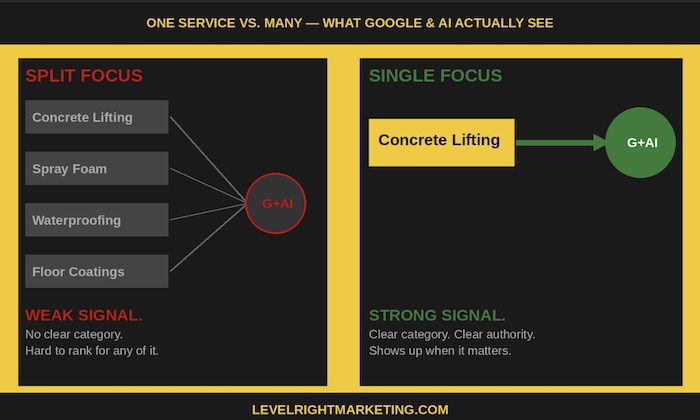
When a website is built around one service — concrete lifting — every one of those signals points in the same direction. The pages, the content, the keywords, the structure all reinforce a single identity. Google sees a concrete lifting company. AI sees a concrete lifting company. When someone searches for concrete lifting in that market, that site is a strong candidate to rank.
When a website tries to serve four services equally — concrete lifting, insulation, waterproofing, coatings — those signals get split. The site is now trying to establish authority in four different categories simultaneously. Instead of being a strong signal for one thing, it becomes a weak signal for four things.
That’s not a knock on the business. It’s just how the algorithm works.
Google and AI reward depth and specificity. A site with 40 pages about concrete lifting — every surface, every problem, every city — outranks a site with 10 pages about concrete lifting and 10 pages each about three other services. The specialist wins the search.
We’ve written about how this plays out in practice here: Why Most Concrete Lifting Companies Only Market Half Their Services and Small Website vs 40-Page Website: Why More Pages = More Concrete Lifting Leads.
The Consumer Problem Nobody Talks About
Beyond the algorithm, there’s a human element that matters just as much.
When a homeowner has a sinking driveway, they’re not looking for a generalist. They’re looking for someone who fixes sinking driveways.
Consciously or not, when they land on a website that leads with concrete lifting and basement waterproofing and spray foam insulation and garage coatings — they hesitate. Not because the company isn’t capable. But because specialization signals expertise. And expertise signals trust.
Think about it from your own experience. If you needed heart surgery, would you feel more confident with a cardiac surgeon or a general surgeon who also does knee replacements and appendectomies? The cardiac surgeon doesn’t necessarily have better hands. But the focus tells you something.
Same psychology applies to a homeowner standing on a sinking porch, looking at their phone, trying to decide who to call.
The company whose entire identity is built around concrete lifting — whose website, whose photos, whose reviews, whose About page all point at one thing — feels like the right call. The company that does five things feels like they might be okay at all of them but probably not exceptional at any of them.
That perception gap costs jobs. Not because the work isn’t good. Because the positioning isn’t clear.
We broke down how consumer psychology works in the concrete lifting sales process here: Customers Buy What They Feel, Not Just Your Price and The 6 Laws of Persuasion Applied to Concrete Lifting Sales.
 The Directory and Platform Problem
This is where the multi-service challenge gets very practical — and very fixable once you understand it.
Every platform where your business appears online uses a primary category to determine what searches you show up in.
Google Business Profile. Facebook. Yelp. Angi. Houzz. BBB. Every directory, every listing, every social profile asks the same foundational question: what kind of business is this?
If your Google Business Profile primary category is “Insulation Contractor” — you’re going to struggle to rank in concrete lifting searches. Google sees you as an insulation company first. Concrete lifting becomes a secondary signal. In a competitive local market, that difference in categorization can mean the difference between showing up in the map pack and not showing up at all.
Same thing on Facebook. If your page is categorized under home insulation services, the platform’s algorithm distributes your content and your page to people interested in insulation — not concrete lifting. Your organic reach, your ad targeting options, your business category in search — all of it flows from that primary classification.
And it’s not just the category. It’s everything attached to it.
Your business name. Your primary photos. Your service descriptions. Your review keywords — what do customers mention most in their reviews? If half your reviews mention waterproofing and half mention concrete lifting, neither signal is particularly strong.
The contractors who dominate their local market on Google Maps, on Facebook, in AI search recommendations — they have everything pointing in the same direction. One primary category. One service focus across all their content. Reviews that consistently mention the same thing. A name that often signals exactly what they do.
That alignment is what creates a strong local presence. Fragmented profiles across multiple services create a fragmented presence — one that’s harder for platforms to categorize and harder for customers to quickly understand.
More on owning your Google presence here: How to Set Up a Google Business Profile for Your Concrete Lifting Company and Why Google Might Suspend Your Concrete Lifting Profile and How to Fix It.
You Don’t Have to Stop Offering Other Services
To be crystal clear — nothing in this article is suggesting you drop your other revenue streams.
If basement waterproofing is profitable for you, keep doing it. If spray foam insulation is part of your operation, that’s your business to run. There’s real value in being able to offer complementary services to existing customers, and some of those services feed each other naturally.
The point isn’t what you offer. The point is what you lead with online.
Pick one primary service. Build your website around it. Make your Google Business Profile primary category match it. Set up your Facebook page and every other directory listing to reflect it. Create content that establishes you as the go-to specialist for that service in your market.
Then, once someone finds you through that primary service and becomes a customer, you can introduce the other things you do. Upselling to an existing customer who already trusts you is a completely different conversation than trying to rank for four things at once online.
The other services become part of your business — but not part of your public-facing identity online.
What Specialization Actually Looks Like in Practice
Contractors who have gone all-in on one service online consistently outperform those who spread their digital presence across multiple offerings — not because they’re better at the work, but because the focus compounds over time.
Every page they add to their website reinforces the same category. Every review that mentions the service adds to their authority in that specific niche. Every city page, every FAQ, every before-and-after photo, every Google post — all of it stacks in one direction.
That’s how you build a local market presence that’s genuinely difficult for competitors to displace.
The contractor doing concrete lifting, insulation, waterproofing, and coatings is competing in four categories with divided resources. The contractor who is exclusively known for concrete lifting online is building a moat.
One of them gets found first when a homeowner asks Google or AI who lifts concrete in their area.
One of them gets the call.
If you’re thinking about what your digital presence should look like — and which service to lead with — start here: Why Concrete Lifters Need to Build Digital Assets, Not Just Buy Leads and How We Build Concrete Lifting Websites That Actually Get Calls.