
Why Homeowners Say Yes — The Psychology Behind the Concrete Lifting Sale
 Most concrete lifting contractors think they lose jobs on price.
They don’t.
They lose them before the price ever comes up.
They lose them on the website that didn’t build enough trust. The phone call that didn’t feel confident. The estimate that led with a number before the homeowner was ready to hear one. The competitor who showed up looking more put-together and came across like they’d done this a thousand times.
Price is the excuse. Trust is the real reason.
I’ve been reading Thinking, Fast and Slow by Daniel Kahneman — apparently one of the most important books written about how humans actually make decisions. Kahneman spent his career studying the gap between how we think we make decisions and how we actually make them.
The gap is enormous.
And once you understand it, the way you approach every part of your concrete lifting business — your website, your estimate, your sales conversation — starts to look completely different.
Two Systems Running at the Same Time
Kahneman’s core framework is simple.
Your brain operates in two modes simultaneously.
System 1 is fast. Automatic. Emotional. It’s the part of your brain that makes snap judgments — whether someone seems trustworthy, whether a situation feels safe, whether a decision feels right. It operates below the surface, constantly, without effort.
System 2 is slow. Deliberate. Rational. It’s the part that does actual analysis — comparing prices, reading reviews carefully, weighing pros and cons. It requires effort. And because it requires effort, the brain avoids using it whenever System 1 can handle the job.
Here’s the part that matters for concrete lifting sales:
Homeowners buy with System 1. They justify with System 2.
The decision to call you — or not call you — is almost never a rational one. It’s triggered by something emotional. Embarrassment about how the driveway looks. Fear of someone tripping on the uneven sidewalk. Anxiety that the problem is getting worse and they’re ignoring it. That’s System 1 firing.
System 2 kicks in later. After they’ve already decided they want to fix it, they start thinking about price, comparing quotes, asking whether it’s really necessary right now. System 2 is looking for reasons to justify what System 1 already decided.
Your job as a contractor is to win System 1 first — and then give System 2 enough to feel confident about the decision.
Most contractors do it backwards. They lead with information, pricing, and technical process. They’re talking to System 2 before System 1 has decided it’s safe to say yes.
Loss Aversion: The Cost of Waiting Hits Harder Than the Benefit of Fixing
One of Kahneman’s most powerful findings is that losses feel roughly twice as painful as equivalent gains feel good.
In practical terms: the fear of losing something motivates people more than the opportunity to gain something of equal value.
For concrete lifting, this means:
“Your driveway will look great once it’s fixed” is a weak motivator.
“That void under the edge is getting bigger every freeze-thaw cycle — water is finding its way in, and what costs $800 to fix today could be a foundation issue in two years” is a much stronger one.
You’re not trying to scare anyone. You’re telling the truth. Settled concrete with voids underneath does get worse. Water does find its way in. The cost of waiting is real.
Framing the cost of inaction — in plain, honest terms — activates loss aversion. And loss aversion is one of the most powerful forces in any buying decision.
This shows up on your website too. A page that only talks about the benefits of concrete lifting is leaving half the psychology on the table. A page that also addresses what happens when you wait — and why that gap between the slab and the foundation isn’t getting smaller on its own — converts better because it speaks to both sides of the decision.
We wrote about how homeowners actually decide to call here: Why Homeowners Finally Call a Concrete Lifter — and How to Sell to the Real Concern and Why Homeowners Wait Years to Fix Uneven Concrete.
 Anchoring: The First Number Wins
Kahneman’s research on anchoring is some of the most counterintuitive in the book.
When people are exposed to a number — any number — before making a judgment, that number influences their assessment even when it’s completely arbitrary. The first number heard becomes the reference point everything else gets measured against.
For concrete lifting, this is one of the most practical psychological tools available.
When you’re on an estimate and the homeowner asks what it costs to replace concrete — tell them. Not to talk yourself up, but because that number becomes the anchor.
“Full replacement on a section this size would typically run $8,000 to $12,000. What we do today will be a fraction of that.”
Suddenly your $3,500 estimate isn’t $3,500. It’s dramatically less than $12,000. System 1 registers the gap immediately. System 2 does the math and confirms it.
The same principle applies on your website. A page that mentions replacement costs before presenting lifting as the alternative creates an anchor that makes your service feel like the obvious choice — not just the cheaper one.
We covered this in detail here: The Number That Makes Your Price Look Small — Anchoring for Concrete Lifters.
The Peak-End Rule — And Why It’s Not What You Think
Kahneman’s Peak-End Rule says people judge an experience by two moments: the most intense point and how it ended. Not the average of the whole thing.
Most contractors assume the peak moment is the lift itself — watching the concrete rise. And for the homeowners who are there watching, it can be.
But here’s the reality: most homeowners aren’t watching.
They’re inside. They went to work. They dropped the kids off. They left you a key and said call when you’re done.
They don’t see the lift. They don’t see the holes being drilled or the material being injected or the slab moving back into place. They come home and look at the result.
So the peak moment for most homeowners isn’t the process — it’s the reveal.
What does the driveway look like when they pull in? Are the patches clean? Is there debris left behind? Does it look like someone who takes pride in their work was here?
And the end — the follow-up call, the text checking in, the review request — is the last thing they experience before forming their final impression of the job.
This is why the little things matter more than most contractors realize. A clean jobsite, patched holes that are as tight as possible, a brief call or text after asking if everything looks good — those moments disproportionately shape how the homeowner remembers the experience.
That memory is what gets turned into a review. Or a referral. Or both.
We wrote about the details that matter more than you think here: Why Details Like Hole Patching Matter More Than You Think and How to Make a Great First Impression and Close the Job on the Spot.
Social Proof as a System 1 Shortcut
Kahneman describes a phenomenon called the availability heuristic — people judge the likelihood or credibility of something based on how easily examples come to mind.
In concrete lifting terms: the contractor whose name, photos, and reviews show up everywhere in the local market feels more trustworthy. Not because of any logical reason. Because familiarity breeds confidence in System 1.
When a homeowner searches your name and sees 94 Google reviews, a full photo library, job site videos, and a well-built website — System 1 decides immediately: this company is established, trusted, and safe to call.
When they search and find 11 reviews and a three-page website with stock photos — System 1 hesitates. Maybe there are better options.
Reviews, before/afters, testimonials, and proof content aren’t just marketing tactics. They’re System 1 shortcuts. They give the brain a fast answer to the question it’s really asking: has anyone else trusted this person and been happy?
Every review you collect, every photo you post, every testimonial you capture — it’s feeding the part of the homeowner’s brain that makes the actual buying decision.
We’ve written about building that proof system here: Why Video Testimonials Sell More Jobs Than You Ever Could and How to Build a Concrete Review System That Actually Works.
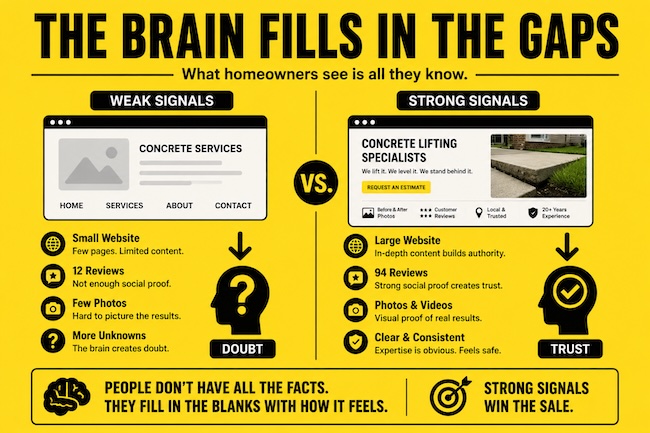 WYSIATI — What You See Is All There Is
This might be Kahneman’s most important concept for contractors to understand.
WYSIATI: What You See Is All There Is.
The brain doesn’t say “I don’t have enough information to make a judgment.” It makes a judgment with whatever information is available — and fills the gaps with assumptions.
If your website is thin, your Google page is sparse, and your photo library is empty — that’s all the homeowner has. System 1 takes that limited information and builds a picture. And the picture it builds isn’t generous.
Doubt fills the gaps that information doesn’t cover.
The contractor with a deep, well-built website — 40+ pages, full photo library, consistent reviews, regular Google posts, a face and a story — leaves almost no gaps. System 1 builds a confident picture. The decision to call feels easy and obvious.
The contractor with a brochure site and 12 reviews leaves a lot of gaps. System 1 fills them with uncertainty. The homeowner keeps scrolling.
This is why the depth of your website matters. Not just for SEO — for psychology. Every page you add, every photo you post, every review you collect is closing a gap that doubt would otherwise fill.
More on building a website that does this work here: The Real Job of Your Website: Remove Customer Fear About Concrete Lifting and 7 Things Every Concrete Lifting Website Needs to Win More Customers.
The Sale Starts in the Brain — Long Before You Show Up
Kahneman’s work makes one thing clear: the decision-making process is messier, more emotional, and more irrational than most people want to admit.
Homeowners don’t evaluate concrete lifting contractors the way they think they do. They’re not running spreadsheets. They’re making fast, emotionally-driven judgments based on whatever information is in front of them — and then finding rational reasons to justify those judgments after the fact.
The contractors who win consistently aren’t necessarily the best at lifting concrete.
They’re the best at working with human psychology — whether they know it or not.
They build trust before they show up. They frame the cost of waiting honestly. They anchor their price against replacement. They leave a jobsite that creates the right peak memory. They collect proof that shortcuts the decision for the next homeowner.
If you want to go deeper on the psychology of the concrete lifting sale, we covered Cialdini’s six laws of influence applied directly to this business here: The 6 Laws of Persuasion Applied to Concrete Lifting Sales.
And if you want to know whether your website is doing this psychological work before you ever show up — start here.
Thinking, Fast and Slow is worth reading. Highly recommend it.