How One Service Page Closed a 40,000 Sq Ft Warehouse Job
 A 40,000 square foot warehouse floor. Sinking.
That’s the job one of our concrete lifting clients just landed.
But here’s the part most contractors miss — the referral didn’t close that job.
The website did.
Let me walk you through exactly what happened, because this is the clearest example we’ve seen in a while of why individual service pages are the highest-leverage asset on your website.
How the Lead Came In
Our client lifted a homeowner’s driveway. Standard residential job. Did great work.
That homeowner knew a guy who owns an appliance parts business. The guy’s warehouse floor — all 40,000 square feet of it — was sinking.
“You should call the company that did my driveway.”
Classic referral. The best kind of lead there is.
So the owner reached out. Job done, right?
Not even close.
The Referral Wasn’t Enough
Here’s what the warehouse owner admitted after he signed:
He was skeptical.
A driveway is one thing. But foam lifting a massive commercial warehouse floor? He wasn’t convinced. Big square footage. Heavy equipment. Real business consequences if it goes wrong.
His friend’s driveway didn’t answer any of those questions.
So he did what every referral does before they call.
He went to the website.
The Page That Closed the Job
And this is where it gets good.
Because our client didn’t have a generic “commercial services” blurb buried on their home page.
They had a dedicated warehouse floor lifting page. And that page did the selling:
It spoke directly to his concerns. Not homeowner language — facility owner language. Downtime. Equipment. Operations. The exact things keeping him skeptical.
It answered his setting-specific questions. Can foam handle this square footage? What about my racking and machinery? How long is my warehouse floor out of commission?
It showed an animation of a warehouse floor being lifted. He could literally watch the process work before ever picking up the phone.
It showed before-and-after photos of other warehouse floors. Real proof. Not “trust us” — “look, we’ve done this exact thing before.”
His words afterward? The page made him completely confident they’d do the job well and fix his issue.
Skeptic to signed. And nobody had to overcome a single objection on a sales call — the page already had.
Build the Page Once. It Closes Jobs Forever.
Here’s the math that should get your attention.
That warehouse page was built once. One time.
It has now closed a major commercial job. And it’s still sitting there — working 24/7 — ready to close the next one. And the one after that.
That’s what we mean when we say your website should be a lead generation machine, not a brochure. Every dedicated service page is a permanent salesperson that never takes a day off.
This is also exactly why most concrete lifting companies are invisible for half the jobs they actually do. If you lift warehouse floors but your website never says so — in depth, with proof — you’re losing $20K+ commercial jobs you never even knew existed.
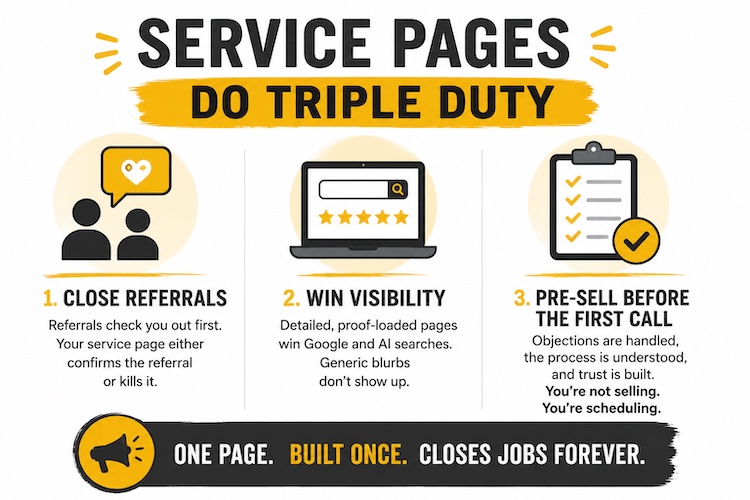 Service Pages Do Triple Duty
Most contractors think of service pages as an SEO play. They are. But that’s only a third of the story.
They close referrals. This is the big one nobody talks about. Referrals don’t call blind anymore — they check you out first. Your service page either confirms the referral or kills it.
They win Google and AI visibility. When a facility manager searches “warehouse floor lifting” — or asks ChatGPT who can fix a sinking commercial slab — the detailed, proof-loaded page wins. The generic blurb doesn’t show up at all.
They pre-sell before the first call. By the time the phone rings, objections are handled, the process is understood, and trust is built. You’re not selling. You’re scheduling.
The Bottom Line
A referral gets people to your website.
Your website decides what happens next.
Build dedicated pages for every service you offer — especially the big-ticket commercial work. Load them with real answers, real photos, real proof. Speak to the actual person reading the page.
Do it once. Then let that asset close skeptical, high-value jobs for years.
That’s not a marketing expense. That’s a machine.