
Concrete Lifting Social Media: Capture Every Job, Post Every Week
You’re already doing the hard part
Every week your crew pulls up to a sunken driveway, sidewalk or patio and leaves it level. That’s a small transformation, and it happens in front of you over and over.
Most of those concrete lifting jobs never get filmed. That’s understandable. You’re running a pump or a foam rig, managing a crew and getting to the next stop.
But it means the best marketing material your lifting company has is disappearing every day.
I was watching a Gary Vaynerchuk talk recently where he made two points that fit concrete lifting well. The place you work is your studio, and showing up often matters more than most people want to admit.
For a concrete lifting contractor, that comes down to two habits: capture every job, and post consistently.
Habit 1: Capture every lifting job
Gary built his name filming in his dad’s liquor store, with no microphone and no lighting. His phrase for it is that the store is the studio.
A concrete lifting job site is a better studio than a store. A slab visibly rises in a few minutes. Very few trades have a moment like that to film.
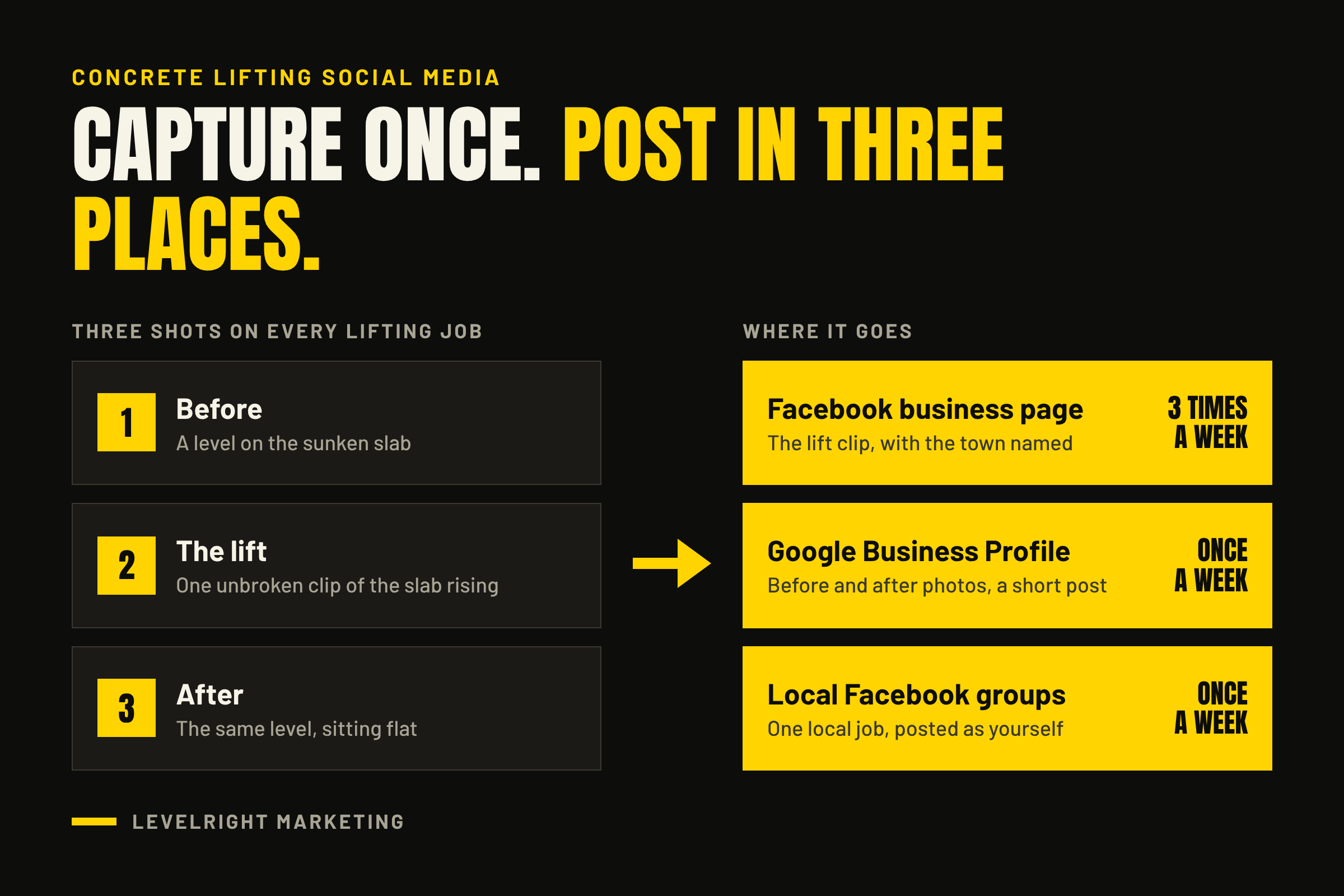
You don’t need a camera crew. You need the phone that’s already in your pocket and three shots:
- Before. A level on the sunken slab, showing the gap or the trip hazard.
- The lift. One unbroken clip of the slab coming up.
- After. The same level, sitting flat.
If you have another 20 seconds, add yourself explaining what caused the slab to settle.
Rough footage is fine. A slightly shaky clip of a real lift in a real neighborhood is more convincing than a polished stock video, because people can tell it’s your crew.
Make it someone’s job. Capturing works when one person on the crew owns it, the same way one person owns loading the truck.
Habit 2: Be consistent
Gary’s other point is that quantity is part of the equation. Each post is an at-bat, and you can’t predict which one your whole town ends up seeing.
For a concrete lifting company, consistency matters for a specific reason. Nobody plans to get their concrete lifted. A homeowner ignores a sunken slab for a couple of years, then one day someone trips on it.
You can’t know which week that is. So you want to be in front of the same local homeowners every week, lifting slabs on streets they recognize.
A rhythm you can keep beats a burst you can’t. Three posts a week, every week, does more than fifteen posts in one week followed by a quiet month.
If you’re capturing every job, you’ll never run out. A crew doing lifting jobs all week has more than enough footage for three posts.
What to post alongside your before and afters
Before and afters work. Keep posting them. They show the result, and the result is what people are buying.
Once you’re capturing every job, mix in what you know. You understand why concrete settles and homeowners don’t.
| Type of post | Example |
|---|---|
| Why it sank | The downspout that dumped water beside this slab for ten years |
| What’s underneath | The void under a patio before you filled it |
| How to keep it level | Sealing the joints and moving a downspout so water stays away from the slab |
| What to expect | What an estimate visit looks like, start to finish |
| Seasonal check | Three spots to look at around your house after a wet spring |
| Your crew and town | Who’s on the truck, and where you’re lifting concrete this week |
The “how to keep it level” posts build a lot of trust. Homeowners remember the concrete lifting contractor who helped them before there was anything to sell.
Where to post: start with what you own
One captured job can go to three places. Start with the two you control.
Your Facebook business page. This is home base. Every job you capture goes here first, with the town named in the post. When a homeowner hears about your concrete lifting company and looks you up, a page with fresh jobs from this month tells them you’re busy and still in business.
Your Google Business Profile. This is the one most lifters skip. People searching for concrete lifting near them see your profile before they ever reach your website. Add the before and after photos from each job, and put up a short post about it: what you lifted, which town, what caused it. Keep the post plain, a couple of sentences and a photo.
The same three shots feed both. Capture once, post twice.
| Where | What to post | How often |
|---|---|---|
| Facebook business page | The lift clip, before and after, a line about the job and town | Three times a week |
| Google Business Profile | Before and after photos, a short post about the job | Once a week |
| Local Facebook groups | One local job, posted as yourself | Once a week |
Take it to your local Facebook groups
Your business page reaches the people who already follow you. Local Facebook groups reach the rest of the town.
Most service areas have several: town and neighborhood groups, “what’s happening in” groups, and local recommendation groups. Homeowners in those groups are the same people who will need concrete lifting at some point.
A few ways to use them well:
- Read the rules first. Many groups limit business posts to one day a week or a single thread. Follow that and admins will leave you alone.
- Post as yourself. A post from a neighbor who owns a concrete lifting company lands better than one from a business page.
- Name the place. “We were on Maple Street in Elm Grove today lifting this sidewalk” gets attention because people know the street.
- Lead with the clip. The 20-second video of the slab rising does the work. Keep the text to a sentence or two.
- Answer questions. When someone asks who fixes a sunken driveway, reply with a short answer and a clip from a similar job nearby.
- Let customers tag you. Ask happy customers to mention your company when a neighbor asks for a recommendation.
Don’t paste the same post into ten groups on the same day. One group, one local job, once a week is plenty, and it keeps you welcome.
For the full walkthrough, read our guide to using Facebook groups for free local concrete lifting jobs.
Why this is worth the effort now
AI can write a decent article about polyurethane foam or mudjacking. So can everyone else’s.
It can’t produce your crew, your truck, or a sidewalk being lifted on a street your neighbors drive down. Real footage of real lifting jobs is yours alone, and it gets more valuable as generic content gets cheaper.
A week you can keep up with
Try this for one month:
- Capture three shots on every lifting job: before, the lift, after.
- Post three times a week on your Facebook business page, and put one of those jobs on your Google Business Profile.
- Make one post a week about why the slab sank.
- Once a week, share one job in a local Facebook group for the town you did it in.
If turning raw clips into something ready to post is what slows you down, that’s why we built LiftReel. It’s free. Upload your job photos or video, add your logo, and download a finished reel.
Capture the work you’re already doing and keep showing up. When a neighbor’s driveway sinks, they’ll already know who lifts concrete.

Josh Fulfer is the founder of LevelRight Marketing, a firm focused exclusively on helping concrete lifting companies generate more visibility & calls.
For over a decade, he has built lead-driven websites, studied how homeowners search, and worked directly with lifting contractors across the country. His approach is rooted in real customer behavior and real-world results.
If you run a concrete lifting company and want your website to work as a true sales tool, you’re exactly who LevelRight Marketing was built for.
📞 Call: (262) 600-2989