
Your Website Is One of the Most Cited Sources in Local AI Search
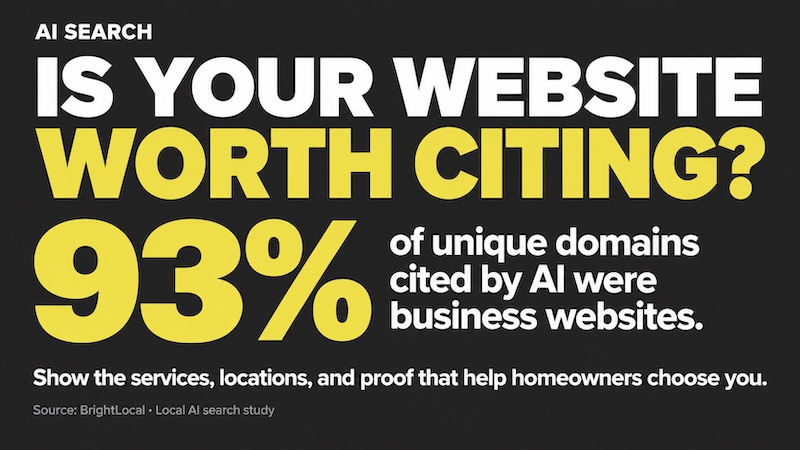
Here’s a number that should change how you think about your website:
Local business websites were cited 93% of the time in local AI searches.
Researchers looked at almost 2 million times that AI tools like ChatGPT and Google’s AI answers pulled information about local businesses.
They found two things that seem to disagree at first — but both are true at the same time.
- A few big websites, like Google Business Profile, get used over and over. So they make up a huge chunk of the total times AI pulls information.
- AND – About 93% of all the websites referenced were regular business websites.
Not directories. Not big platforms. Just normal companies’ own sites.
This means AI isn’t just checking your Google listing and moving on. It’s reading deep into real business websites to find answers. And it’s doing this a lot.
The data comes from a study by BrightLocal. You can see the full report at brightlocal.com/resources/ai-directory-sources. We’ve also written before about how AI is changing local search in general. This new data backs that up with hard numbers.
What the Numbers Actually Show
Here are the numbers worth knowing, and what each one tells you:
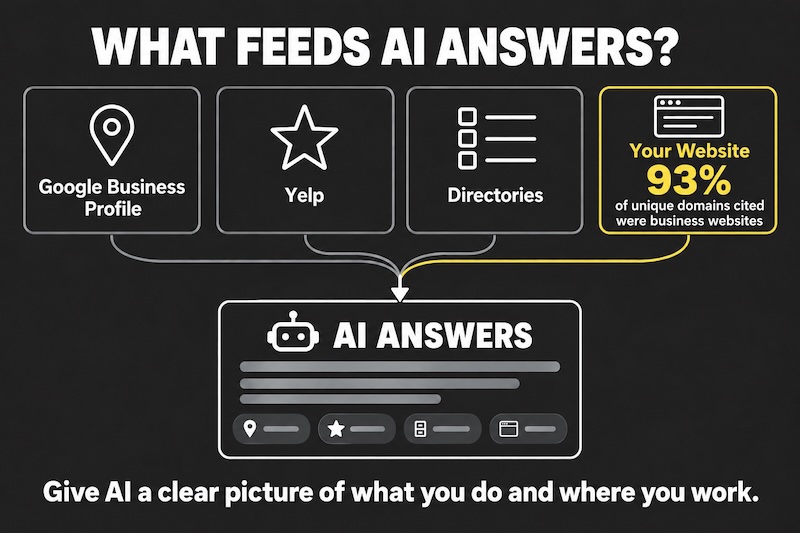
- Google Business Profile was used in about 28–29% of all citations across the whole study. That makes it the single biggest source by far. If yours isn’t fully filled out, that’s step one.
- Yelp came in second, at about 8–9% of all citations. It was actually the #1 source ChatGPT used specifically — showing up in most of ChatGPT’s local answers.
- Other directories showed up a lot too — BBB, Angi, MapQuest, Yellow Pages, HomeAdvisor, Thumbtack, and Houzz, etc. Each one is a smaller slice, but they add up.
- And here’s the big one again: 93% of searches cited regular business websites — not directories at all.
So here’s the short version: a small number of big platforms get picked constantly, which is why Google and Yelp lead the numbers. But once you look at every different site AI actually used, most of them are local business sites. That’s the part most contractors don’t know is happening.
 What This Looks Like for Businesses Like Yours
The 28–29% number above is an average across every kind of business in the study — restaurants, dentists, lawyers, plumbers, everyone. Restaurants pull that number down a bit, because they also use sites like OpenTable that don’t apply to a concrete lifting business. So it helps to look at the number just for service businesses, since that’s closer to what you do.
For service businesses specifically- like concrete lifting- Google Business Profile was used in about 45% of citations — a lot higher than the overall average. Yelp was next at about 12%, then Facebook at about 4%. After that, BBB, Angi, MapQuest, Houzz, Thumbtack, and HomeAdvisor each picked up a smaller share.
Why This Matters for Concrete Lifting
People don’t casually browse for a concrete lifting company. When someone asks an AI tool something like “who fixes sunken driveways near me,” they’re asking about a real problem they’re worried about. The AI is trying to give a specific, trustworthy answer — not just a random list of names.
A directory listing can tell AI that your business exists and roughly what you do. It can’t tell AI whether you handle sidewalk leveling, whether you’ve fixed pool decks before, or what your warranty covers. That kind of detail — the stuff that actually answers someone’s specific worry — usually only lives in one place: your website. And based on this data, that’s exactly where AI is looking for it.
This connects to something else we’ve written about: most concrete lifting companies are invisible for half the jobs they actually do. If a service or a problem you solve never made it onto your website, it doesn’t exist to AI — or to a homeowner searching online — no matter how many times you’ve actually done that job in real life.
What to Actually Do With This
None of this changes the basics. It just proves, with real numbers, why the basics matter.
Build Real Depth Into Your Own Website
This is the part the data makes hard to ignore. Build a page for every service you actually offer. Add real before-and-after photos. Explain the problems you solve, in plain language — trip hazards, sunken slabs, water pooling in the wrong spot. Add pages for every area you serve. This is exactly what we’ve talked about before when it comes to building a strong website. Now there’s real data showing AI rewards that kind of depth instead of ignoring it.
It’s worth treating your website like a lead-generating machine, not just a brochure. That machine is now doing double duty. It convinces homeowners directly, and it feeds AI tools the exact information they need to recommend you in the first place.
Fix Your Google and Yelp Listings First
These two still carry the biggest share of citations by a wide margin. If either one is missing information, unclaimed, or out of date, fix that before anything else.
Get Listed on the Directories That Actually Show Up
BBB, Angi, MapQuest, Houzz, Thumbtack, and HomeAdvisor aren’t old news. They’re still showing up as real sources in real AI answers. Being listed correctly on each one is still worth the time.
The Bottom Line
Directories get you on the map. Your own website is what fills in the real answer. With 93% of the different websites AI uses turning out to be regular business sites, the message is simple: a thin website doesn’t just lose you homeowners who land on it directly. It also makes you invisible to the AI tools more and more homeowners are asking first. Build the deep, detailed site. It’s doing more work than you probably realized.