
What The E-Myth Gets Right About Why Concrete Lifting Businesses Stall
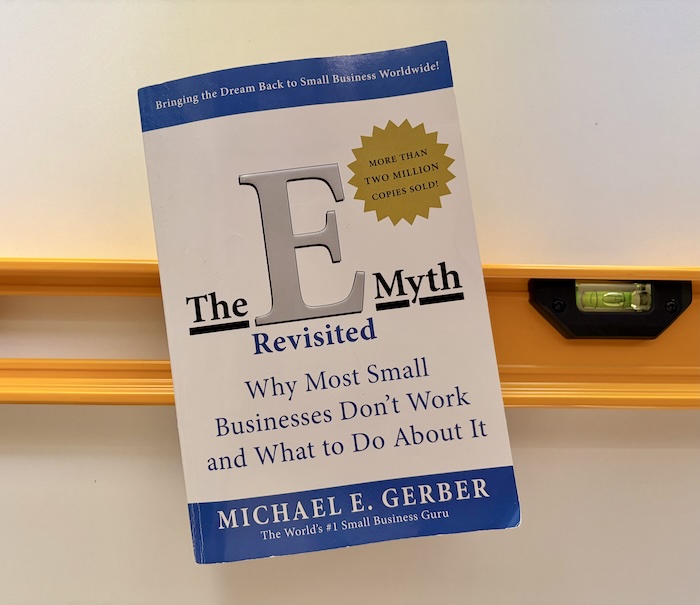 I just reread The E-Myth Revisited by Michael Gerber. First time in probably fifteen years.
It’s one of my favorite business books of all time, and I wanted to see how it hit now — after running my business over a decade, and after actually living through the stuff Gerber writes about instead of just reading it as a concept. It hit different. A lot different. And if you run a concrete lifting company, I think it’s one of the most useful books you could possibly pick up, so I wanted to break down why.
The Fatal Assumption
Gerber’s whole book starts from one idea, and it’s a gut punch if you’re a hands-on operator: most small businesses are started by someone who’s great at the technical work — and that person assumes that because they understand the work, they understand how to run a business that does the work.
Those are two completely different skill sets. Being the best guy in your market at reading a slab and pumping foam tells you nothing about how to price a job for profit, build a lead pipeline, hire and train a crew, or manage cash flow through a slow winter. It’s an incredibly common trap, and it’s not a knock on anyone who falls into it — it’s just what happens when passion for the craft turns into “I should start my own company.”
If you’ve ever felt like you’re amazing at the actual lifting but constantly underwater on everything else, that’s not a personal failing. That’s the fatal assumption, playing out exactly the way Gerber described it.
Three Roles Living Inside Every Owner
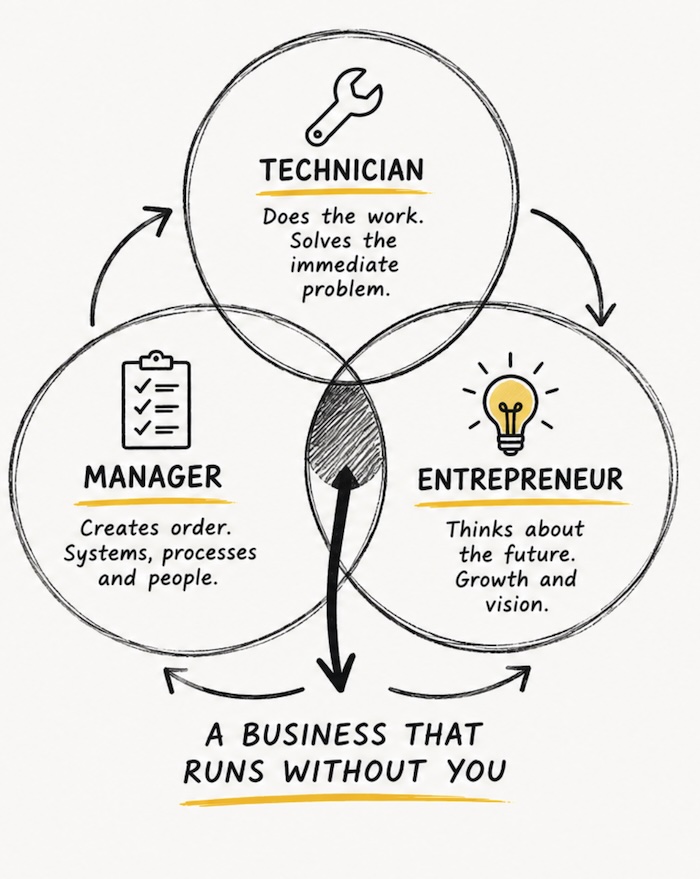 The framework that made this book famous is the idea that every business owner is actually three different people wearing one shirt, and most owners are wildly out of balance between them.
The Technician is the doer. The one who wants to be on the job, hands on the equipment, solving the problem in front of them right now. This is where almost every concrete lifter starts, and it’s the role that feels the most satisfying — because it’s the work you’re actually good at.
The Manager is the one who wants order. Schedules, systems, processes, follow-up. The Manager is the person who makes sure the business runs the same way whether or not you personally show up to it.
The Entrepreneur is the visionary. The one thinking about where the business is going, not just what job is next. The Entrepreneur asks “what does this business need to become” instead of “what do I need to do today.”
Most contractors are 90% Technician, a little bit Manager when they’re forced to be, and almost never Entrepreneur — because there’s no time left over once the Technician has eaten the whole day.
Working IN the Business vs. ON the Business
This is the line from the book that sticks with people the longest, and it’s the one that hit hardest on this reread. Working in your business means you’re the one doing the job — running the crew, pumping the foam, answering the phone between quotes. Working on your business means you’re building the thing that lets jobs get done without you personally touching every one of them.
Almost every concrete lifter starts entirely in the business, because there’s no other choice on day one. It’s just you, a rig, and a phone. The problem is when that never changes — when five years in, you’re still the one who has to be on every job, answer every call, and chase every invoice, because nothing was ever built that could run without you.
That’s not a bigger business. That’s the same one-person operation, just busier and more exhausted.
Build It Like You’re Going to Franchise It — Even If You Never Will
One of Gerber’s central ideas is what he calls the franchise prototype — the idea of building your business as if you were going to hand the exact blueprint to someone else and have them run it exactly the way you would, without you standing over their shoulder. You don’t actually have to franchise anything for this to be useful. It’s a discipline: document how you do things, so the business doesn’t live only in your head.
This is the exact idea behind something we’ve written about before — using your phone to film how you walk a customer through an estimate, how you set up your hoses, how you handle a tricky void fill — and turning your day-to-day into something a new hire can actually learn from. If you haven’t read it, we go deep on the practical side of this in How to Build a Team You Can Trust (And Get Off the Rig). Gerber gives you the “why.” That article gives you the “how.”
Where This Shows Up in a Concrete Lifting Business Specifically
A few places this plays out over and over in this trade:
The best installer becomes the owner, and never leaves the rig. The guy who was great at the technical craft starts a company, and five years later he’s still the one everyone waits on, because he never built anything that didn’t require him personally.
Nobody’s managing the business — because nobody has time to. Leads sit unanswered for a day because the owner was on a job. Follow-up doesn’t happen because there’s no system, just whoever remembers to do it. The Manager role never gets staffed, not even by the owner, because the Technician role ate the whole calendar.
There’s no real vision beyond “get through this week.” Without the Entrepreneur role getting any oxygen, the business never grows past what one exhausted person can personally carry. Marketing, pricing strategy, and expansion all stay theoretical because there’s no bandwidth to think about them.
Why This Matters to Me Specifically Right Now
Part of why this book hit different on the reread is that I’m actively trying to live it out with my own business — building LevelRight into something that runs on systems and a team that operates independently, with the goal of it needing a fraction of my time to keep moving, instead of all of it. That’s the Manager and Entrepreneur roles getting real attention instead of getting whatever’s left over after the Technician work is done. It’s a real shift, and it takes deliberate effort to make, not just wanting it to happen.
That’s exactly the shift Gerber is describing, and it’s exactly the shift most concrete lifting owners need to make too — not because working with your hands is a problem, but because a business that only works when you’re physically present isn’t a business. It’s a job you happen to own.
Where to Start
You don’t have to overhaul everything this week. Pick one thing you do constantly that only exists in your head right now — how you quote a job, how you answer the “we’re getting other quotes” conversation, how you train a new hire on the first day — and write it down or film it. That’s the Manager role, showing up for the first time in a while. Do that a few times, and you’ve started building the version of the business Gerber’s whole book is about: one that doesn’t disappear the day you’re not on site.
If it’s been a while since you read The E-Myth Revisited — or you’ve never picked it up — I’d genuinely put it on your list. Fifteen years later, it still holds up, and it might hit you differently depending on where you’re at in your own business right now.