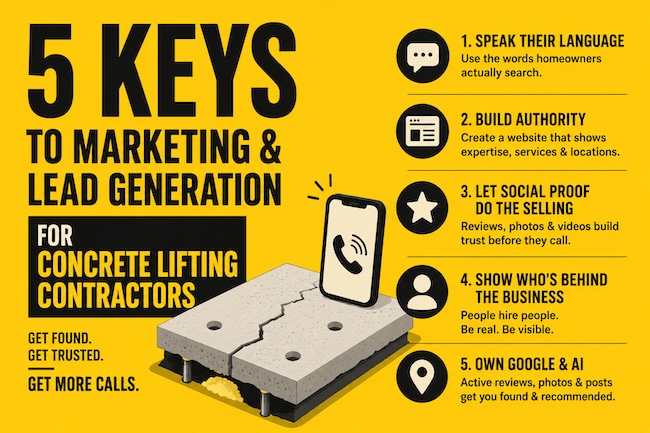
5 Keys to Marketing & Lead Generation for Concrete Lifting Contractors
 Every concrete lifting contractor wants more calls.
More estimates. More booked jobs. More revenue.
But most of the advice out there focuses on what happens after a customer calls — how to run the estimate, how to close the sale, how to price the job.
What about everything that happens before they call?
Because by the time a homeowner picks up the phone, a decision has already been made. They’ve Googled you. They’ve read your reviews. They’ve looked at your photos. They’ve formed an opinion about whether you seem trustworthy, professional, and worth calling.
The sale starts long before you show up.
Here are the five things that determine whether you win that invisible competition — or lose it to a competitor before you ever get a chance to speak.
1. Speak the Language of the Customers You Want to Reach
Most contractor websites have the same problem.
They’re written by contractors, for contractors.
They talk about polyurethane foam injection. High-density foam. Hydraulic pressure. The science of slab settlement and void formation beneath concrete substrates.
Your customers don’t know any of that. And they don’t care.
What they know is what they see standing in their driveway:
“My driveway is sinking.” “There’s a trip hazard by my front steps.” “My porch is pulling away from the house.” “Part of my patio is lower than the rest.”
Those are the words they type into Google. Those are the phrases they speak into ChatGPT when they grab their phone and ask “who fixes uneven sidewalks near me?”
A homeowner’s sidewalk is a trip hazard. They pull up ChatGPT and ask who fixes it. Your competitor gets recommended. You don’t. Not because they’re better at the work — because they have those words on their website and you don’t.
Here’s how Google and AI search both work at the most basic level: someone types or asks a question, and they look for websites that have those words. No words = no match = no recommendation.
This applies to locations too. If your website only mentions your home city, you only exist in one place on Google. Every town you serve but don’t mention? Invisible.
The fix is simple — but it requires actually building it. Service pages written around the problems customers describe. City pages for every market you serve. Content that uses the words real homeowners type into real search bars.
When your website speaks your customer’s language, you show up when they’re looking. When it doesn’t, your competitor does.
We broke this down in detail here: Your Website Can’t Rank for Words That Aren’t On It and What Homeowners Search Before Hiring a Concrete Lifting Company.
2. Build Authority Before You Arrive
Your website is your credentials.
Before a homeowner ever meets you — before they hear your voice on the phone or see your truck pull up — they’ve already formed an impression of your business based on what your website looks like and what it says.
A website with three pages and a contact form says: small operation, probably fine, nothing special.
A website with 40+ pages covering every service you offer, every problem you solve, and every city you serve says: this company knows what they’re doing, they’ve been around, and they take this seriously.
Most concrete lifting contractors have brochure sites. Home page. About page. Contact page. Maybe a services page that says something generic about “restoring your concrete surfaces to their original position.”
That’s not authority. That’s invisibility.
The contractors who consistently win the jobs — who get called first and close at higher prices — have built something. A website that functions as a lead generation machine, not a digital business card.
Think about what that looks like in practice:
- A page for every surface you lift — driveways, sidewalks, patios, pool decks, garage floors
- A page for every commercial application if you target that market — warehouse floors, factory floors, municipalities, assisted living facilities
- A page for every city and town you serve
- Content that explains how the process works, what causes concrete to sink, why lifting beats replacement
Each of those pages is a searchable asset. Each one is another door a customer can walk through to find you.
We’ve covered the difference between a brochure site and a lead generation machine in depth here: Brochure Website vs. Lead Generation Machine for Concrete Lifting and Why Small Concrete Lifting Websites Fail and Why You Need a Big One.
 3. Let Social Proof Do the Selling
Before a homeowner calls you, they Google you.
They read your reviews. They look at your photos. They check how recently someone left a review and what it said. They’re asking one question: has anyone else trusted this company — and were they happy?
This is social proof in action. And in concrete lifting, it does more selling than most contractors realize.
Think about what a homeowner is dealing with before they call. They’ve never heard of concrete lifting. The process sounds strange — drilling holes in their driveway and pumping material underneath it? They’re skeptical. They’re nervous. They need reassurance that this actually works before they’re willing to let you touch their property.
Reviews provide that reassurance. Before/after photos provide it. Job site videos showing the lifting process provide it. Testimonials from homeowners who went through the same skepticism and came out the other side happy — those provide it.
The contractor with 87 detailed reviews and a full photo library closes more jobs than the one with 12 reviews — even if the work quality is identical. That’s not unfair. That’s human psychology. People follow what others have already validated.
Every job you complete is an opportunity to add another proof asset. Ask for the review. Take the photo. Shoot the short video. Each one compounds.
We’ve written about building a proof system that works here: How to Build a Concrete Review System That Actually Works, 7 Proven Ways to Get More Google Reviews Without Feeling Pushy, and Why Video Testimonials Sell More Jobs Than You Ever Could.

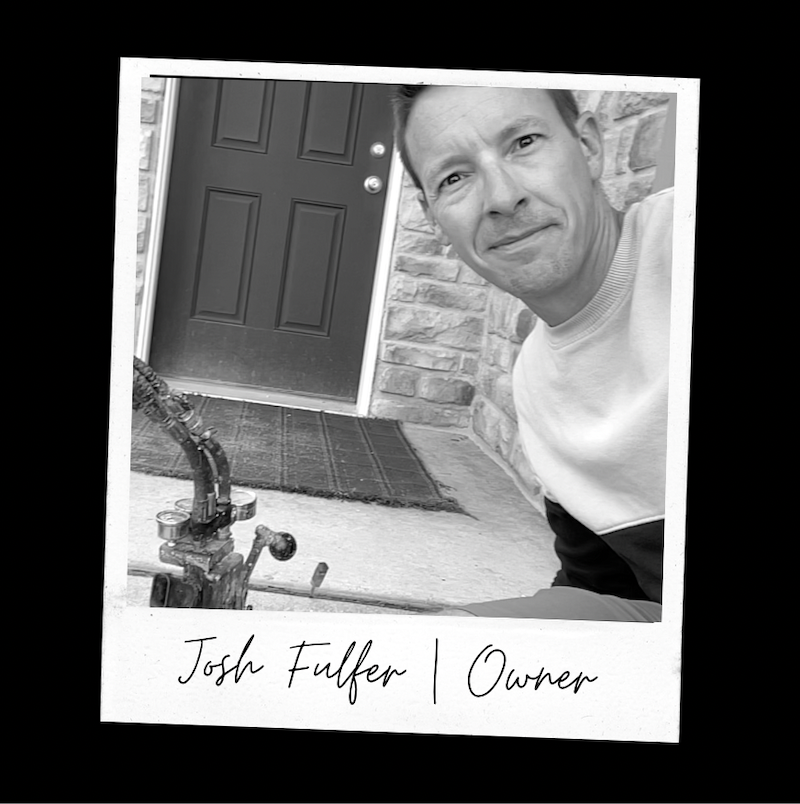
Josh & Angie Fulfer
4. Show Who’s Behind the Business
People don’t hire companies. They hire people.
When a homeowner is deciding between two concrete lifting contractors with similar reviews and similar pricing, they’re going to call the one they feel more comfortable with. The one who feels like a real person — not a faceless LLC with a stock photo and a generic tagline.
Your About page is one of the most visited pages on your website. And most contractor About pages are completely forgettable.
“We are a family-owned concrete lifting company serving the greater [city] area with over X years of experience and a commitment to quality and customer satisfaction.”
Nobody reads that. Nobody connects with it. Nobody picks up the phone because of it.
What actually works is showing up as a real person. Your photo — a real one, not a stock image. Your story — why you got into this business, what you care about, what you’ve learned. Your team. Your truck. Your face on the job site.
This extends beyond the About page too. A short intro video on your homepage. Photos of you on the job. Content that sounds like a person wrote it rather than a committee.
The contractor who feels human wins the call over the polished but faceless operation every time. Because liking is one of the most powerful forces in any buying decision — and people can’t like someone they’ve never seen.
We explored this concept in depth here: Your Realness is Your Brand and 7 Ways to Impress People Before You Even Show Up for a Quote.
5. Own Google and AI — Reviews and Recency Win
Google Business Profile is one of the most powerful — and most underused — tools a concrete lifting contractor has.
When someone searches “concrete lifting near me” or asks an AI assistant who lifts concrete in their area, Google Business Profile is one of the primary sources those results pull from. Your profile, your reviews, your photos, your posts — all of it signals to Google and AI whether you’re an active, credible, trustworthy business.
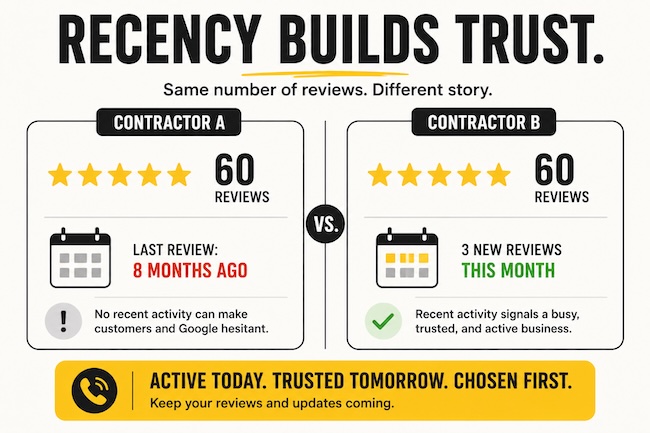
And recency matters more than most contractors realize.
A profile with 60 reviews and the most recent one from 8 months ago looks different than a profile with 60 reviews and three new ones this month. The active profile looks like a business that’s busy, current, and worth recommending. The dormant one raises questions.
Weekly proof posts — job photos, before/afters, short videos — keep your profile looking alive. They signal to Google that you’re active. They give AI search something recent and specific to pull from when someone asks who does this work in your area.
This is what building assets looks like in practice. A Google Business Profile with 100 reviews, consistent photos, and regular posts is an asset you own. It works while you’re on the job. It generates calls while you’re sleeping. It compounds over time in a way that paid leads never will.
The contractors who have built this out tell us the same thing: the phone rings from cities they rarely heard from before. From people who found them through AI search. From homeowners who said “I saw all your reviews and photos and you were the obvious choice.”
That doesn’t happen by accident. It happens because someone built something.
More on owning your Google presence here: How to Set Up a Google Business Profile for Your Concrete Lifting Company, Why How to Post Updates on Your Google Business Profile, and AI is Changing Local Search — Why Your Website Foundation Matters More Than Ever.
The Throughline: Build Assets, Not Dependencies
Every one of these five keys has something in common.
They’re all things you build once and compound over time.
A website with the right words keeps ranking. Reviews keep accumulating. Photos keep building your library. Your GBP keeps signaling trust. Your story keeps connecting with people who were on the fence about calling.
None of it requires writing a check every month to keep the leads flowing.
That’s the fundamental difference between a business built on assets and one built on paid leads. Assets work while you’re on the job. Assets work while you’re on vacation. Assets don’t stop when you stop paying.
The contractors who are booked out weeks in advance — who get called first and close at strong prices — didn’t get there by running ads. They got there by building something.
The five keys above are how you build it.
If you’d like to see what that looks like for a concrete lifting business in your market, start here.