
$195 a Day, Zero Ad Spend — What One Website Is Actually Worth
 Most concrete lifting contractors are stuck in the same loop: spend money to get a lead, spend more money to get the next one, and watch the cost per lead creep up every single year. The moment you stop paying, the leads stop coming. That’s not a marketing strategy — that’s rent.
There’s a different model, and it looks like this: a client of ours launched a new website six weeks ago. No ad spend behind it. Last week, he sent us this:
“Good morning Josh, I wanted to let you know I’ve been very happy with the website. We have been getting an average of 2-3 calls per day. Nice work!”
Two to three calls a day, from a site that isn’t costing him a dollar in ad spend to keep running. That’s not luck — that’s what it looks like when you own the asset instead of renting it. Here’s the math behind why that matters.
What 2-3 Calls a Day Is Actually Worth
If you’re buying leads instead of generating them, you’re paying somewhere around $65 a lead on average. So let’s price out what this contractor is getting for free every single day:
- 2 leads/day = $130/day in leads he didn’t pay for
- 3 leads/day = $195/day in leads he didn’t pay for
That’s $130-$195 a day showing up on its own. No ad account to babysit. No daily budget to adjust. No agency invoice tied to how many calls come in. Six weeks in, and this is already the new normal for his phone — right in line with what we’ve seen in our own six-week ranking update case study.
Most contractors stop the math right there and feel pretty good about it. They should. But that number is actually the floor — not the ceiling — of what this is worth.
But Lead Cost Isn’t the Real Payback — Jobs Sold Are
Here’s the part that math based on lead cost alone doesn’t capture: not all leads are equal, and these aren’t average leads.
A lead that comes from an ad click is someone who saw a headline and hit “call now” — often before they’ve decided whether they trust you, understand what you do, or even know what a fair price looks like. They’re calling three other companies right after they call you.
A lead that comes from a site that’s actually done its job — one that answered their questions before they ever picked up the phone — is a different kind of lead entirely. They already know what causes concrete to settle. They already understand how the process works, roughly what it costs, and why it beats tearing everything out and pouring new concrete. By the time they call, they’re not shopping. They’re confirming.
Those leads close at a meaningfully higher rate. And when a $65 lead turns into a $3,000-$5,000 concrete lifting job, the real payback isn’t measured in lead cost avoided — it’s measured in jobs sold. One closed job from a well-qualified lead can cover a huge chunk of what the entire website cost to build — sometimes a job as large as the one service page that closed a 40,000 sq ft warehouse job.
That’s why the true payback period on a site like this is almost always faster than the lead-cost math alone suggests. You’re not just saving what you would’ve spent on ads for an equivalent lead — you’re winning better jobs, faster, at a higher close rate, and you’re doing it with a marketing asset that didn’t cost you a dime this month.
Why “Just Run More Ads” Isn’t the Same Answer
A lot of contractors hear a story like this and think, “great, I’ll just spend more on Google Ads and get the same result faster.” But that’s a different business model, not a faster version of the same one.
With ads, the leads stop the moment the spend stops. There’s no equity being built — you’re paying rent on visibility every single day, and the landlord — the ad platform — can raise that rent whenever it wants. We’ve watched Google Ads costs climb 20%+ a year for concrete lifting keywords. Every year, the same lead costs more. Every year, your margin on paid traffic shrinks a little more, even if your close rate stays exactly the same. We broke this comparison down in more detail in SEO vs. Google Ads for concrete lifters.
With an owned site, it works the opposite direction. Every month it’s live and ranking, it’s building authority that makes the next month easier, not harder — more pages indexed, more reviews collected, more local signals stacked up, more content answering more of the questions your next customer is going to ask before they’ve ever heard of you. The asset compounds. The ad spend doesn’t.
That’s the real difference between marketing that’s an expense and marketing that’s an asset. An expense disappears the moment you stop paying for it. An asset keeps producing whether you touch it or not — the same idea we get into in why concrete lifting contractors should stop renting their leads and start owning them.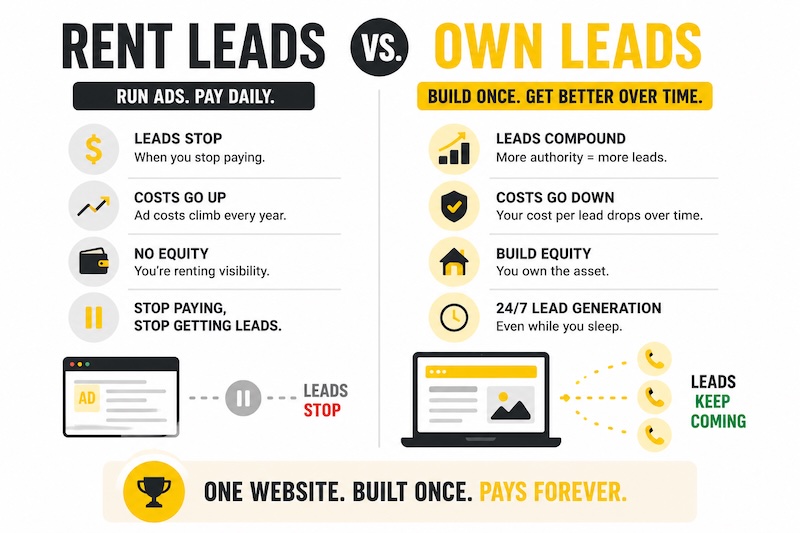
How We Actually Did It
This wasn’t a redesign for the sake of a fresh coat of paint. The site started as a small, brochure-style page — a few sentences about the business, a phone number, and not much else. We rebuilt it into a full lead generation asset from the ground up, the same way we break down the difference in brochure website vs. lead generation machine.
That started with sitting down with the real questions and objections that homeowners actually have before they’ll trust someone to lift their slab: What’s causing this? Is it going to happen again? How long does the process take? Is it messier than it sounds? Is this cheaper than tearing it out and pouring new concrete? Is this contractor even legit? Every page on the new site was built to answer one of those, not just to look nice sitting there — the approach we outline in turning objections into assets.
We also layered in strategy for how people are searching today — including how AI-powered search tools and chat-based assistants surface and summarize local contractors when someone asks “who does concrete lifting near me.” That’s a newer piece of the puzzle, and most contractor websites aren’t built with it in mind at all. It’s a shift we cover in how AI search is changing the way homeowners find contractors.
Alongside that, we handled the fundamentals that actually get a site ranking in the first place: site structure, page speed, local signals like Google Business Profile alignment, and content that matches what homeowners are actually typing into search — not just what sounds good in a sales pitch. Those fundamentals are the same ones we walk through in 5 keys to marketing and lead generation for concrete lifting contractors.
None of that is guesswork. It’s built on more than 10 years of developing websites specifically for concrete lifting contractors — not a general web agency dabbling in a niche it doesn’t understand, but a process refined by doing this exact work, in this exact industry, for over a decade.
The Real Takeaway
This isn’t a story about one lucky contractor. It’s what happens when you stop renting your leads and start owning the asset that generates them — we’ve seen it play out the same way with clients like the one behind this concrete lifting website that’s still producing without ads.
Six weeks in, this client is already getting calls that would’ve cost him real money to buy — and closing jobs off leads that came in already sold on why he’s the right call. That’s not luck. That’s what a website is supposed to do when it’s actually built to sell, not just built to exist.
Whether the payback ends up being measured in months or in a single closed job, the direction is the same either way: every dollar of value this site produces from here forward didn’t come out of a monthly ad budget. It came from a page that was built once, built right, and left to keep working.
Want to know what your market’s version of this looks like? Let’s talk about what an owned lead gen asset could do for your business.