How to Sell Your Warranty as a Closing Tool for Concrete Lifting
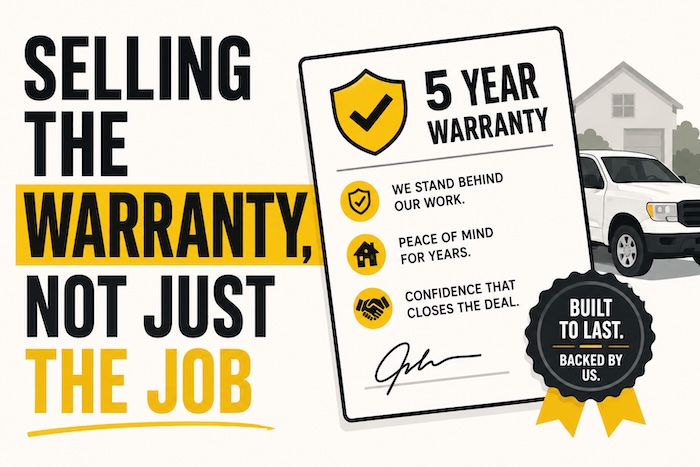 Two contractors quote the same job. Same price, give or take a hundred bucks. Same estimated timeline. One mentions a warranty almost as an afterthought — “yeah, it’s covered, don’t worry about it.” The other looks the homeowner in the eye and says, “Here’s exactly what’s backed for the next five years, and here’s what that actually means for you.”
Same job. Same price. But the second contractor just won, and it usually isn’t close.
Most guys in this trade treat the warranty like fine print — something that exists in case a homeowner asks, buried at the bottom of the paperwork. That’s a missed opportunity. Your warranty isn’t a legal formality. It’s one of the strongest trust signals and closing tools sitting right in front of you, and most contractors never actually sell it.
Why the Warranty Does More Work Than the Price
Homeowners can’t verify the quality of a lift once the foam’s cured and the crew’s packed up. They can’t see the void underneath. They’re trusting your word on something they’ll never personally inspect. In that situation, a strong warranty isn’t just a safety net — it’s proof of confidence. It tells the homeowner: “I believe in this work enough to put my name behind it for years, not just until the truck leaves the driveway.”
That’s a fundamentally different message than price. Price says “here’s what this costs.” A warranty says “here’s what I’m willing to stand behind.” Homeowners respond to the second one on a gut level, especially when they’re already nervous about hiring someone for a job they don’t fully understand. It’s part of the same instinct we covered in The Halo Effect — homeowners are constantly reading small signals to decide whether they trust you, and a confidently-stated warranty is one of the strongest signals you can give them.
What Warranties Actually Look Like Across the Trade
There’s a real range out there, and it tends to track with how competitive a given market is. Some contractors — usually in less competitive areas, or newer operations still building confidence in their own process — offer as little as 2 years. The more common middle ground across the trade is 3 to 5 years. And in markets with real competition, where a handful of established players are all fighting for the same jobs, you’ll see contractors pushing warranties out to 10 years as a way to separate themselves.
None of these numbers are “right” or “wrong” in isolation. What matters is how your warranty compares to what else is being quoted in your specific market, and whether you’re actually using it as a selling point or just letting it sit in the paperwork.
The Math That Makes a Longer Warranty an Easy Call
Here’s the part most contractors underestimate: the real callback rate on lifting work, once you’re a few years out, tends to run low — often somewhere around 3% or less. The vast majority of jobs done right simply don’t come back. That means a longer warranty isn’t the financial risk it feels like on paper. You’re not signing up to redo one in twenty jobs. You’re signing up to redo a small handful, in exchange for a trust signal that helps you win a much larger share of the jobs you’re quoting in the first place.
If extending your warranty from 3 years to 5, or 5 to 7, costs you almost nothing in actual callbacks but helps you win more jobs at your price instead of losing them to the guy who talked about warranty length more confidently — that’s not generosity. That’s just good math, and it’s the same principle behind knowing your worth instead of undervaluing your services: a stronger guarantee is a way to justify your price, not undercut it.
How to Actually Sell It (Instead of Just Offering It)
Having a good warranty and selling a good warranty are two different things. Most contractors do the first and skip the second entirely.
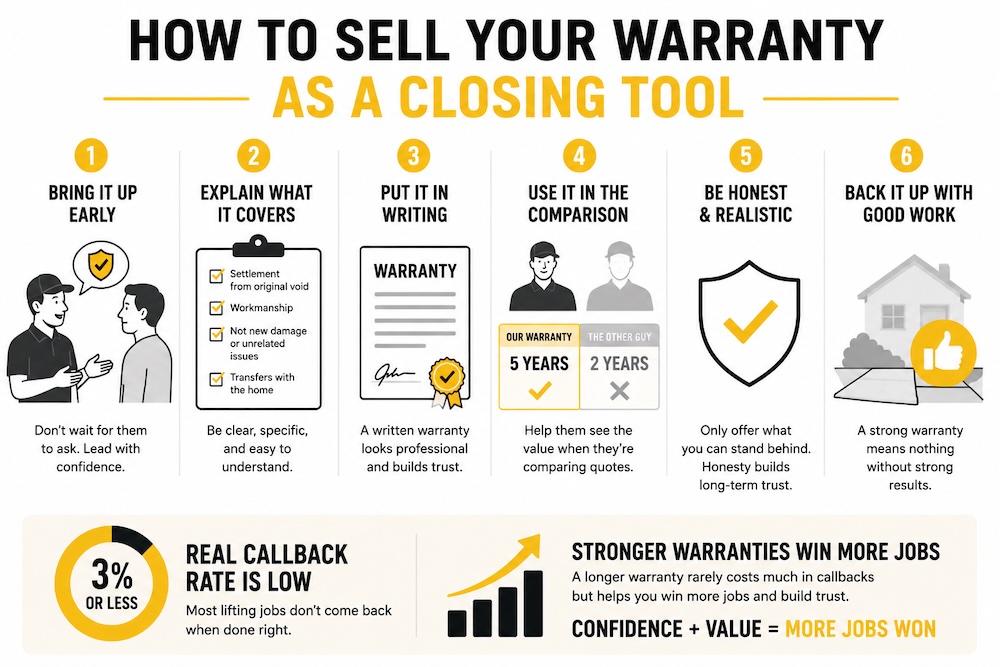
Bring It Up Before They Ask
Don’t wait for a homeowner to ask “is this covered?” Say it early in the walkthrough, plainly: “Everything we do here is backed by a 5-year warranty — if this settles again from the same issue within that window, we come back and make it right, no charge.” That single sentence, said with confidence before the price ever comes up, does more to build trust than almost anything else you’ll say on the estimate.
Explain What It Actually Covers
Vague warranty language creates doubt, not confidence. Be specific: what’s covered (settlement from the original void, workmanship), what isn’t (new damage, a different area of the slab, issues caused by something unrelated like a tree root or a plumbing leak), and whether it transfers if they sell the house. Homeowners trust specifics. They’re skeptical of “yeah, it’s covered” with no detail behind it.
Put It in Writing, and Make the Document Look Like It Matters
A warranty that lives only in a verbal promise doesn’t carry the same weight as one that’s printed, clear, and handed over at the end of the job. It doesn’t need to be complicated — a clean one-page document with your terms, your contact info, and your signature does more for trust than a line buried in a contract’s fine print.
Use It Directly in the Multi-Quote Conversation
When a homeowner tells you they’re comparing quotes, your warranty is one of the sharpest things you can point them toward. “When you’re comparing, ask the other guys how long their warranty runs and what’s actually covered” does real work here — because a lot of price differences in this trade come down to exactly that, and most homeowners have never thought to ask until you tell them to.
Don’t Oversell What You Can’t Back
None of this works if the warranty is hollow. Only offer terms you can actually honor, and be straight about what triggers a callback versus what doesn’t. A warranty that gets disputed or denied when a homeowner actually needs it does far more damage to your reputation than a shorter, honest warranty ever would. The whole value of this as a trust signal depends on it being real.
The Bottom Line
Your warranty is doing more selling work than you’re giving it credit for — or it could be, if you started treating it that way. The real numbers are on your side: callback rates are low, so a stronger warranty rarely costs you much in actual redo work, but it consistently helps you win the jobs where a homeowner is nervous, comparing quotes, or just needs one more reason to trust you over the next guy. Stop burying it in the paperwork. Lead with it.