You’re Only Reaching 5% of Your Market
Most concrete lifting websites are built for people who already know what concrete lifting is.
That’s a problem. Because those people are a tiny slice of your market.
Here’s what I mean.
The Iceberg Nobody Talks About
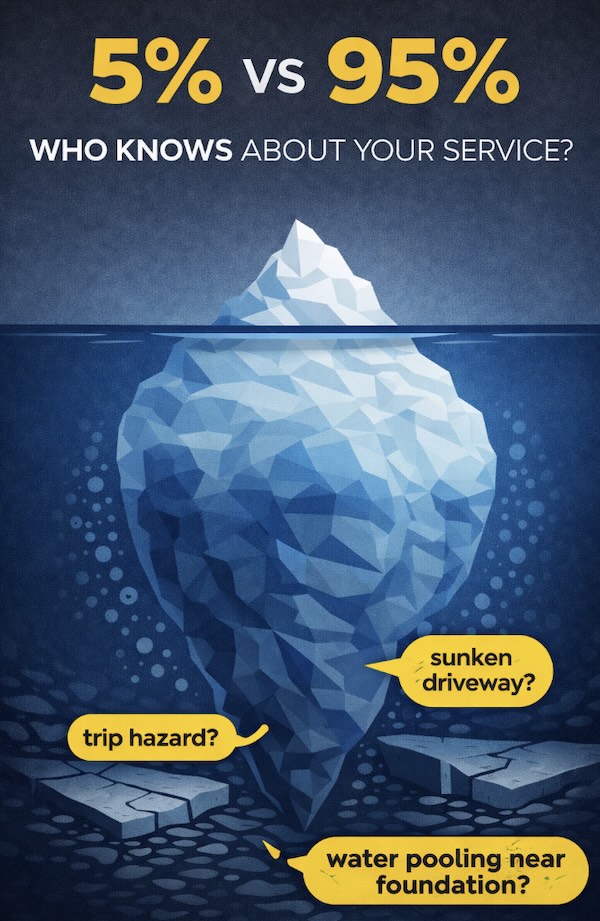
Picture an iceberg. The tip above the water — that’s about 5% of your market. These are the people who already know what concrete lifting is. They’ve already Googled “concrete lifting near me” or “mudjacking cost.” They’re ready to buy. They just need to find the right company.
That’s who most contractor websites are built for.
But everything below the surface? That’s the other 95%. These are homeowners who have a real problem. Their driveway is uneven. Their patio is sinking. Water is running toward their house after every rain. There’s a crack in their sidewalk that keeps growing. Their garage floor is separating. They’ve got a trip hazard on their front walkway that they’re embarrassed about — or worse, scared someone’s going to fall.
They have the problem. They just don’t know concrete lifting exists.
And if your website only talks about “concrete lifting” and “polyurethane foam injection,” you are invisible to them. Completely invisible.
What These People Are Actually Typing Into Google
They’re not searching “concrete lifting.” They’re searching things like:
- “sunken driveway repair”
- “water pooling next to my house foundation”
- “uneven sidewalk fix”
- “why is my patio sinking”
- “trip hazard on walkway”
- “garage floor crack getting worse”
- “how to fix concrete that’s settled”
They describe what they see. What they feel. What they worry about.
If your website doesn’t have content that speaks their language — their words, their problems, their fears — Google won’t show you to them. And neither will AI search tools like ChatGPT or Google’s AI overviews, which are pulling answers from the same content.
The Real Growth Is Below the Surface
Here’s the truth most contractors miss: the tip of the iceberg is competitive. Everyone is fighting for those “concrete lifting” and “mudjacking” searches. You’re bidding against other experienced companies who’ve been doing this a long time.
Everything below the surface? Way less competition. And way more potential customers.
Think about how many homeowners in your market right now have a sunken sidewalk. A settled patio. A driveway with a 2-inch drop between slabs. Water sheeting toward their foundation after it rains. Those people exist in massive numbers — and most of them have no idea concrete lifting is an option. They don’t even know to look for it.
If your content speaks to their exact problem — in their words — you show up where nobody else does.
That’s asymmetric growth. You’re reaching people that most of your competitors don’t even know exist.
What “Speaking Their Language” Actually Looks Like
It’s not just about keywords. It’s about reflecting the exact situation they’re in.
Imagine a homeowner standing in their backyard after a rainstorm. The water isn’t draining away from the house — it’s running toward it. They’re thinking: Is this going to hurt my foundation? Should I be worried? How do I fix this?
That’s the moment you want to show up for.
A page that says “Concrete Lifting and Leveling Services” doesn’t help them. But a page that says “Sunken Patio Letting Water Run Toward Your House? Here’s What’s Happening” — that page pulls them in.
Same thing for:
- A grandmother who trips on the lifted edge of her front sidewalk every time she comes home
- A homeowner who’s embarrassed by the cracked, uneven driveway before guests arrive
- A business owner whose customers have to navigate a dangerous walkway to get to the front door
- A new homeowner who noticed the garage floor dropping and doesn’t know if it’s serious
Each of these is a different visual. A different fear. A different version of the same problem.
Your website and content need to show up in all of them.
Why Your Website Is More Powerful Than You Think
Your website isn’t just a digital business card. It’s a 24/7 lead machine.
When it’s built right — with the right pages, the right language, the right photos and proof — it reaches people at every stage of the problem awareness journey. From “what is that crack in my driveway” all the way to “I need someone out here this week.”
But it only works if the content is actually there.
That means:
Content that reflects the problem — not just the solution. Pages built around sunken driveways, trip hazards, water drainage issues, settling patios. Real problems described in plain language.
Photos and videos that show the before — the cracked slab, the pooling water, the sunken step. People recognize their own problem when they see it.
Proof that the fix works — before-and-afters, case studies, ranking results, customer reviews. The kind of evidence that turns a skeptic into a booked job.
Language written at the level people actually read — simple, clear, and human. Not technical jargon. Not industry language. Like you’re explaining it to a neighbor over the fence.
When those pieces are in place, your website starts working for the 95% below the surface. It starts reaching people who didn’t even know concrete lifting was an answer to their problem.
The Bottom Line
Targeting “concrete lifting” searches alone isn’t a growth strategy. It’s a survival strategy. You’re competing for a small, known pool of buyers — and hoping to get your share.
Real growth comes from reaching people before they know the answer exists.
That means content built around problems. Language that mirrors what a homeowner sees and says. Photos that make them think, that’s exactly what my driveway looks like. Pages that show up when they search for their symptom, not your service.
The iceberg is real. The tip is crowded.
The opportunity is everything below the surface.
Want to talk about how your website is set up to reach both groups? Let’s look at where you’re showing up — and where you’re not. Schedule a call →