
The Number That Makes Your Price Look Small — Anchoring for Concrete Lifters
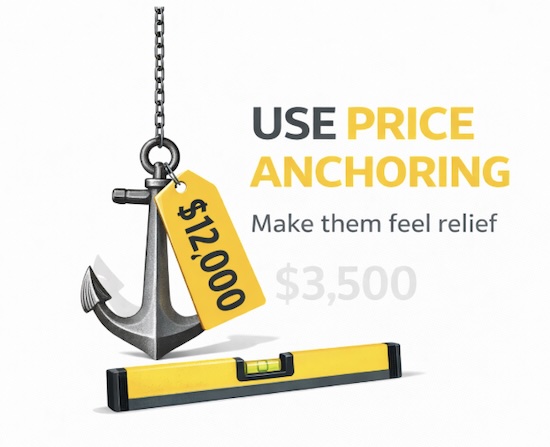 There’s a psychological principle that the best salespeople in every industry use, usually without even realizing it. It’s called price anchoring. And once you understand how it works — and how to use it deliberately on every estimate you run — it changes the way homeowners react to your number.
Here’s the short version: the first significant number a person hears sets the frame for everything that follows. If the first number they hear is $14,000, your $3,500 quote doesn’t sound expensive. It sounds like a deal.
Concrete lifting might be the single best industry in the trades for using this principle — because you have a natural, honest, legitimate anchor sitting right there on every job site. It’s called concrete replacement. And most homeowners have no idea what it costs until you tell them.
Why Replacement Is Your Best Sales Tool
Before you quote a single dollar of your lifting price, ask the homeowner a simple question: “Have you gotten any quotes for replacement?”
Most haven’t. They called you because someone told them about lifting, or they found you online, or they just wanted to explore options. They don’t know what replacement costs. They don’t know the disruption involved — the demo, the haul-off, the forms, the cure time, the landscaping damage, the weeks before they can use their driveway again.
So tell them. Not to scare them. Not to manipulate them. Just to inform them — because they genuinely need to understand the full picture to make a smart decision. We have a whole guide on how to explain concrete lifting vs replacement to homeowners if you want a framework for this conversation.
“Just so you have context — concrete replacement in this area typically runs between $12,000 and $18,000 for a driveway this size. It takes several weeks from start to finish, you can’t use it during that time, and the demo alone is a significant project. What we do is different. We’re in and out in a few hours, same-day use, no demo, and a fraction of the cost.”
Now your price lands inside a completely different frame. You’re not the expense. You’re the relief.
The Three-Option Menu and Why It Works
Anchoring gets even more powerful when you present options — specifically, when you lead with your premium option first.
Top concrete lifting operators structure their estimates with three tiers: a premium option at the high end, a mid-range option that includes everything most homeowners actually want, and a basic option at the entry level. The premium option isn’t there because most people will buy it. It’s there because of what it does to the perception of everything below it.
When a homeowner sees a $5,500 premium package — lifting, joint sealing, surface sealing, full warranty — and then sees a $2,800 mid-range option right below it, the mid-range suddenly looks reasonable. Maybe even smart. The same $2,800 quote presented in isolation, without that anchor above it, feels much more expensive. The number hasn’t changed. The frame has.
Most homeowners end up on the mid-range or mid-range-plus option. They feel like they made a savvy decision — got the good stuff without going overboard. You closed a better ticket than you would have if you’d just quoted the lift alone. Everyone wins. If you want to go deeper on the add-ons that make the premium tier worth it, this piece on upsells that add real profit is worth reading.
The basic option at the bottom serves a purpose too. It makes the mid-range look like the safe, sensible choice. And it gives you a floor — something to offer the rare customer who genuinely needs the lowest possible number to say yes. You’re not leaving anyone behind, but you’re also not letting price-sensitive buyers drag your whole book of business down.
 The Dirty Secret Nobody Talks About: Competitors Anchoring Against Each Other
Here’s where it gets a little messier — and where you need to be aware of what’s happening in your market.
Poly guys and mudjacking guys don’t just compete on price. Sometimes they compete by tearing each other down in front of the customer. And it’s more common than most people want to admit.
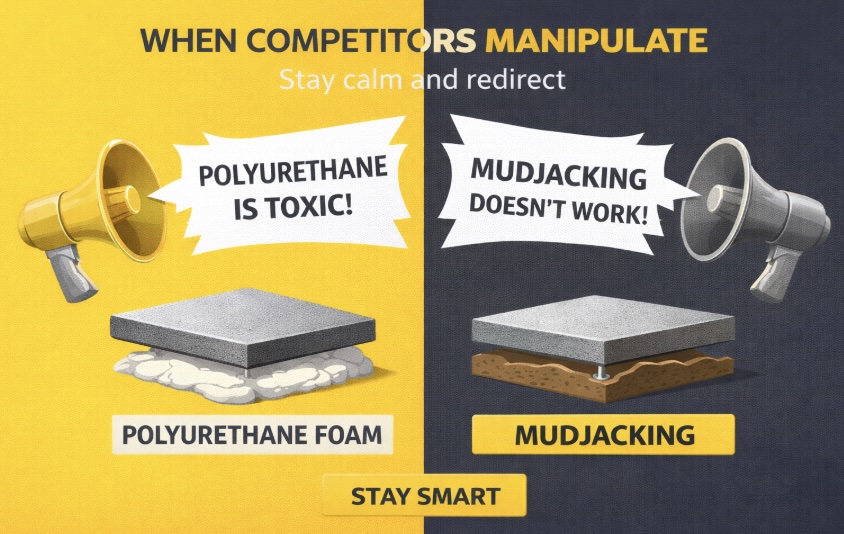
You’ve probably heard versions of this. A mudjacking contractor tells a homeowner that polyurethane foam is toxic. That it’ll leach chemicals into the soil. That it’s not safe near gardens or water. None of that is true for the materials used in professional concrete lifting applications — but a nervous homeowner doesn’t know that, and a well-timed warning from the guy standing in their driveway lands hard.
On the other side, poly guys sometimes tell customers that mudjacking doesn’t work. That the material is too heavy, that it’ll just sink again, that it’s old technology that’s been replaced for a reason. Some of that has legitimate merit in certain soil conditions and applications — but it gets weaponized as a blanket dismissal to win jobs, which isn’t honest either.
Mudjacking guys say poly is too expensive and just a trend. Poly guys say mudjacking is outdated. And both sometimes imply the other is basically incompetent.
This is bad for everyone in the industry — including you, even if you’re not the one doing it. And it often backfires — homeowners can smell desperation. We wrote about why both methods have a legitimate place and how understanding that makes you a better salesperson.
How to Handle It When a Competitor Has Already Been There
If you show up to an estimate and the homeowner says “the last guy told me polyfoam is toxic” — or “the other company said mudjacking never holds” — you have a choice in how you respond.
The wrong move is to fire back and make it a he-said-she-said situation. Homeowners hate that. It makes them feel like they’re stuck in the middle of someone else’s argument, and it erodes trust in everyone involved, including you.
The right move is to stay calm, stay factual, and redirect to what matters.
“I can’t speak to what they told you, but I can tell you what I know. The materials we use are EPA-compliant and used extensively in commercial and municipal applications. I’d be happy to show you the product data sheet if that would help.” Then move on. Don’t dwell. Don’t escalate.
The contractor who stays above the noise almost always wins the job. The one who gets defensive or retaliatory almost always loses it — even if they’re technically right.
The truth is, both poly and mudjacking are legitimate solutions. They have different strengths, different ideal applications, different price points. A professional knows when each one is the right tool and can explain that clearly. That kind of confidence is its own form of anchoring — it positions you as the expert in the room, which is exactly where you want to be.
Anchoring Works Before They Ever Call You Too
This isn’t just a job site technique. It applies to your website and your marketing as well.
When a homeowner lands on your site after searching “sunken driveway repair,” they’re usually starting from zero. They don’t know if this costs $500 or $50,000. The first number they encounter — even a ballpark, even a range — sets their expectations for everything that follows.
That’s why smart concrete lifting websites address replacement cost early. Not to scare visitors off, but to establish context. A line like “concrete replacement typically costs $10,000–$20,000 or more — lifting is a fraction of that, done in hours, not weeks” does a lot of psychological work before anyone picks up the phone. By the time they call, the anchor is already set. Your price makes sense before you’ve even said it.
This is the same principle behind why customers buy what they feel, not just your price — the emotional and contextual setup matters as much as the number itself.
What Good Anchoring Is Not
Worth saying clearly: anchoring is not manipulation. It’s not inflating a fake premium price to make your real price look better. It’s not scaring homeowners with worst-case replacement estimates that don’t reflect reality.
The replacement numbers you use should be accurate for your market. The premium option you present should be a real service you actually offer at a real price. The goal isn’t to trick anyone — it’s to make sure homeowners have the full picture so they can make a genuinely informed decision.
When you do it right, anchoring actually builds trust. Because you’re the one who gave them context they didn’t have before. You’re the one who walked them through their options without making them feel pressured. And you’re the one whose number made sense once they understood the whole landscape.
That’s not a sales trick. That’s just being a good communicator — and a professional who respects the person standing in front of them.
The Bottom Line
Concrete replacement is your silent sales partner on every estimate. Use it. Quote the replacement cost first, honestly and accurately, before you ever mention your number. Structure your options with a premium anchor at the top. Stay above the competitive mud-slinging — literally and figuratively. And carry that same framing onto your website so the anchor is set before the call even happens.
Your price isn’t the problem. The frame around it is. Fix the frame, and the price takes care of itself.
If you want to go deeper on how this connects to the emotional side of the sale — why people buy and what actually closes jobs — the Hot Sauce Why is worth reading alongside this one.
Want to talk about how your website and sales process can work together to bring in better leads and close more jobs? Let’s get on a call →