
Why Setting Expectations is the Most Underrated Skill in Concrete Lifting
 My parents are building a new house.
Top builder in the area. Great reputation. Not a cheap build.
They’ve been excited about this project for months. New floor plan, new neighborhood, everything they’ve wanted.
But as construction moves along… they keep noticing things.
Little issues. Stuff that doesn’t look right.
A wall that seems uneven. A window that doesn’t look flush. Gaps where there shouldn’t be gaps.
Now — most of it will probably get fixed before the project is done. That’s just how new construction works. Things get rough-framed, adjusted, finished. The process is messy before it’s clean.
But nobody told them that.
So instead of trust… there’s anxiety. Instead of excitement… there’s doubt.
They’re questioning the builder. Second-guessing decisions. Wondering if they made the right call — not because anything is actually wrong, but because nobody prepared them for what the process looks like in the middle.
Same builder. Same quality. Same end result.
Completely different experience — because expectations were never set upfront.
This Happens in Concrete Lifting Every Single Day
Most contractors don’t realize it’s happening until it’s too late.
A homeowner calls. You show up to do the estimate, the job looks straightforward, and you get to work.
Then the questions start.
“Are you going to drill holes in my driveway?”
Yes. That’s how it works. But if you didn’t tell them beforehand, that drill hitting concrete sounds like a problem.
“Is this going to crack my concrete?”
No. But if they’re watching for the first time and don’t understand the process, every sound and movement looks like damage.
“That crack wasn’t there before…”
Maybe it was. Maybe it wasn’t. But if they’re already nervous and they notice something mid-job, you’re now on defense.
“What is that sound?”
The pump. Running normally. But to a homeowner who’s never seen this process, it sounds alarming.
“Is that stuff supposed to be coming out of the cracks?”
Yes. That’s the material doing its job. But it looks wrong if nobody told them to expect it.
Every one of those moments is avoidable.
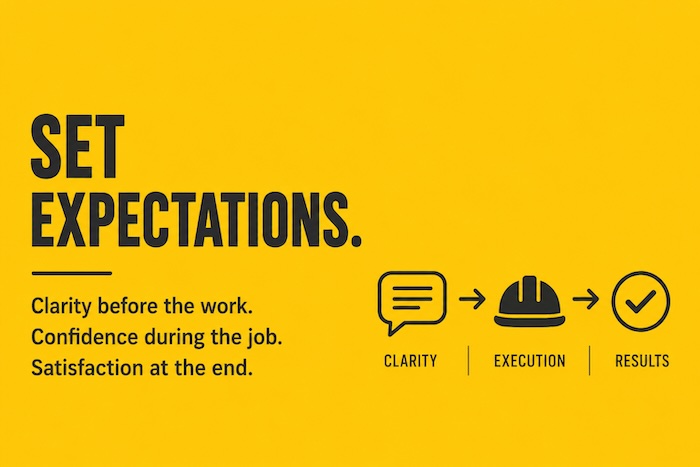
Not with better technique. Not with better equipment. With a better conversation — before the job starts.
The Real Cost of Skipping the Pre-Job Walkthrough
Most contractors think the sale is closed when the customer says yes to the estimate.
It’s not.
The sale gets re-evaluated every single time something happens on the job that the customer didn’t expect.
Each unexpected moment is a micro-doubt. A small erosion of trust.
One or two of them — no big deal. But stack enough of them together, and by the time you’re done, a customer who was happy when you started is now lukewarm. They’re not sure how they feel. The work looked good, but the experience felt off.
And when it comes time to leave a review?
They hesitate. They leave three stars instead of five. They say something like “the work was fine but…” — and that “but” costs you the next ten jobs that read it.
You did everything right technically. You just skipped the conversation.
What a Pre-Job Walkthrough Actually Looks Like
This doesn’t have to be a production. It’s not a presentation or a sales pitch. It’s five minutes before you start — walking the customer through what they’re about to see and hear.
Here’s what that sounds like:
On the drilling: “We’re going to drill some small holes through the concrete — usually about the size of a quarter. When we’re done, we’ll patch those so they blend in as well as possible. You’ll hear the drill, which can be loud, but it goes fast.”
On the pump: “You’re going to hear the pump running throughout the job. That’s completely normal — that’s how we inject the material under the slab. Don’t be alarmed by the noise.”
On the lifting: “The slab is actually going to move — that’s the whole point. You might see it shift as we inject. We’re monitoring it constantly and we’ll stop when it’s where it needs to be.”
On material at the surface: “Sometimes a little material comes up around the cracks or edges as we inject. That’s totally normal and it just means the material is filling the voids underneath. We’ll clean that up before we leave.”
On cracks: “Hairline cracks can sometimes become slightly more visible during the process. This doesn’t mean we cracked your concrete — it just means the slab is moving as designed. If you see anything that concerns you, come grab me and I’ll walk you through it.”
The close: “Any questions before we get started? And if anything looks strange to you while we’re working, just come get me — I’d rather explain it in the moment than have you wondering.”
That’s it. Five minutes. Maybe less.
But those five minutes change the entire dynamic of the job.
What Changes When You Do It Right
When a customer is prepared, something shifts.
They stop watching for problems. They start watching the process.
Instead of “that doesn’t look right,” they think “oh — he told me about that.”
Instead of interrupting you mid-job to ask worried questions, they watch with curiosity.
And when something does look unusual — and something always does — they come to you calmly instead of with anxiety, because you already told them to.
The job feels smoother. Even if it isn’t.
The customer feels more confident. Even if they were nervous when you started.
And when it’s done and they’re standing there looking at a slab that used to be sunken — they feel great. Because the whole experience felt professional and transparent from start to finish.
That’s when the review gets written.
Not because you asked. Because the experience earned it.
Proof Follows Trust
Here’s the thing most contractors miss: the review isn’t about the concrete.
It’s about how the customer felt.
A customer who felt informed, respected, and taken care of will write you a glowing review — even if the job wasn’t perfect.
A customer who felt confused, anxious, or like they were kept in the dark will write you a lukewarm review — even if the job was flawless.
The concrete doesn’t write the review. The experience does.
And the experience starts with the conversation before you ever touch their driveway.
Building It Into Your Process
If you want to make this consistent — not just something you remember to do on good days — it has to become part of your system.
Some simple ways to do that:
Create a verbal checklist. Five bullet points you hit every time before a job starts. Drilling, pump noise, lifting, material at surface, cracks. Run through them like a checklist until it becomes automatic.
Use video. A short job-site video explaining the process can be sent to the customer the night before. Thirty seconds of you walking through what they’ll see tomorrow does a lot of the work before you even show up.
Put it in your estimate follow-up. When you send the estimate, include a brief paragraph: “Here’s what to expect on job day.” Set the stage before they even book.
Train your crew. If you have guys running jobs without you, they need to know this too. The pre-job walkthrough isn’t your thing — it’s the company’s thing. Every tech, every job.
 Back to My Parents
They’re still building the house.
And honestly — my guess is it’ll turn out great. The builder has a strong track record. The issues they’re noticing are probably exactly the kind of thing that gets resolved in the normal course of construction.
But my parents don’t know that. Because nobody told them.
That’s not a craftsmanship problem. That’s a communication problem.
And the frustrating thing is — it would have taken ten minutes at the start of the project to explain how new construction works. What they’d see at each phase. What looks alarming but is completely normal. What to actually watch for versus what to ignore.
Ten minutes would have completely changed the experience.
You have that same opportunity with every concrete lifting customer you work with.
They’ve never seen this process before. It looks strange. It sounds strange. Things move that they didn’t expect to move.
Prepare them. Walk them through it. Be the contractor who treats communication like part of the job — because it is.
Because once doubt creeps in…
It’s a lot harder to fix than concrete.
That’s the difference between a 5-star review and a headache.