Why Concrete Lifting Contractors Should Stop Renting Their Leads and Start Owning Them
 Had a conversation recently with a concrete lifting contractor who reached out after seeing one of my posts.
Good guy. Solid operation. Booked three weeks out — and has been for years.
He told me he wasn’t ready to invest in his website yet. Things were going well. Schedule was full. No real reason to change anything.
I get it. When business is good, marketing feels like a solution to a problem you don’t have.
But then I asked him one question.
“Are you paying for ads or booking organically?”
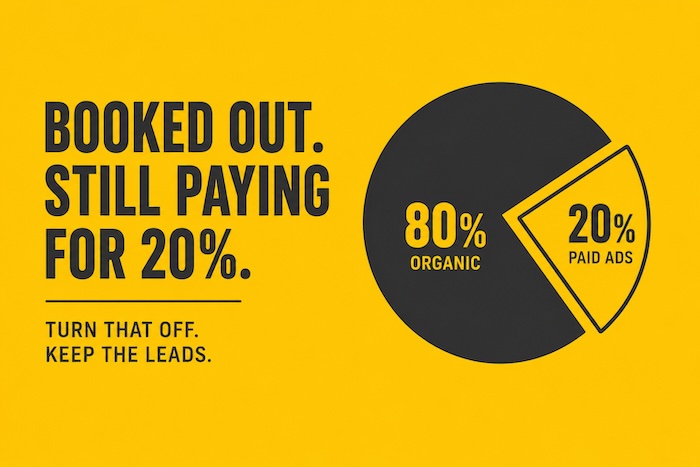
His answer: about 80% organic, 20% paid.
And that’s when the conversation got interesting.
The Hidden Cost of “Good Enough”
Here’s what that 20% paid actually means.
It means every single month, he’s writing a check to Google or a lead gen platform or a home services directory — just to keep that slice of his pipeline alive.
Not to grow it. Not to build something. Just to maintain it.
And the moment he stops writing that check?
Those leads disappear. Instantly. No wind-down. No residual. Just gone.
That’s the nature of paid leads. You’re not building anything. You’re renting access to customers — and the landlord can raise the rent, change the terms, or shut the whole thing down whenever they want.
He’s already generating 80% of his business through organic search. His website, his Google profile, his reviews — they’re quietly doing most of the work without him thinking about it.
But he’s still paying for the other 20%.
What if he didn’t have to?
Assets vs. Ads: The Core Difference
There are two ways to generate leads in this business.
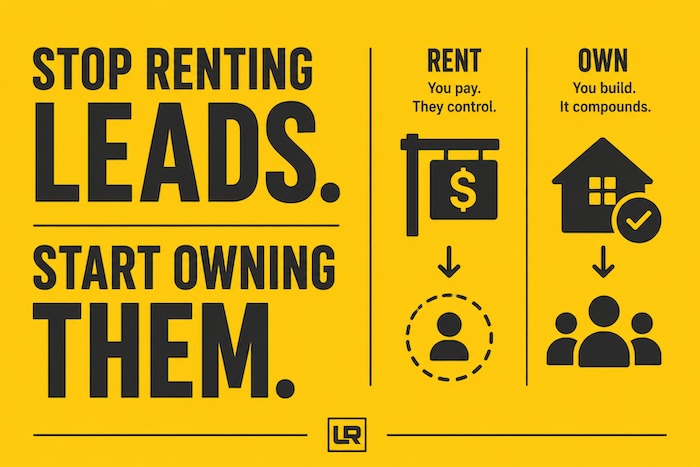
You can rent them. Or you can own them.
Renting looks like this: Google Ads, HomeAdvisor, Angi, Thumbtack, pay-per-click campaigns. You pay, you get leads. You stop paying, the leads stop. There’s no equity. No compounding. No long-term value being built.
Owning looks like this: a strong website with service pages built around what customers are actually searching for, city landing pages that rank in every market you serve, a Google Business Profile with consistent reviews, and a content library that answers the questions your customers are asking before they ever call.
The difference isn’t just philosophical. It’s financial.
Ads are an expense. Every dollar you spend is gone.
Assets are an investment. Every dollar you spend builds something that keeps working — this month, next month, next year, even when you’re not actively doing anything.
A well-built website doesn’t take a day off. It doesn’t charge you more when competition increases. It doesn’t disappear when you pause your budget. It just keeps ranking and keeps sending calls.
That’s the fundamental difference between renting and owning.
Why Booked-Out Contractors Still Pay for Ads
This is more common than people think.
A contractor gets busy. Really busy. Schedule fills up, revenue is strong, and there’s no time to think about marketing — so the ads just keep running on autopilot.
It worked when they needed it. Now it’s just a line item nobody’s questioned in a while.
Meanwhile, their organic presence has quietly grown. Reviews have accumulated. The website has been around long enough to gain some authority. Google Maps is generating calls.
But the ad spend never got adjusted.
So they’re paying for leads they might not need — or leads they could be generating for free — because nobody stopped to ask the question.
The contractor I talked to is a perfect example. 80% organic. Fully booked. And still sending money to a platform every month for the remaining 20%.
What happens if that 20% gets replaced by organic?
The ad spend turns off. The leads keep coming. And that monthly check stays in his pocket.
What It Actually Takes to Get There
Let me be direct about something: getting to 100% organic doesn’t happen overnight. And it doesn’t happen by accident.
The contractors who are fully booked on organic alone built something. Intentionally.
Here’s what that typically looks like:
A website built around search intent. Not a brochure. Not a pretty portfolio. A site with pages built around the actual words customers type into Google when their driveway is sinking. “Concrete lifting [city].” “Mudjacking near me.” “Sunken sidewalk repair.” Pages that answer those searches directly — and then convert.
City pages that expand your reach. Most contractors service more than one city. But if your website only mentions your home base, you only exist in one place on Google. City-specific landing pages let you show up in every market you actually serve — not just the one on your letterhead.
A Google Business Profile that gets maintained. Reviews coming in consistently. Photos updated. Posts going up. Q&A answered. A GBP that looks active and current signals trust to both Google and the customer reading it.
Reviews that compound over time. Every job is an opportunity. Contractors who ask consistently — and make it easy — build a review profile that does selling before the phone even rings.
Proof assets that convert skeptics. Before and after photos. Job site videos. Case studies. Content that shows the work and builds confidence in the process. Customers who’ve seen your proof don’t need to be sold — they just need to book.
None of this is complicated. But it takes consistency. And it takes building the right foundation first.
The Math Worth Running
Take whatever you’re spending on ads every month. Write that number down.
Now ask yourself: what would it mean to your business if that number went to zero — and the leads kept coming?
For some contractors that’s $500 a month. For others it’s $2,000, $3,000, or more.
Over a year, that’s $6,000 to $36,000 staying in your pocket.
Not because you stopped marketing. Because you shifted from renting leads to owning them.
That’s the return on a website investment that most contractors never stop to calculate. They think about the cost of building the asset. They rarely think about the cost of not building it — which is exactly what they’re paying every month to a platform that owns the leads, not them.
 A Word on Timing
The contractor I talked to pushed back with something I hear a lot.
“I’ll do it when I’m ready to grow.”
It makes sense on the surface. If you’re already booked out, why add marketing capacity you can’t fulfill?
But here’s the thing about organic search: it doesn’t work on your timeline.
A website built today doesn’t rank next week. It takes time — months, sometimes longer — for new pages to gain authority, for Google to index and trust them, for reviews to accumulate.
The contractors who are fully booked on organic didn’t start building when they needed it. They built it before they needed it — or they built it early and let it compound over time.
The best time to build the asset was two years ago.
The second best time is now.
Because the competitor in your market who’s building their site today is going to be ranking above you in twelve months — while you’re still writing that monthly check.
Back to the Contractor
He’s not a bad businessman. He’s a smart one.
Booked solid. Strong organic foundation already in place. Good instincts.
He just hasn’t asked the question yet: what would it take to turn that ad spend off completely?
The answer probably isn’t that far away.
A stronger website. More city pages. A few more reviews. Some proof content.
Assets he’d own forever — not a bill he pays every month just to stay in the game.
That’s the shift.
Ads rent you customers.
Assets build you a business.
The goal isn’t to keep paying for leads forever.
The goal is to build something that makes paying for leads unnecessary.