Your Website Can‘t Rank for Words That Aren’t On It
 A homeowner’s driveway is sinking.
It’s been bugging them for two years. They finally decide to do something about it.
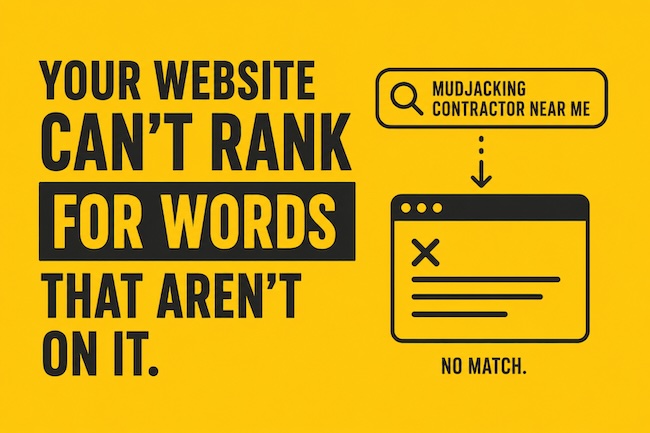
So they pull out their phone and type into Google:
“mudjacking contractor near me”
Your competitor shows up.
You don’t.
Not because they’re better at the work. Not because they’ve been in business longer. Not because they have a fancier logo or a bigger truck.
Because they have the words on their website — and you don’t.
That’s it. That’s the whole reason.
How Google (and AI) Actually Works
People make this more complicated than it needs to be.
At its core, search works like this: someone types words into a search bar, and Google looks for websites that have those words. The sites that match best — and have the most authority — show up at the top.
That’s the simplified version. And for most concrete lifting contractors trying to understand why their site isn’t generating calls, it’s the only version that matters.
If a customer types “mudjacking” and your website never uses the word “mudjacking” — Google has no reason to show your site. There’s no match. You’re invisible for that search.
This isn’t just true for Google anymore.
AI search tools like ChatGPT, Google’s AI Overviews, and voice assistants like Siri and Alexa all pull from the same place. They read websites. They look for clear, specific language that matches what someone is asking.
Sites with that language get surfaced. Sites without it get skipped.
The game hasn’t changed. It’s just being played on more fields now.
The Brochure Website Problem
Most concrete lifting contractors who aren’t getting calls from their website have the same thing in common.
They have a brochure site.
You know what a brochure site looks like. Home page. About page. Contact page. Maybe a services page that says something like “We lift concrete using the latest technology to restore your surfaces to their original position.”
It looks fine. It’s professional. It has a phone number and a logo.
But it’s not built to rank. It’s built to exist.
A brochure site is the digital equivalent of a business card. It tells people you’re real if they already know who you are and go looking for you. But it does almost nothing to bring in people who have never heard of you — which is every new customer you’ve ever wanted.
Google doesn’t rank brochure sites for competitive searches. There’s not enough there. Not enough words, not enough pages, not enough signals that say “this site is a serious resource for people with this problem in this area.”
If your website has three pages and a contact form, it’s a brochure. And brochures don’t generate leads — they just confirm you exist.
We’ve written more about the difference between a brochure site and a lead generation machine at levelrightmarketing.com/brochure-website-vs-lead-generation-machine-for-concrete-lifting. If you’re not sure which one you have, that’s a good place to start.
Your Customers Describe What They See — Not What You Call It
 Here’s something most contractors never think about.
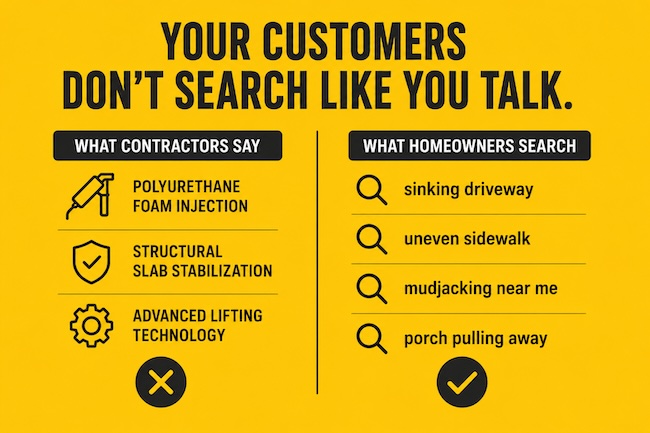
You know exactly what you do. You inject polyurethane foam or slurry beneath a slab to fill voids and lift settled concrete back to grade. You know the process, the equipment, the terminology.
Your customers know none of that.
What they know is what they see standing in their driveway.
“My driveway is sinking.” “There’s a big crack in my sidewalk.” “My porch is pulling away from the house.” “I’ve got a trip hazard by the front steps.” “My garage floor is uneven.” “Part of my patio is lower than the rest.”
Those are the words they type into Google. Not “polyurethane foam injection.” Not “slab lifting services.” Not even “concrete leveling” in many cases.
They type the problem they see in plain English.
And if your website doesn’t use those words — if it only talks about your process and your equipment and your years of experience — you’re speaking a language your customers aren’t searching for.
This is why the mudjacking conversation matters so much. Most poly lifters compete against mudjacking — they don’t offer it, and some actively position against it. But mudjacking still wins in raw search volume in most markets. Customers who’ve heard the word mudjacking from a neighbor or a parent will type mudjacking into Google. If your site never mentions the word, you don’t show up.
It doesn’t matter whether you offer mudjacking or not. If your page mentions the word and explains the difference, you can still show up for that search — and then educate the customer on why poly is the better choice.
The words have to be there first. Everything else comes after.
We’ve covered the customer language problem in depth at levelrightmarketing.com/what-homeowners-search-before-hiring-a-concrete-lifting-company-and-why-your-website-must-match-their-language — worth reading if this concept is new to you.
Locations Work the Same Way
The word problem doesn’t just apply to services. It applies to geography too.
If your website mentions one city — your home base — you essentially only exist in one city on Google.
A customer twenty miles away searching “concrete lifting [their town]” won’t find you. Not because you don’t serve their area. Because your website never mentions their town. Google doesn’t know you go there.
This is exactly why city pages exist.
A city page is a dedicated page on your website built around a specific market you serve. It uses the city name, the surrounding area, local landmarks, and local search terms. It signals to Google that yes — this contractor serves this area.
When you have city pages for every market you serve, you start showing up in every one of those markets. Not just your home base.
Contractors who have built this out consistently tell us the same thing: calls start coming in from towns they hadn’t heard from in years — or ever — simply because they put the words on the page.
We go deeper on this in levelrightmarketing.com/how-city-pages-help-you-rank-across-every-area-you-serve. If you’re only showing up in one city right now, that article is a fast way to understand what you’re missing.
How to Find Your Missing Words
Here’s the honest truth: most contractors don’t know what words are missing from their site.
They built it a few years ago, it looks decent, and they assume if they’re not ranking it must be some complex technical SEO problem. Algorithm updates. Backlinks. Schema markup.
Sometimes it’s those things. But more often than not — it’s simpler than that. The words just aren’t there.
The fastest way to find out what’s missing is to run your site through our free SEO Analyzer tool built specifically for concrete lifting contractors.
It scans your website and shows you the key terms and topics that are absent — the words customers are searching for that your site isn’t covering. Service terms. Problem-specific language. Location signals.
You’ll get a clear picture of what’s there and what isn’t — and that gives you a roadmap for exactly what to add.
You can run it here: levelrightmarketing.com/concrete-lifting-seo-analyzer-tool/
It takes about two minutes and it’ll tell you more about your site’s visibility gaps than most audits that cost hundreds of dollars.
The Fix Isn’t Complicated — But the Words Have to Be There
This isn’t about gaming the system.
It’s not about stuffing keywords into pages in a way that reads like garbage. It’s not about tricks or hacks or paying for some service that promises page one in thirty days.
It’s about building a website that actually speaks the language your customers use when they’re looking for help.
Service pages that describe the problems people actually have. Location pages that cover every market you serve. Content that uses the words — mudjacking, sinking driveway, uneven concrete, trip hazard, sunken porch — that real customers type into real search bars every single day.
When the words are there, you have a chance to rank.
When they’re not, you don’t. It’s that simple.
A brochure site with three pages and generic copy isn’t going to generate calls no matter how much time passes. The foundation has to be built first — and the foundation is words.
Your competitor isn’t beating you because they’re better.
They’re beating you because they showed up for the search.
And they showed up because the words were on the page.
Run your site through the analyzer. Find out what’s missing. Then build it.
Because you can’t win a search you’re not in.