Loss Aversion: Why “It‘ll Only Get Worse” Sells Better Than “It’ll Look Better”
 Picture two versions of the same pitch.
Version one: “We can lift that slab and make your driveway look brand new.”
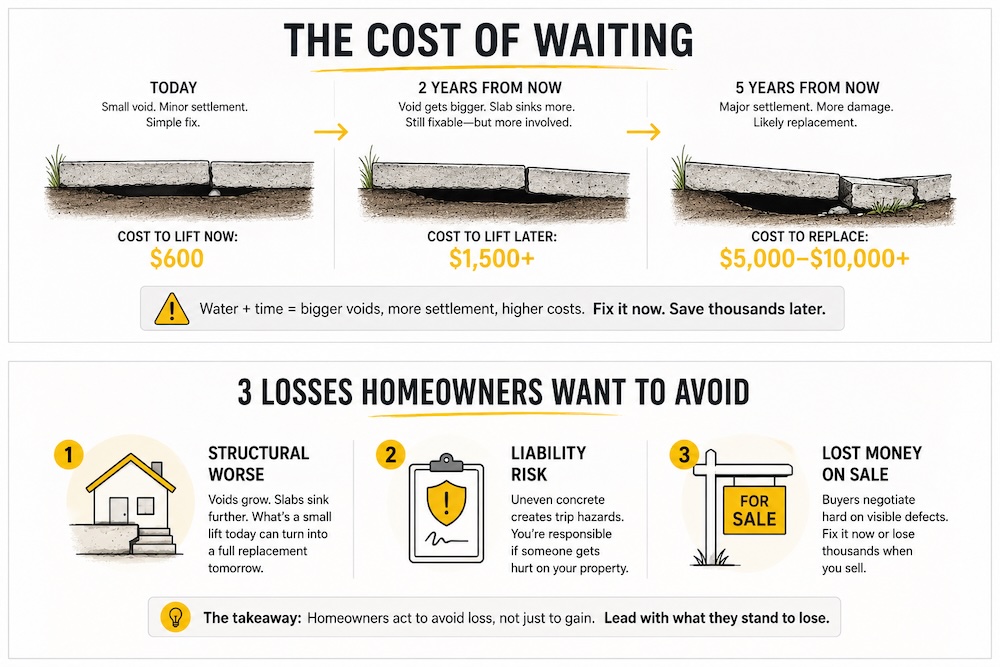
Version two: “That gap under your slab is only getting bigger. Right now it’s a $600 fix. Wait two more winters and water gets under there, the void grows, and you’re looking at a full replacement instead.”
Same job. Same contractor. Same price today. But one of those pitches sells, and it’s not the one about looking nice.
Why Your Brain Weighs Loss Heavier Than Gain
This isn’t a sales trick someone invented. It’s wired into how people make decisions. Daniel Kahneman’s research on this — the same body of work behind a lot of what we’ve written about anchoring and buyer psychology — found that people feel the pain of losing something roughly twice as strongly as they feel the pleasure of gaining something equivalent. A $500 loss doesn’t just feel bad. It feels about twice as bad as a $500 gain feels good.
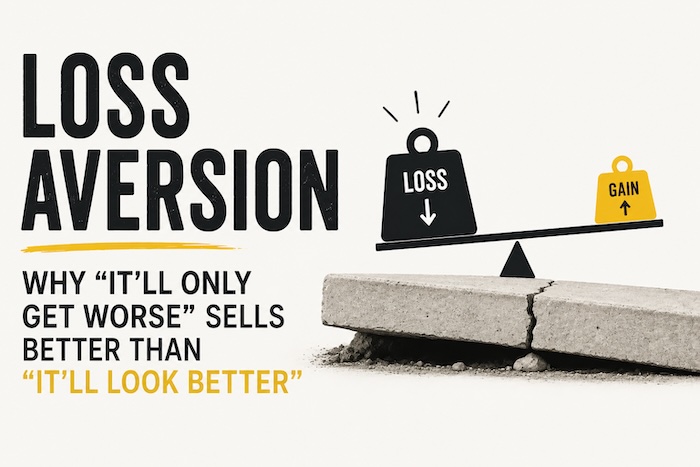
That asymmetry is called loss aversion, and it explains a lot about why concrete sits sunken in driveways for years even when the homeowner knows it needs fixing. “My driveway could look better” is a gain. Gains are nice to have, not urgent to chase. “My driveway is going to get worse and cost more the longer I wait” is a loss in motion — and loss in motion is the thing people act on.
We’ve written before about why homeowners wait years to make the call — the short version is that uneven concrete doesn’t feel urgent until something makes it urgent. Loss aversion is one of the most reliable ways to make it feel urgent, honestly, because in most cases it’s simply true.
The Three Losses That Actually Move Homeowners
Not every loss frame works equally well. These three are the ones that consistently connect, because they’re the ones homeowners already worry about — you’re just naming what they’ve been feeling.
1. It’s Going to Get Structurally Worse
This is the most literal version of loss aversion, because it’s not a framing trick — it’s physics. Void spaces under slabs don’t stay the same size. Water gets in, washes out more soil, the void grows, the slab drops further. A quarter-inch settlement this year can be a two-inch settlement in three years if the underlying cause never gets addressed.
That means you don’t have to manufacture urgency. You just have to explain the mechanism. “Right now this is a lifting job. If the void keeps growing under there, you’re eventually looking at replacement instead of a repair” is not a scare tactic. It’s an accurate description of what happens to unaddressed concrete settlement, and it reframes the decision from “spend money to improve something” to “spend less money now to avoid spending a lot more later.”
2. It’s a Liability Sitting on Their Property
Nobody wants to think of their front walk as a legal exposure. But a raised slab is a trip hazard, and a trip hazard on a residential property is the homeowner’s liability if a guest, a mail carrier, or a delivery driver gets hurt on it.
This lands hardest for the customers who’ve had a close call — someone stumbled, someone’s kid caught a toe on the edge, someone commented on it at a party. You don’t need to invent fear here either. You just need to help them connect a hazard they’ve mentally filed as “cosmetic” to what it actually is: a real risk they’re currently carrying. This is the same dynamic we covered in why strip malls can’t ignore uneven concrete — it applies just as much to a residential front walk as it does to a commercial parking lot, just at a smaller scale.
3. It’s Costing Them Money on the Sale of the Home
For homeowners who are selling, or thinking about selling, this loss frame writes itself. A home inspector will flag uneven concrete. A buyer will use it as a negotiating point. And the discount a buyer asks for is almost always bigger than what the actual repair would have cost, because buyers price in hassle and uncertainty, not just materials and labor.
“Fix it now for $800, or a buyer knocks $3,000 off your asking price and still complains about it during the walkthrough” is a loss comparison that homeowners in a selling mindset understand instantly, because they’re already thinking about their equity.
How to Actually Use This — In Copy, On the Phone, In Person
Loss aversion isn’t a headline trick you bolt onto a page. It’s a shift in what you lead with. Here’s what that looks like in practice.
On Your Website
Compare these two headline approaches for a service page:
- Gain-framed: “Professional Concrete Lifting — Restore Your Driveway’s Curb Appeal”
- Loss-framed: “Sinking Concrete Gets Worse Every Year You Wait — Here’s What It’s Actually Costing You”
The second one isn’t more aggressive. It’s more honest about what’s actually at stake, and it matches the mental state of the homeowner who’s already noticed the problem and is trying to decide if it’s worth dealing with now or later. This is the same instinct behind why homeowners buy on feeling, not price — loss framing simply names the feeling they already have.
On the Phone
Instead of leading with the fix, lead with the trajectory. “So it sounds like this has been sinking gradually over the past couple years — that’s actually really common, and the tricky part is it doesn’t stop on its own. The good news is we can usually get ahead of it now for a lot less than what it’d take to deal with later once it’s spread further.” That’s not a hard sell. That’s just explaining the timeline honestly, in a way that makes waiting feel like the more expensive option — because it usually is.
In Person, On the Estimate
This is where loss aversion works best, because you can point at the actual problem. Show them where water is pooling. Point out the direction the crack is moving. If you’ve seen this exact situation turn into a bigger repair before, say so — “I’ve seen this exact gap double in size over two winters when nobody addressed it” carries more weight standing on the driveway than it ever will in an ad.
Where the Line Is
This only works — and it only should work — because the loss is real. Concrete under stress from water and freeze-thaw cycles genuinely does get worse. Liability genuinely does sit on the homeowner until it’s fixed. Buyers genuinely do negotiate against visible defects. You’re not inventing urgency out of nothing. You’re just choosing to lead with the true cost of waiting instead of burying it under a pitch about curb appeal.
However – The moment you catch yourself exaggerating a timeline or inventing a risk that isn’t there, you’ve crossed from loss aversion into fear-mongering — and homeowners can tell the difference, especially the ones who get a second opinion. Stick to what’s actually true about the physics of the problem and the real financial exposure, and you don’t need to inflate anything.
The Bottom Line
Homeowners don’t put off calling because they don’t care about their driveway. They put it off because “it’ll look better” isn’t a strong enough reason to act today. “It’s going to keep getting worse, and it’s cheaper to fix now” is. That’s not a manipulation of how people think — it’s an accurate description of the tradeoff they’re actually facing, and your job is to make sure they see it clearly before they decide to wait one more year.
Next time you write a headline, answer the phone, or stand on a driveway during an estimate, try leading with the cost of waiting instead of the benefit of fixing it. It’s a small shift in framing, and it’s usually the difference between “let me think about it” and “when can you start.”