What to Say When They Tell You “We’re Getting 3 Quotes”
 You’re standing on the driveway, you’ve just walked through the job, and the homeowner says it:
“We’re actually getting a few quotes before we decide.”
Most contractors hear that sentence and feel their stomach drop a little. It sounds like the beginning of a “no.” So they do one of two things — they get a little defensive, or they quietly panic and start shaving the price to try to win on the spot.
Both are the wrong move. And here’s the thing worth sitting with: that sentence isn’t rejection. It’s an invitation. The homeowner just told you exactly what’s about to happen — they’re going to compare you to two other contractors — and they told you before it happened, while you’re still standing right there. That’s a genuine advantage if you know what to do with it.
What They’re Actually Saying
“We’re getting a few quotes” almost never means “we’ve already decided against you.” Most of the time it means one of these things:
- They don’t know if your price is fair, because they have nothing to compare it to
- They’ve been burned before by a contractor who overpromised, and they’re being careful this time
- Someone in the house — a spouse, a parent — wants to feel like they did their due diligence before signing off on the spend
- It’s genuinely a bigger job and comparison shopping feels responsible
None of those are about you personally. They’re about uncertainty. And uncertainty is something you can address directly, right there on the driveway, if you don’t flinch when you hear it.
What Not to Say
Before the script, a few reactions to avoid, because they’re the ones that actually lose the job:
Don’t get defensive. “Why, you don’t trust me?” or any variation of that puts the homeowner on the back foot and makes the rest of the conversation awkward. They weren’t accusing you of anything.
Don’t badmouth the competition. Even if you know exactly who else is bidding the job and you have real opinions about their work, trashing another contractor makes you look insecure, not credible. Homeowners remember who talked trash more than they remember what was said about the other guy.
Don’t immediately drop your price. The instant you cut your number because someone mentioned other quotes, you’ve told them your original price had slack in it — which makes them wonder what else you’re padding. We’ve written before about why racing to the bottom on price is a losing strategy, and this is exactly the moment that race usually starts.
Don’t go quiet and passive. “Okay, sounds good, let me know” is how you become one of three anonymous quotes in an inbox. This is the moment to lean in, not fade out.
What to Actually Say
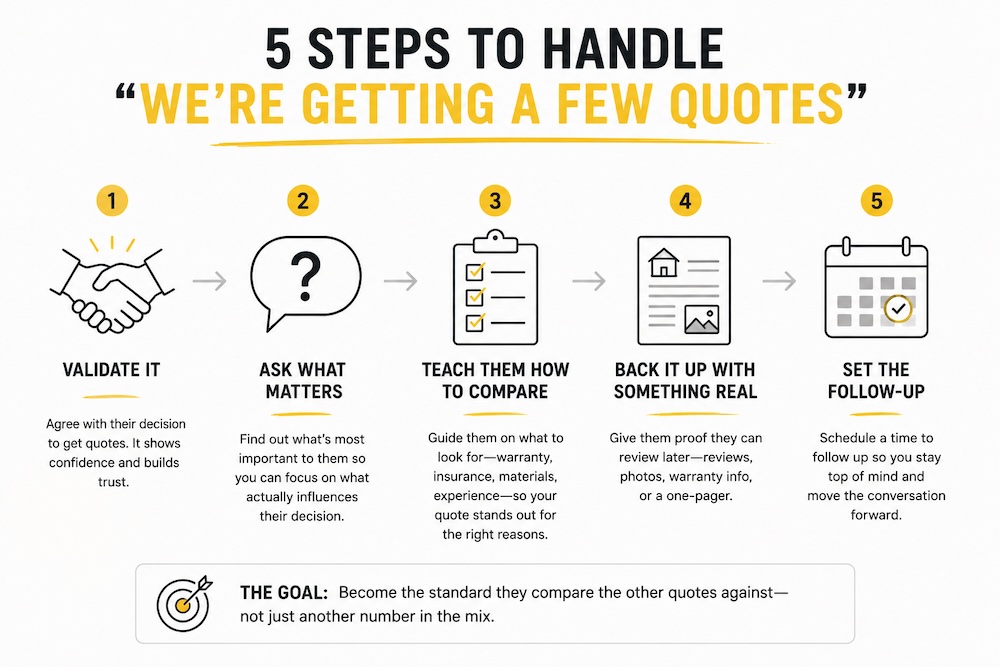
1. Validate it — genuinely
Start by agreeing with them. Not because it’s a sales tactic, but because it’s true: comparing quotes on a job like this is smart.
“That’s smart — you should. This isn’t a cheap job, and you want to feel good about who you hire. I’d do the same thing.”
This does two things immediately. It removes any tension from the moment, and it positions you as confident enough to not be threatened by comparison — which, on its own, is a trust signal most of their other quotes won’t give them.
2. Ask what actually matters to them
Instead of assuming price is the only variable, ask.
“When you’re comparing the quotes, what matters most to you — the price, how fast it gets done, or what kind of warranty stands behind the work?”
Whatever they answer, you now know exactly what to emphasize for the rest of the conversation and in your follow-up. And if they say “probably price,” that’s useful information too — it tells you they haven’t yet been educated on the things that actually differentiate one lifting company from another, which is your opening for the next point.
3. Teach them how to actually compare quotes
This is the single highest-leverage thing you can do in this conversation, and almost no contractor does it. Most quotes on paper just show a number. Homeowners assume that number is the whole story. Your job is to show them it isn’t — without trashing anyone.
“One thing worth asking whoever else quotes it — ask about their warranty length, whether they’re insured, and what material they’re actually using. A lot of the price difference between contractors comes down to those three things, not just labor.”
Now every other quote they get is filtered through the questions you just planted. If a competitor is cheaper because they carry a 1-year warranty instead of your 10, or they’re uninsured, or they’re using a lower-grade fill material — the homeowner is going to find that out, and they’re going to remember who told them to ask.
4. Make your case concrete, not just verbal
Whatever you emphasized — warranty, insurance, material, speed — back it up with something they can hold onto after you drive away. A printed one-pager, a link to your reviews, a couple of before/after photos from a similar job nearby. Verbal reassurance fades by dinner. Something they can look at later while comparing quotes doesn’t.
5. Set the follow-up before you leave
Don’t leave “let me know” as the plan. Set an actual next step.
“Take your time comparing — I’d want you to. I’ll follow up with you Thursday to see where you landed and answer anything that’s come up. Sound good?”
This does something subtle but important: it gives you permission to follow up without seeming pushy, because they agreed to it. It also keeps you top of mind on a specific day, instead of hoping they remember to call you back. If you want more on staying in front of leads who aren’t ready to commit on the spot, we’ve covered that in how to close jobs when no one answers.
Why This Works
Almost every contractor they call is going to react to “we’re getting a few quotes” with either quiet anxiety or a reflexive price drop. You calmly agreeing, asking a smart question, and educating them on what actually separates one quote from another makes you stand out simply by not being rattled. You’ve turned the moment that usually signals a lost job into the moment you become the standard the other two quotes get measured against.
This ties directly into selling value instead of just a bid number — the multi-quote conversation is where that philosophy actually gets tested in real time, on a driveway, with no script to hide behind except the one in your head.
The Bottom Line
“We’re getting a few quotes” is one of the most common sentences you’ll hear on an estimate, and it’s also one of the most misread. It’s not a door closing. It’s the homeowner telling you, out loud, exactly what’s about to happen to your bid — and handing you a chance to shape how that comparison goes before it even starts. Don’t flinch. Validate it, ask what matters to them, teach them how to actually compare contractors, and leave with a real follow-up plan. That’s how you win the job you didn’t get to close on the spot.