How a Gas Station Page Landed a Multi-Property Client (And Why Speaking to the Right Persona Wins)
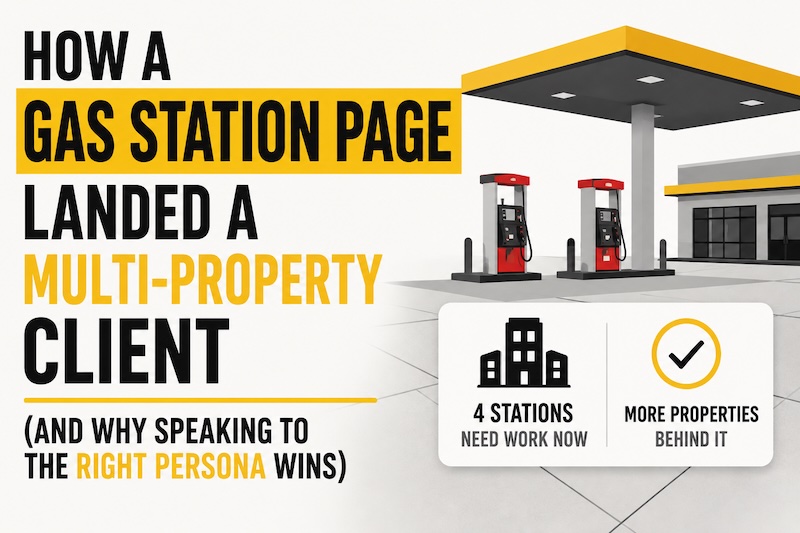 A gas station and convenience store owner recently found one of our partner contractors through a Google search. Not through a referral, not through an ad — he found a dedicated page on the website built specifically for gas station concrete lifting.
He owns several stations. Four of them need work right now — settled slabs around the pump islands, trip hazards near the entrances, pooling water that customers complain about. And he owns plenty of other properties beyond those, which means this isn’t a one-job win. It’s the start of an account that could keep producing work for years.
Here’s the part worth sitting with: he didn’t find a generic “commercial concrete services” page and have to guess whether this contractor understood his situation. He found a page that spoke directly to him — his industry, his specific headaches, his specific vocabulary — and it did the convincing before the phone ever rang.
Why the Gas Station Page Did What a Generic Page Couldn’t
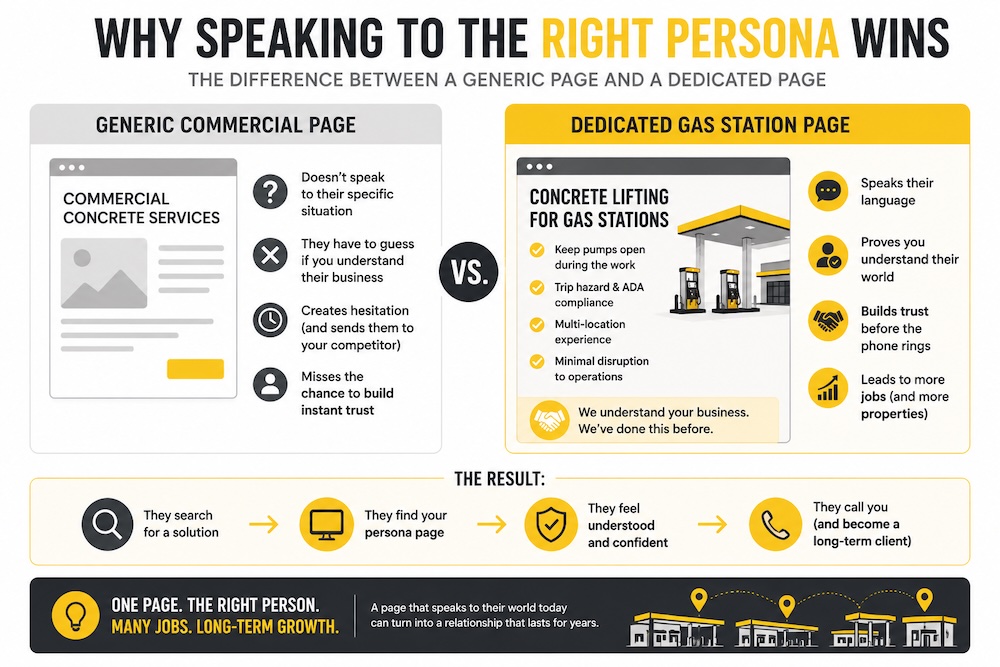
Picture the alternative. A gas station owner lands on a typical concrete lifting homepage — “Residential & Commercial Concrete Lifting, Serving Your Area” — with a stock photo of a driveway and a paragraph about foam injection. Nothing on that page tells him this contractor understands what it means to keep pumps running during a repair, what ADA compliance means for his entrances, or that he’s not the first multi-location owner this company has worked with.
So he keeps scrolling. He looks elsewhere. Maybe he calls three other numbers before he finds someone who clearly gets it.
Now picture what he actually found: a page built around his exact world. Language about keeping pumps open during the work. Language about trip hazard liability by the entrances. Language acknowledging that station owners often manage multiple locations and need one contractor who can handle all of them, not five separate quotes from five different guys. We laid out exactly what that page needs to include in How to Sell Concrete Lifting Jobs for Gas Stations — and this lead is the real-world proof that speaking his language, in writing, before he ever picks up the phone, is what actually moves a skeptical commercial buyer to make the call.
This Isn’t the First Time We’ve Seen This Pattern
We watched almost the identical thing happen with a warehouse floor client. A referral led a facility owner to a website, but the referral alone wasn’t enough to close a large commercial job — he needed to see a page that answered his specific concerns about square footage, equipment, and downtime before he trusted the work. We broke that story down in How One Service Page Closed a 40,000 Sq Ft Warehouse Job. Different vertical, same mechanism: a dedicated page did the selling that a generic one never could have.
That’s not a coincidence. It’s a pattern, and it points to something every concrete lifting company should be paying attention to.
The Psychology of Speaking to a Specific Persona
Here’s why this works, underneath the marketing tactics: people trust a message that sounds like it was written for them, specifically, over a message that sounds like it was written for everyone. When a gas station owner reads generic language about “commercial properties,” his brain has to do the translating — does this apply to me? Do they actually know what my business needs? That translation gap creates hesitation, and hesitation is where leads quietly leave and call the next name on the list.
When that same owner reads a page that already speaks in his terms — pump uptime, ADA compliance, multi-site scheduling — there’s no translation gap. The page has already done the work of proving “we understand your situation” before he’s typed a single word to you. That’s not a copywriting trick. It’s just removing the friction between what he’s worried about and what he’s reading.
We’ve written before about the different buyer personas that show up across this trade — homeowners, property managers, facility owners, municipal buyers — and how each one needs a different pitch because each one is worried about different things. If you haven’t read it, Concrete Lifting Buyer Personas: How to Speak to Every Type of Customer lays out the full range. This gas station lead is that concept playing out in real dollars.
It Works the Same Way in Residential — Just With Different Personas
This isn’t only a commercial phenomenon. A retiree worried about a trip hazard on the front walk is a completely different persona than a young family who just noticed a crack after a wet spring, who’s different again from a homeowner trying to sell their house and needs the driveway fixed before a home inspection kills the deal. Generic residential copy — “We fix sinking concrete!” — doesn’t speak to any of them specifically. A page or a piece of content that addresses the pre-sale homeowner’s timeline and resale concerns, separately from the family worried about a grandkid tripping in the driveway, does the same quiet convincing this gas station page just did, at a smaller scale.
The mechanism doesn’t change. Only the persona and the language do.
The Multiplier Most Contractors Miss
Here’s what makes a commercial persona page even more valuable than a residential one: the owner behind it usually isn’t buying one job. He’s buying a vendor relationship. Four stations need work today. More properties sit behind that. If this first round goes well, that’s not four jobs — it’s the start of a standing account that keeps producing work with no additional marketing spend required.
Gas stations in particular are worth building this kind of page for — they’re among the largest owners of concrete in the country, and most of them operate more than one location. One well-built page, aimed at the right persona, can compound into a multi-site account that a homeowner lead never will.
Build the Page Once. Let It Keep Working.
The gas station page that landed this client was built one time. It’s still sitting on the website right now, ready to do the exact same thing for the next multi-location owner who searches for someone who understands his business. That’s the core idea behind treating your website as a lead generation machine instead of a brochure — every dedicated page you build is a standing asset, not a one-time expense.
And if you don’t have a page like this for every commercial vertical you actually serve — gas stations, warehouses, HOAs, municipal properties, whatever you’ve quietly been doing without ever writing about it — you’re invisible to those buyers before they even know your name. We covered exactly this gap in Why Most Concrete Lifting Companies Only Market Half Their Services. If a gas station owner can’t find proof on your site that you understand his world, he has no reason to believe you do — no matter how many gas stations you’ve actually lifted.
The Bottom Line
A generic page speaks to no one in particular, which means it fails to fully land with anyone. A dedicated page, built around a specific persona’s actual language and actual worries, does the convincing before you ever say a word — and in commercial work, that conviction can turn into a standing multi-property account instead of a single job. This gas station lead is proof, in real numbers: four properties needing work now, more behind it, and it all started with a page built to speak to exactly the right person.
If you’re doing commercial work — of any kind — and don’t have a page speaking directly to that specific buyer, that’s the gap costing you the accounts you don’t even know you’re missing.