
The Right Photo Closes the Sale Before You Ever Show Up
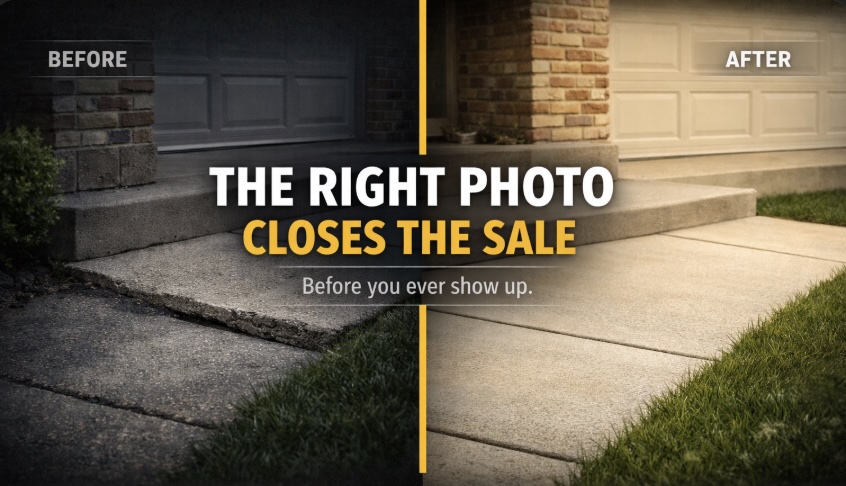
There’s a moment that happens before you answer the phone. Before you drive to the estimate. Before you say a single word to the homeowner.
A decision is already being made.
The person who filled out your contact form is sitting at their kitchen table, or scrolling on their phone in bed, and they’re doing what every buyer does before they commit to anything: they’re looking for proof that you’re the right choice. They’re scanning your website. Looking at your photos. Trying to answer one question in their mind before they ever talk to you.
Has this company seen a problem like mine before?
If your photos answer that question — clearly, visually, specifically — you’ve already won half the sale. If they don’t, you’re walking into that estimate carrying doubt that you’re going to have to overcome in person. And that’s a harder job.
This is the psychology of before and after photos. And most concrete lifting contractors are completely underestimating them.
A Photo Isn’t Documentation. It’s a Mirror.
Here’s the thing most contractors get wrong about job photos. They think of them as a record. Proof that the work was done. A way to show off the finished product.
That’s not what the homeowner sees.
When a homeowner looks at a photo on your website, they’re not admiring your work. They’re looking for themselves. They’re looking for their driveway. Their patio. Their sidewalk. The exact problem they’ve been staring at for two years and finally decided to do something about.
When they find a photo that mirrors their situation — same setting, same type of damage, same emotional weight — something shifts. The fear starts to dissolve. Because now they have evidence that this problem is solvable. That someone has fixed it before. That the person they’re about to call knows exactly what they’re dealing with.
That’s not marketing. That’s psychology. And it works at a level that no amount of text or credentials can match.
Fear Is the Real Obstacle — Not Price
When a homeowner hesitates on a concrete lifting job, the instinct is to think it’s about money. But usually it’s not. It’s fear.
Fear that the repair won’t hold. Fear that they’re going to tear up their property and it won’t look right. Fear that they’re going to spend money on something that doesn’t actually fix the problem. Fear that they picked the wrong company.
Photos address every single one of those fears without you saying a word.
A sharp before photo shows them you’ve seen this exact problem. An after photo shows them it gets fixed — completely, cleanly, permanently. A setting that matches theirs — a sidewalk in front of a brick ranch, a sunken slab next to a garage door, a patio with a 3-inch drop — tells them you’ve been in their world before.
The right photo doesn’t just show the work. It removes the objection before it’s ever raised.
And here’s what makes this even more powerful: the homeowner who finds that photo on your website before they call you arrives at the estimate in a completely different mental state than someone who found nothing specific. They’re not skeptical. They’re not guarded. They’ve already seen proof. You’re walking into that estimate as the trusted expert — not a stranger trying to earn their business.
Setting-Specific Photos Are Worth Ten Times a Generic One
Not all before and after photos are equal. And this is where most contractors leave serious money on the table.
A photo of a lifted concrete slab — any slab, anywhere — does something. But a photo of a sunken front walkway leading to a brick colonial, with a clear trip hazard at the first step, does something completely different to a homeowner whose front walkway looks exactly like that.
It stops them cold. Because it’s not just proof of your work. It’s proof that you understand their situation specifically.
This is why you need photos across every setting you work in. Residential driveways. Front walkways. Garage floors. Pool decks. Patios with water drainage problems. Sidewalks with raised edges. Commercial parking lots. Curbs. Church entrances. School pathways.
Every setting is a different buyer with a different fear. And every buyer needs to see their own reflection in your work before they fully trust you.
If Your Competitor Has These Photos and You Don’t, You’ve Already Lost
Think about what happens when a homeowner is comparing two concrete lifting companies.
Company A has a website with general photos — a few lifted slabs, some foam injection shots, a couple afters that look fine. Clean site. Professional enough.
Company B has a page specifically about sunken patio repair. It has six before photos of patios that look just like theirs — water pooling at the foundation, settled slabs, visible cracks at the edges. It has after photos showing the surface level, the gap sealed, the drainage restored. It has a line that says “back in service the same day, no demo, no mess.”
The homeowner with a sunken patio isn’t choosing between those two companies. They already chose Company B before they ever picked up the phone.
That’s the competitive reality right now. And it’s only going to get more pronounced as AI search tools get better at surfacing specific, relevant content over generic pages. Google and ChatGPT are both rewarding specificity. A page with real photos tied to a real setting ranks higher, converts better, and builds more trust than a page that could belong to anyone.
Your photos are one of the most important SEO and conversion assets you own. They’re proof. They’re trust. They’re specificity. And they’re yours — your competitor can’t copy the fact that you did that job, in that setting, and documented it.
What This Means Practically
You don’t need a professional photographer. You need a phone and a habit.
Every job is a content opportunity. The before photo takes 30 seconds before you start drilling. The after photo takes 30 seconds when you’re done. That’s it. But what it creates — a permanent visual asset that lives on your website, your Google Business Profile, your social feed, and in the minds of every future customer who sees it — that compounds for years.
The contractors who build a deep library of setting-specific before and afters are building something their competition can’t easily replicate. It takes time to accumulate real jobs in real settings. The sooner you start, the bigger the moat.
Take the photo at the curb, not just standing over the slab. Get the full context — the house, the driveway apron, the landscaping. Shoot the before from the same angle you’ll shoot the after. Make it easy for someone scrolling your site to immediately recognize their own situation in your photo.
And then put those photos where they belong — on dedicated service and setting pages that are built around the exact buyer who has that problem. Not buried in a generic gallery. On the page where that buyer lands when they search for their specific issue.
That’s how you get found. That’s how you convert. And that’s how the right photo closes the sale before you ever show up.
Want help building out the pages and photo strategy that actually drives leads? Let’s talk →