The 6 Laws of Persuasion — Applied to Concrete Lifting Sales
 Every time a homeowner says yes to your estimate, there’s a reason that has nothing to do with your price.
And every time they say “I need to think about it” — there’s a reason for that too.
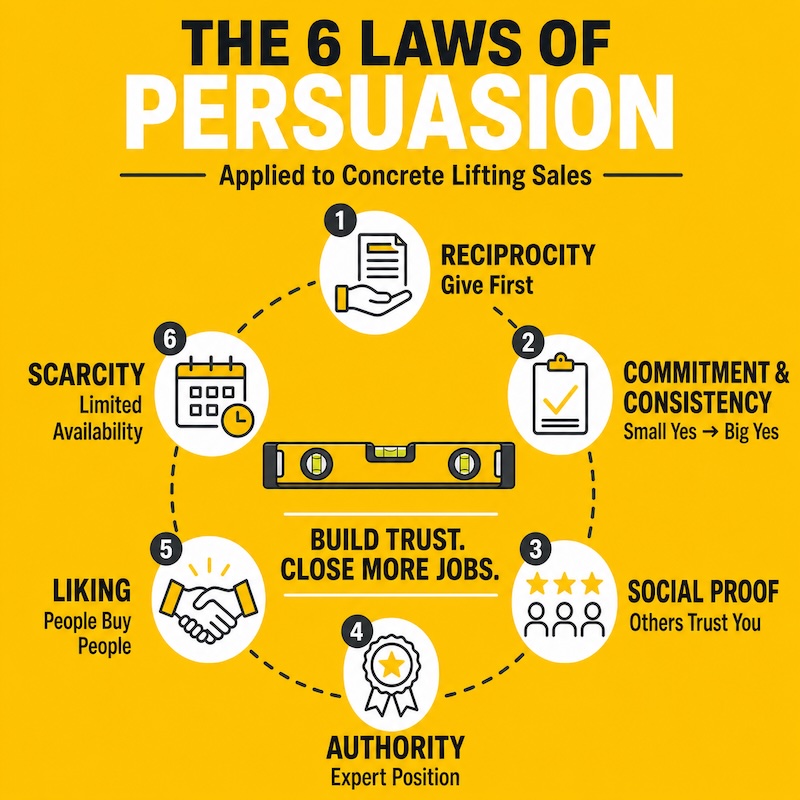
In 1984, a psychologist named Robert Cialdini published a book called Influence: The Psychology of Persuasion. He’d spent years going undercover — training with car salespeople, fundraisers, and telemarketers — trying to understand what actually makes people say yes. Not what salespeople think makes people say yes. What actually does.
He found six principles. Universal, cross-cultural, hardwired-into-humans principles. And they’ve been quietly running the show in every sales interaction ever since — whether the salesperson knows it or not.
Here’s the thing: the best concrete lifting operators are already using most of these without realizing it. The ones who struggle? Usually violating at least two or three without knowing it either.
Here’s how all six show up in your estimates, your website, and your follow-up — and how to put them to work deliberately.
 1. Reciprocity — Give First, Win the Job
The principle: when someone does something for us, we feel a deep, almost automatic obligation to return the favor. It’s not politeness. It’s psychology. Cialdini found that even small, unsolicited gifts create powerful feelings of indebtedness.
Most contractors show up to an estimate and immediately ask for something — the sale. The operators who consistently close more jobs flip that script. They give first.
Spend real time on the property. Walk the whole thing. Explain what you’re seeing, what caused it, what they should watch for. Be genuinely useful before there’s any transaction on the table. Don’t make it feel like a pitch — make it feel like a consultation from someone who actually knows what they’re talking about.
That costs you nothing but time. And it creates something powerful: the homeowner feels like you’ve already done something for them. Saying yes starts to feel like the natural response.
The same principle runs through your marketing. The contractor who shows up having already given value — a helpful website, real answers to real questions, content that treats the homeowner like an adult — enters the estimate with an invisible head start. There are even more ways to apply this thinking when no one’s home and you need to build trust from a distance. We covered a lot of them here: Nobody’s Home — How to Close More Concrete Lifting Jobs When No One Answers the Door.
Give first. It comes back.
2. Commitment and Consistency — Get Them to Take One Small Step
The principle: once people commit to something — even something small — they’ll behave in ways that are consistent with that commitment. We like to see ourselves as people who follow through. Once we’ve taken a position, we defend it.
In concrete lifting sales, this shows up in how you run the estimate.
Ask questions during the walkthrough. Get them talking about the problem in their own words. “So the main concern is the tripping hazard near the front steps — is that the priority for you?” When they say yes, they’ve just committed to that problem being real and worth solving. Now your solution isn’t you selling them something — it’s them following through on what they already told you matters.
On the phone, the same principle applies. “Do you want us to come out and at least take a look so you know exactly what you’re dealing with?” That’s a tiny ask. A low-stakes yes. But that small commitment makes the next yes significantly more likely.
Small steps build momentum. Every yes leads to the next one.
3. Social Proof — Show Them Who Else Said Yes
The principle: when people are uncertain, they look to others to figure out what to do. We assume that if a lot of people are doing something, it’s probably the right call. Reviews, testimonials, and case studies aren’t marketing fluff — they’re decision-making shortcuts.
In a market where most homeowners have never heard of concrete lifting, social proof does the heavy lifting before you ever show up.
Think about what a homeowner does before they call you. They Google your name. They read your reviews. They look at your photos. They want to know — has anyone else trusted this company? Did it work? Were they happy?
A strong Google Business Profile with recent, detailed reviews isn’t a luxury. It’s a conversion tool. The contractor with 87 reviews and a 4.9 rating closes more jobs than the one with 12 reviews and a 4.6 — even if the work quality is identical. That’s social proof in action.
And it doesn’t stop at reviews. Before-and-after photos are social proof. A local job portfolio is social proof. Even a simple line in your estimate follow-up — “We’ve completed over 2,000 jobs across the area” — is social proof.
People want to know they’re not the first. Make it easy for them to see they’re in very good company.
4. Authority — Look Like the Expert Before You Say a Word
The principle: we defer to experts. Titles, credentials, demonstrated knowledge, and professional appearance all trigger an automatic trust response. We’re wired to follow people who look like they know what they’re doing.
Here’s the advantage in concrete lifting: most homeowners know absolutely nothing about slab settlement, soil voids, or the difference between mudjacking and polyurethane foam. In a market where the customer can’t easily evaluate your technical skills, authority signals carry enormous weight.
You’re not “Chuck in a truck” the second you pull up in a clean, wrapped vehicle with a real logo. A uniform says professional. A website that explains the science of slab settlement — why it happens, what causes it, how the repair process works — says expert. Showing up prepared, asking the right questions, and explaining what you’re seeing in plain language says this person actually knows their stuff.
And authority compounds. The contractor with a professional online presence, a branded truck, and a calm, knowledgeable presence on site is perceived as more valuable before the price conversation even starts. We broke down exactly how that pricing perception works here: The Number That Makes Your Price Look Small.
Authority isn’t arrogance. It’s showing up like you’ve done this a thousand times — because you have.
5. Liking — People Buy From People They Like
The principle: we say yes to people we like. And we like people who are similar to us, who show genuine interest in us, and who feel familiar. Cialdini found that liking is one of the most consistent predictors of whether a sale closes.
This one sounds soft. It isn’t.
The contractor who connects with the homeowner — who notices the college flag on the garage, who asks about the dog, who remembers that the backyard needs to be ready for a graduation party next month — is building liking fast. Not through manipulation. Through basic human connection.
On your website and in your marketing, liking comes from showing your face. Real photos of you and your team. A genuine About page that explains why you started the company and what you care about. A brand that feels like a real person, not a faceless LLC.
People hire people they like. And they refer people they like. Make it easy for them to like you before you ever knock on the door.
6. Scarcity — The Job That Won’t Wait
The principle: we want things more when they feel rare or time-limited. Loss aversion is one of the most powerful forces in human psychology — we work harder to avoid losing something than to gain something of equal value.
In concrete lifting, scarcity is built into the product. You just have to say it out loud.
“We’re booking about three weeks out right now.” If that’s true — and in season, it usually is — say it. It signals demand. It signals you’re not desperate. And it quietly tells the homeowner that waiting might mean waiting longer.
The other scarcity angle is the problem itself. Settled concrete doesn’t fix itself. The void underneath isn’t getting smaller. If water is finding its way in, the situation is getting worse. Saying that plainly — not as a scare tactic, just as a factual heads-up from someone who’s seen it a thousand times — is entirely legitimate.
“This is the kind of thing that’s a lot easier and cheaper to address now than in two or three years.” That’s true. That’s scarcity. And it moves people from I’ll think about it to let’s get it on the schedule.
 All Six, Working Together
The contractors who consistently close 65, 70% of their estimates aren’t necessarily the best at lifting concrete.
They’re the best at trust. At connection. At making the homeowner feel like saying yes is the obvious, natural, safe thing to do.
Cialdini’s six principles aren’t tricks. They’re a map of how humans already make decisions. When you give first, build small commitments, show social proof, demonstrate authority, create genuine connection, and frame the timing honestly — you’re not manipulating anyone.
You’re just making it easier for people to do what they already wanted to do.
That’s the job. And now you’ve got the playbook.
Want a website and marketing system that puts all six of these to work before you ever show up on site? Let’s talk. →