
Google Ads for Concrete Lifters: A No-Fluff Guide to Getting Started
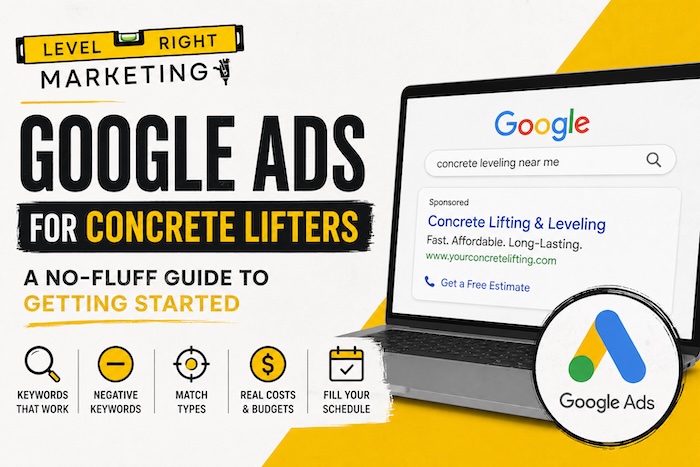 Every few months a contractor asks us the same question: “Should I just run Google Ads?”
It’s usually someone who is just getting started, or is waiting for SEO to build, or who saw a competitor’s ad at the top of the page and got that gut-punch feeling of “they’re getting my leads.”
We get why it’s tempting. And to be straight with you — Google Ads isn’t something we manage for partner contractors we work with. We used to invest thousands each month into Google Ads (and Facebook ads too), but we’ve moved away from Google Ads for the most part.
Why? Because most concrete lifters are better off putting their money into building digital assets they own – that keep working for free forever (site, SEO, Google Business Profile, reviews).
But we still get asked about it constantly, so here’s the honest, no-fluff primer: what Google Ads actually is, how to think about getting started, and where guys blow their budget.
What Google Ads Actually Is
Google Ads (Search Ads specifically — that’s what matters here) puts your business at the top of the results page when someone types in a search. You’re not earning that spot with content or reviews like you do with SEO. You’re paying for it, click by click.
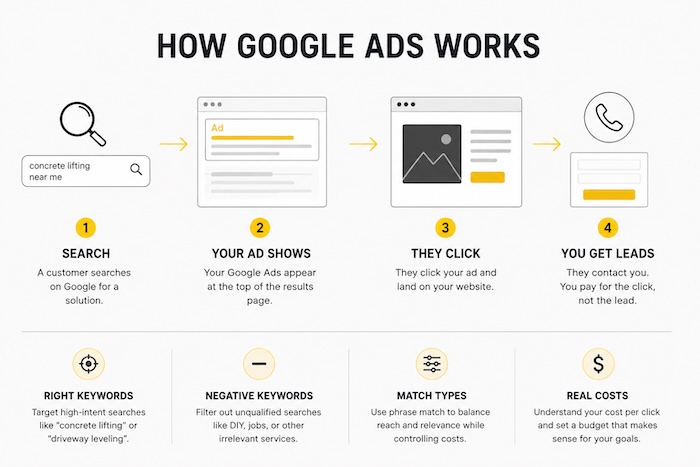
Someone searches “concrete lifting near me.” Your ad shows up above the organic results. They click it, land on your site, and you get charged whether they call you or not. That’s Pay-Per-Click, or PPC — you’re renting visibility, not building it.
That’s the fundamental trade-off. SEO is slower and compounds. Ads are instant and stop the second you stop paying. If you haven’t seen it, we broke down how the two work together in SEO vs. Google Ads for Concrete Lifters. This article goes deeper into actually running the ads side.
Picking the Right Keywords (This Is Where Most Guys Get It Wrong)
Your keyword list makes or breaks the campaign. Get greedy or vague here and you’ll burn budget on clicks that were never going to turn into a job.
The Terms That Actually Convert
Based on what we see across dozens of contractor markets, your bread-and-butter search terms are variations of:
- Concrete lifting / concrete leveling / concrete raising
- Mudjacking
- Sidewalk leveling, driveway leveling, slab leveling
These are the phrases homeowners use when they already know what’s wrong and are looking for someone to fix it. High intent, decent volume, and specific enough that you’re not competing with every concrete company in the phone book.
 The Trap: “Concrete Repair”
This one feels like it should be a goldmine because of the volume — and that’s exactly the problem. “Concrete repair” is so broad it pulls in people looking for crack sealing, new pours, stamped concrete, driveway replacement, patio builders, and a dozen other jobs that have nothing to do with lifting. You’ll pay premium prices for clicks that were never going to become your customer.
The Other Trap: Going Too Narrow
On the flip side, don’t build a campaign entirely out of hyper-specific long-tail terms like “polyurethane foam injection contractor for sunken pool deck.” Nobody’s typing that. Terms that specific might feel perfectly targeted, but there’s often not enough search volume behind them to generate meaningful traffic. You end up with a technically pristine campaign that nobody sees.
The sweet spot is the handful of terms above, localized to your city and surrounding areas — not the broad category term, not the ultra-specific long-tail.
Use “Phrase Match” When You’re Starting Out
Google gives you a few different ways to tell it how loosely or tightly to match your keyword to a search. When you’re new to this, phrase match is usually the right call. It shows your ad when someone’s search includes your keyword phrase in that order, with some flexibility around it — so “concrete lifting” would match “concrete lifting cost” or “affordable concrete lifting,” but not something unrelated.
Broad match casts too wide a net when you’re just getting started — it’ll show your ad for searches Google merely thinks are “related,” which is exactly how you end up paying for DIY researchers and job seekers. Exact match is tighter but can limit your volume too much before you’ve learned what people actually search. Phrase match is the middle ground: enough control to stay relevant, enough reach to actually get data.
Set Your Location Targeting
This one sounds obvious but gets missed constantly. Google Ads will let you target by radius around your business, by city, or by zip code — and if you don’t set this deliberately, you can end up paying for clicks from people two hours outside your service area who were never going to book you.
Set a realistic service radius (or list your actual service cities/zip codes) and check it periodically. As you expand into new areas, adjust it. As you learn certain outer zip codes never convert, tighten it up.
Negative Keywords: Non-Negotiable
If keyword selection is picking who you want to show up for, negative keywords are just as important — they’re how you tell Google who not to show your ad to. Skip this step and you’ll bleed money on searches that were never going to convert.
At minimum, build out negatives for:
- DIY intent — “how to,” “DIY,” “yourself,” “kit”
- Job seekers — “jobs,” “hiring,” “careers,” “salary”
- Wrong service — “asphalt,” “foundation repair” (unless you actually do that), “stamped concrete,” “new driveway install,” “concrete contractors” if it’s pulling in new-pour searches
- Price shoppers with no intent — “free,” “cost calculator,” “average cost of”
- Education/research — “what is,” “definition,” “vs” comparisons unrelated to your service
This list should keep growing. Check your Search Terms report regularly and add negatives every time you spot a search that triggered your ad but was never going to become a lead. This is ongoing maintenance, not a one-time setup.
Cost Per Click Varies Wildly by Market
This is the part that surprises a lot of contractors. In some markets, concrete lifting keywords are still relatively cheap — you can get meaningful clicks without breaking the bank.
In others, especially areas where a big national player has decided to compete for the same keywords, cost per click can get expensive fast. Depending on how much competition is in your market, you could be paying anywhere from a few dollars a click up to $25 or more. When a national company with deep pockets is willing to outbid local guys just to dominate the top spot, it can get difficult to run a profitable campaign per job — you might be paying more for the click than your margin on the job supports.
There’s no way to know which situation you’re in without testing. Some markets are wide open. Others are a bidding war. It’s worth a small, controlled test to see where your specific area lands before committing real budget.
But just be aware that it can be pricey. We’ve seen the cost of Google Ads rise by 20+% yearly each of the last few years. Costs are way up relative the years prior.
So keep a close eye on the costs you’re paying.
Expect It to Take 15–20 Clicks Before the Phone Rings
Set your expectations here before you start, because this trips people up more than almost anything else. Not every click is a lead — most aren’t. A reasonable rule of thumb is somewhere around 15 to 20 clicks before you get a genuine call or form fill. If your cost per click is on the higher end in a competitive market, do that math before you commit a budget: at $15–$25 a click, 15–20 clicks to a single lead adds up fast, and that’s before you’ve even converted the lead into a booked job.
This is exactly why the keyword and negative keyword work above isn’t optional — every irrelevant click that sneaks through pushes that number in the wrong direction.
Track Your Calls, Not Just Your Clicks
None of this matters if you can’t see what a click actually turned into. Set up conversion tracking — call tracking on your ad phone number, and tracking on your quote form — before you spend real money. Without it, you’re guessing at what’s working. With it, you can see exactly which keywords are producing real leads and which ones are just draining budget, and adjust accordingly. Most contractors skip this step and end up making decisions off gut feel instead of numbers.
Where to Get Started
If you want to test this yourself, here’s the basic setup path:
- Create a Google Ads account and set up a Search campaign (not Display, not Performance Max — Search, so you’re only showing up when someone actively types in a relevant term)
- Set your location targeting to your real service area — city, radius, or zip codes
- Build one ad group around your core keyword set (concrete lifting, leveling, raising, mudjacking, polyjacking) using phrase match
- Load your negative keyword list before you launch, not after
- Write 2–3 ad variations that lead with what homeowners actually care about — same day quotes, warranty, local, reviews — and let Google test which performs better
- Set up call tracking and conversion tracking before you spend a dollar
- Set a modest daily budget you’re comfortable losing while you learn what your market actually costs
- Give it a few weeks of real data before judging it — a few days of clicks won’t tell you anything reliable
And send that traffic to a page that’s actually built to convert — before/after photos, reviews, a clear quote form, no dead ends. Even a perfectly built campaign will underperform if it lands on a weak page. We covered what that page needs in SEO vs. Google Ads for Concrete Lifters.
The Bottom Line
Google Ads can work for concrete lifters. It’s fast, it’s controllable, and it’s genuinely useful for one thing in particular: keeping your crew busy during a slow stretch when you need jobs on the board now, not in three months. That’s its real strength.
What it’s not is a great long-term profitability engine. You’re paying for every single click, forever, with no asset left behind when you stop. In a competitive market at $15–$25 a click and 15–20 clicks per lead, the math on a slow month can get tight fast. It takes tight keyword selection, an aggressive negative keyword list, and real tracking— and even done well, it’s a short-term lever, not a foundation. Helpful content and SEO is the foundation. Ads are a tool you pull out when you need volume right now and you’re willing to pay for it.
We don’t manage ad accounts for clients — it’s not what we do. But if you’re weighing whether to test it, or you want your website and Google Business Profile dialed in first so any ad traffic you do send actually converts, that’s exactly our lane. Let’s talk.