
Your Marketing Got the Call — Your Sales Process Determines What It’s Worth
 Picture this.
A homeowner finds your website at 9pm on a Tuesday. Their driveway has been sinking for three years. They’ve been putting it off — too busy, too unsure, didn’t know who to call. But tonight something clicked. Maybe their neighbor just got theirs done. Maybe their mother-in-law almost tripped at the holiday dinner and nobody said anything but everyone was thinking it. Maybe they just got tired of looking at it.
They read through your site. They see photos of jobs that look exactly like theirs. They read a review from someone in their neighborhood. They feel like you get it. They fill out the contact form and go to bed.
That’s your marketing working. That’s the website doing exactly what it was built to do — finding someone at the moment they’re ready and making you the obvious call.
Now the question is: what happens next?
Because everything that marketing worked to build — the trust, the credibility, the connection — can be reinforced or unraveled in the first sixty seconds of that appointment. The lead is only worth what your sales process makes of it. And most concrete lifting contractors have never really thought about those two things as a system.
The Leaky Bucket Nobody Talks About
Most conversations about growing a concrete lifting business focus on getting more leads. More traffic. More calls. More form fills. And that’s not wrong — volume matters.
But there’s a number that matters just as much as lead volume, and most contractors never track it: close rate.
Think about what that number actually means in dollars. If you’re running 20 estimates a month and closing 8 of them, you’re at 40%. If you improve that to 50% — just two more jobs a month — without spending a single extra dollar on marketing, you’ve grown your revenue by 25%. Those two extra jobs came from the same leads you were already getting. The marketing didn’t change. The process did.
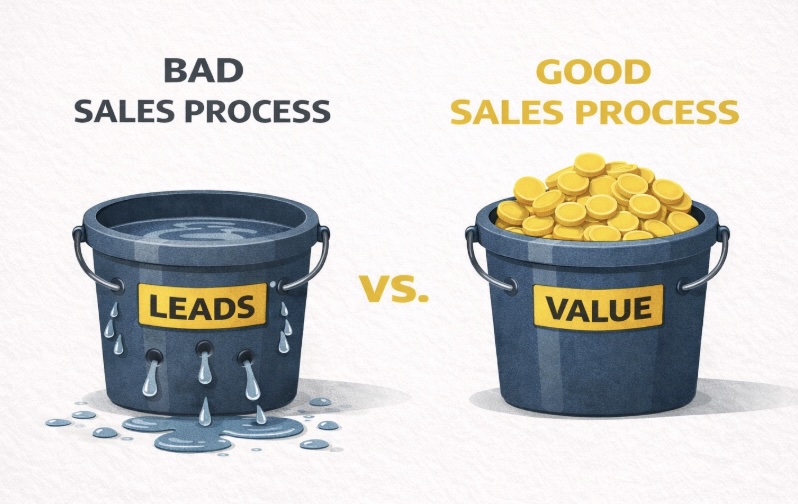
Now flip it around. If you’re pouring money into a website, into SEO, into ads — and your close rate is sitting at 25% because you’re showing up, giving a price, and leaving — you’ve got a leaky bucket. You can keep filling it, but you’re losing more than you’re keeping.
Marketing and sales aren’t two separate departments. They’re one system. And the system is only as strong as its weakest point.
What Marketing Actually Does (And What It Can’t Do)
A great concrete lifting website does a lot of heavy lifting before you ever show up. It builds familiarity. It establishes credibility. It answers the questions a nervous homeowner has at 9pm when no one’s around to ask. It shows them photos of problems that look exactly like theirs and proves that you’ve fixed them.
By the time a well-marketed lead calls you, they’re already partway sold. They’ve done their research. They’ve read your reviews. They’ve watched you explain the process on video. They’ve seen your before-and-afters. They feel like they know you a little bit.
That’s an enormous head start. Most contractors don’t realize how much trust has already been built before the first handshake.
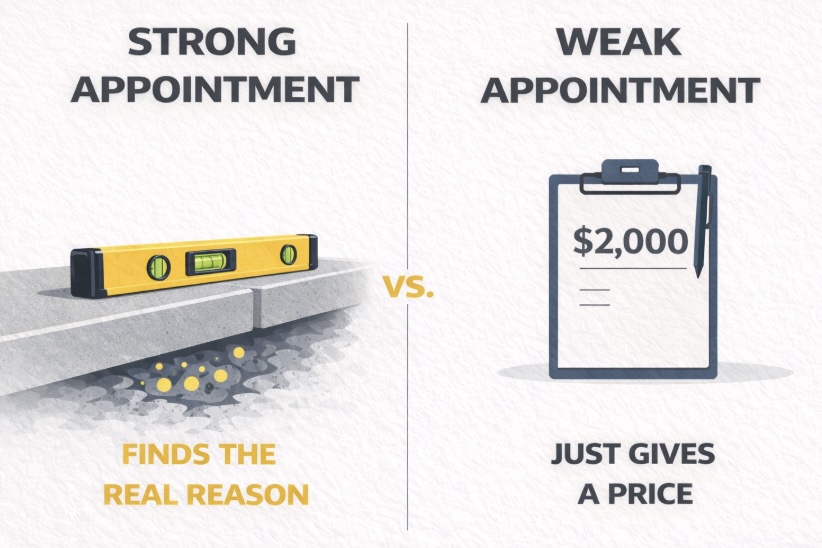
But here’s what marketing can’t do: it can’t find the Hot Sauce Why. It can’t ask the right questions at the kitchen table. It can’t show the homeowner the hollow spot under their concrete with a tap of a level and watch their eyes go wide. It can’t anchor the price against replacement before it’s quoted. It can’t read the room and know when to slow down, when to push, and when to go quiet and let the silence do the work.
That’s the salesperson’s job. And in most concrete lifting businesses, that salesperson is you.
We talk a lot about why customers buy what they feel, not just your price — and the reason that’s true is because marketing sets the stage, but the appointment is where the emotion gets confirmed or contradicted. If the website says “professional, trustworthy, expert” and then you show up distracted, give a number without context, and disappear — the gap between expectation and reality kills the sale.
 The Appointment Is Where the Money Is Made or Lost
Here’s something worth sitting with: two contractors can run the exact same lead and get completely different outcomes.
Same homeowner. Same problem. Same neighborhood. Same budget. One contractor shows up, does a quick walk-around, quotes $2,400, and leaves. The other shows up, asks how long it’s been like this, finds out grandma almost tripped on the front walk at Easter, slows down during the inspection, uses a string line to show the homeowner exactly what’s settled and what’s still hollow underneath — and by the time they sit down to go over options, the homeowner is already halfway there.
Same lead. Completely different close. Probably different ticket size too.
The difference isn’t luck. It’s not even talent, really. It’s process. The second contractor knows that the real reason someone calls isn’t always the reason they give you — and they take the time to find it before they ever talk numbers.
They know that slowing down during the inspection — actually using tools, drawing it out, measuring, showing — does more selling than any brochure ever could. When a homeowner watches you take your time on their property, they feel like you care. When you tap on a hollow spot and let them hear the difference between solid and void, they understand the urgency in a way no explanation could create. That’s the same principle that drives great website content — show the problem, don’t just describe it.
And they know that when it’s time to present options, you don’t lead with the cheapest thing you offer. You anchor high — against replacement first, then against your own premium option — so that by the time the homeowner hears the number that actually fits their situation, it feels like exactly the right decision. That’s price anchoring, and it works every time it’s used correctly.
What a Tuned System Actually Looks Like
When marketing and sales are working together — really working together — the whole thing feels almost effortless. Not because it is, but because every piece is doing its job.
The website reaches people at the moment they’re searching their problem, not your service. It speaks their language. It shows their exact situation reflected back at them. It builds enough trust that when they call, they’re not starting from zero — they’re starting from “I think this might be the right company.” That’s reaching people at the moment they finally decide to act — which is the whole game.
Then the appointment picks up exactly where the website left off. The first question finds the emotional reason behind the call. The inspection builds urgency and demonstrates expertise without a single word of sales talk. The options are presented in a way that makes the right choice feel obvious. And the close isn’t a moment of pressure — it’s a natural conclusion to a conversation that was always heading there.
That’s not a fantasy. That’s a repeatable system. And the contractors running it are the ones closing 50, 55, 60% of their leads while their competitors are grinding through twice the volume to get the same revenue.
The ROI Math Nobody Does
Let’s make this concrete — no pun intended.
Say your website and SEO investment generates 25 leads a month. At a 35% close rate and a $2,000 average ticket, that’s about 8-9 jobs and roughly $17,000 in monthly revenue from those leads.
Now you tighten the sales process. You find the Hot Sauce Why on every appointment. You slow down on the inspection. You start presenting three options instead of one price. You anchor against replacement before you ever quote. Your close rate moves to 50% and your average ticket moves to $2,600 because you’re including joint sealing and surface protection more consistently.
Same 25 leads. Same marketing spend. Now you’re closing 12-13 jobs at $2,600. That’s over $32,000 in monthly revenue.
That’s not a better website. That’s a better process applied to the same leads your website was already generating.
The marketing ROI didn’t change. The sales process amplified it.
This Is Why We Care About Both
LevelRight Marketing builds websites and drives visibility. That’s what we do. But we’ve spent enough time in this industry — owning concrete lifting businesses, generating leads, watching contractors win and lose jobs — to know that a great website for a broken sales process is just an expensive way to collect leads you don’t close.
We talk about the sales side because we’ve seen what happens when both sides are working. The phone rings more. The jobs close more. The tickets are bigger. The customers are happier because they feel like they were heard and helped — not just sold to.
And the contractor? They’re building something. Not just running jobs. A business with compounding momentum — better leads, better close rates, better referrals — all feeding each other in a loop that gets stronger every month.
That’s what a tuned system looks like. And it starts with understanding that marketing and sales aren’t separate problems. They’re one system. And you need both sides working.
Where to Start
If your marketing is already generating leads and your close rate feels lower than it should be — start with the sales process. Two questions at the start of every appointment: how long has it been like this, and what made you want to get it taken care of now. That’s the whole entry point. Find the real reason they called and build the rest of the appointment around it.
If your sales process is solid but the phone isn’t ringing enough — the website needs work. More pages, better language, problem-first content that reaches the 95% of your market who don’t know concrete lifting exists yet. The difference between a brochure site and a lead machine is bigger than most contractors realize until they’ve seen both in action.
And if both need work — start with the website, because you can have the best sales process in the world and it won’t matter if the phone isn’t ringing. But don’t stop there. Because the real money isn’t in more leads. It’s in what you do with the ones you already have.
Want to look at where your system is strongest — and where it’s leaking? Let’s get on a call →