Nobody’s Home — How to Close More Concrete Lifting Jobs When No One Answers
 Most contractors show up, take a look, and leave a card.
That’s the competition. And that’s exactly why this gap exists.
One of our clients recently shared that his closing rate on in-person estimates — where someone’s actually home — runs around 66%.
When no one’s there? 40%.
Same price. Same crew. Same quality of work. The only variable is whether someone was standing in the driveway.
That’s a 26-point swing, and it’s costing real money. The good news: most of it is fixable. And almost none of your competitors are doing any of this.
Why This Happens (And Why It’s Not About Price)
When no one’s home, the estimate stops feeling like a sales moment. It feels like paperwork. So the visit gets shorter. The walkthrough gets lazier. You leave something behind and move on.
But the homeowner isn’t ignoring you. They’re evaluating you — from whatever you left behind, from your Google reviews, from your website, and in many cases, from their Ring camera footage.
My first experience with concrete lifting — before I got into the lifting industry — was exactly this. Came home and found a single-sided business card on the door. Just a price scrawled on it. Nothing about the process. Nothing that said we know what we’re doing and we’re worth calling back.
I didn’t call them back. It felt sketchy.
Perception is reality. And when no one’s home, you’re leaving that perception entirely up to chance.
Start With the Foundation — Before Any of This Matters
Before we get into job site tactics, let’s be honest about something.
If a homeowner Googles your name after you leave and your website looks outdated, your Google reviews are thin, or there are no photos of a real person and a branded truck — no tactic on this list saves you.
Your website and your reviews are your silent salesperson. Make sure there are smiling photos of you or your team on your site. Make sure there’s a clean, professional shot of your branded truck. Make sure your Google Business Profile has recent 5-star reviews. That’s what a homeowner is checking while your estimate sits on their counter.
This is the foundation. Everything else stacks on top of it.
It Starts Before You Pull in the Driveway
The empty-house estimate doesn’t start when you arrive. It starts the moment the lead comes in.
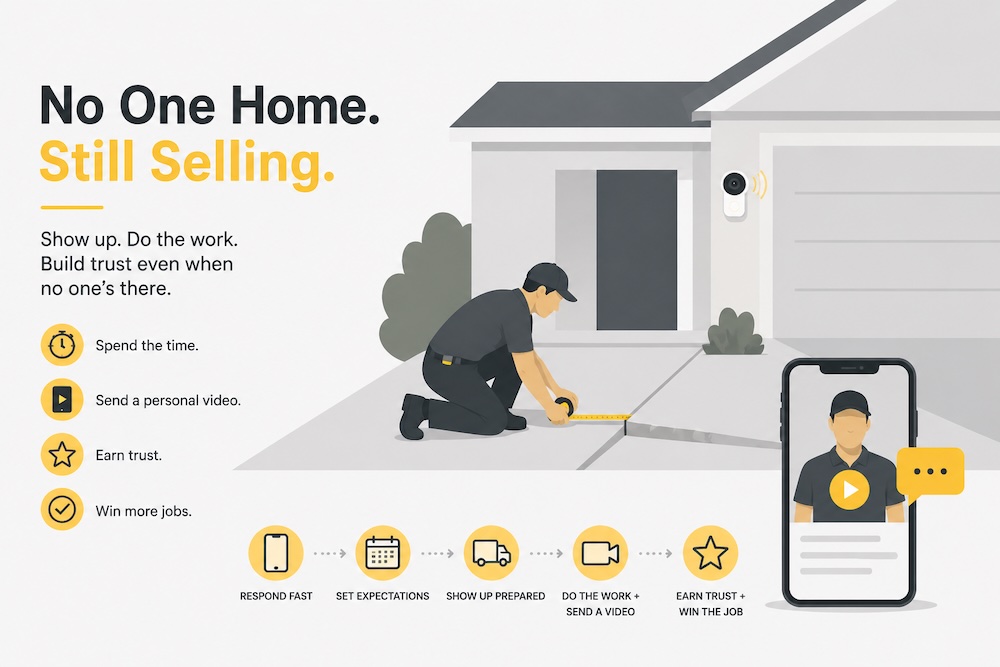
Respond fast. When someone fills out your form or calls, that’s the hottest moment you’ll get. Responding in minutes versus hours doesn’t just get you the appointment — it signals that this is a real, professional operation.
Set expectations before you go. A simple message: “We’ll be out Tuesday between 10 and noon. We’ll take a close look, measure, and send you an estimate within 24 hours.” That’s it. Now they know what’s coming.
Send them something useful before the visit. A link to a page on your website — What to Expect on Your Quote Day — does more work than you’d think. A photo of your truck. A photo of you. A brief walkthrough of the process. Even just a paragraph.
You’re building trust before you ever ring the doorbell. And when no one’s home, that trust is already banked when they come back to review your estimate.
 Act Like You’re Being Watched — Because You Are
Ring cameras. Nest. Blink. Arlo. Half of American driveways have a camera on them.
When you show up to a home where no one’s there, assume you’re on video.
If you spend two minutes on the property and drive away, the homeowner reviews that footage later and sees someone who clearly wasn’t that interested. That’s not closing a job.
But if you spend 10, 12, 15 minutes out there — measuring the slab, walking the edges, crouching down to look at crack patterns — that footage tells a completely different story. This person actually looked at my problem. This isn’t a price-and-run operation.
You might know in 90 seconds what you’re going to charge. That’s experience. But show the work anyway — because the homeowner doesn’t know what you know. And they’re forming their entire impression of your professionalism from what they see on that camera.
Take the time. It costs you nothing. It wins jobs.
The 30-Second Video That Separates You From Everyone Else
Here’s the move most contractors aren’t making.
While you’re on site, pull out your phone and shoot a short video. 30 seconds. 60 seconds max. Just you, standing in the driveway, talking naturally.
“Hey, this is Mike from Springfield Concrete Lifting. I just finished looking at your driveway — there’s some settling on the right side near the garage. The cause is usually voids underneath from soil washout over time. Good news is this is very fixable. Here’s what I’d do…”
Text it to the prospect as soon as you leave.
And if you have a before and after from a similar job — a driveway lift, a sidewalk panel, a garage apron — drop that in the text too. Or link them to a page on your site showing that same type of work. “Here’s an example of a similar driveway we did last month.” We’ve written about how much those images influence a homeowner’s decision before a call is ever made: The Right Photo Closes the Sale Before You Ever Show Up.
Think about what just happened. They now know what you look like. They’ve heard your voice. They know you actually looked at their specific problem — not just a generic slab. You’re not some anonymous company that dropped off a price. You’re a real person who cared enough to explain what they saw.
People are afraid of the unknown. They don’t know this industry. They don’t know who’s coming to their home. They don’t know if they can trust you. A 30-second video answers all of that before they’ve even looked at your price.
The Follow-Up Sequence Most Guys Skip
Here’s where a lot of the conversion gap actually lives — not in the visit itself, but in the 48 hours after.
Most contractors send the estimate and go quiet. They wait and hope.
The ones who close the most empty-house jobs do something different: they follow up. Once. Twice. Without being pushy.
A simple text the day after: “Just wanted to make sure you got the estimate — happy to answer any questions.”
A few days later: “Still happy to help if the timing is right — just let me know.”
That’s it. No pressure. No desperation. Just a reminder that you’re a real person who’s still available.
Many contractors using a CRM already have this automated — and if you’re not, you should be. Set it up once, let it run, and watch your empty-house close rate climb.
 The Leave-Behind: Upgrade Your Game
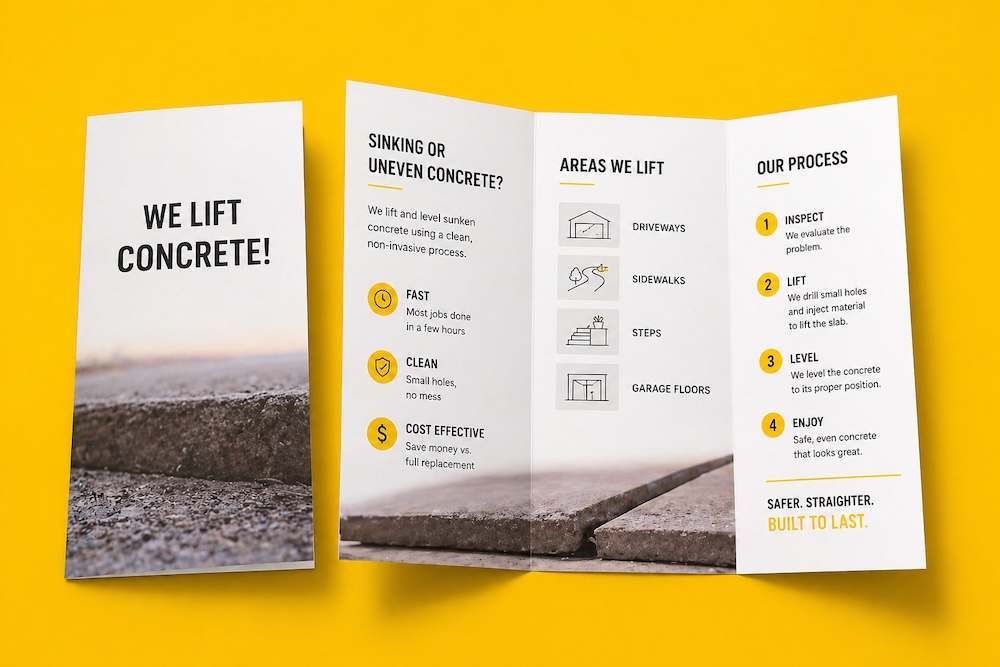
Most guys leave a business card. Some leave a CRM estimate email — which is fine, but it’s a floor, not a ceiling.
Here’s how to think about it in three tiers:
Level 1 — The CRM estimate email. Most of you are already here. That’s fine. But make sure the email itself is dialed in — not just a price. A brief note on what you found. A photo from the job site if you can grab one. A sentence or two that makes it feel like a real conversation, not an automated output.
Level 2 — A leave-behind booklet or pamphlet. Your brand. Your process. A few Google review callouts. A QR code that links to your website or a before/after gallery. Something that stays in the house after you leave — on the counter, on the fridge — and keeps talking for you. This is what makes you look like the real operation in the market.
Level 3 — A portable printer. Not many guys are doing this. Show up, assess the job, print a professional-looking proposal on site, and hand it over before you drive away. It’s a moment. It’s unexpected. And it signals a level of professionalism that sticks.
Any one of these is better than a blank card with a number on it.
The Ideal Situation — And How to Stack the Deck for It
To be clear: the best scenario is always an in-person estimate where the decision-maker is home.
Not just home — the actual decision-maker. If you’re presenting to someone who needs to check with a spouse before committing, you haven’t fully closed the room yet.
So when you’re scheduling, ask: “Would you like to be there when we come out?” Some customers will say yes, and that estimate becomes a completely different conversation.
But when no one’s home, the gap doesn’t have to be 26 points.
Close the Gap
66% in-person. 40% empty house.
That gap isn’t about your lifting skills. It’s not about your pricing. It’s about the perceived trust and professionalism you’re able to build when you can’t shake someone’s hand.
Respond fast. Set expectations before you arrive. Take 15 minutes on site even when no one’s watching — because someone might be. Shoot a 30-second video and text it. Follow up once or twice without pressure. Leave something behind that looks like a real business.
Do all of that consistently, and your empty-house numbers start climbing toward where your in-person numbers already are. The gap is real — but it’s not permanent. And the contractors who close it aren’t doing anything complicated. They’re just not leaving the job half-done because no one was standing there to see it.
Want a website that builds trust before you ever show up on site? Let’s talk. →